Teach the Game
A script to teach Indonesia at the table — how you win, the board, a year, the end, every way to make money and what each piece is for.
How you win
“Indonesia, as its economy grows from rice fields to oil. Each of us is a tycoon: we start plantations and shipping lines, ship goods to growing cities, and buy and merge companies. Three eras, three to four hours. Whoever ends with the most money wins — there are no points.”
You need rupiah. It comes from three places:
- Production companies — plantations of
 rice,
 spice,
 rubber,
 siap saji and
 oil earn money for every good they sell to a city;
- Shipping companies —
 ships earn 5 for every good they carry, for every ship on the way;
- Mergers — selling your companies to the highest bidder, or buying others cheaply.
The loop: take companies (free, but you need a free slot), operate them every year to earn money and grow, research to do more, and merge at the right moment and price.
The board
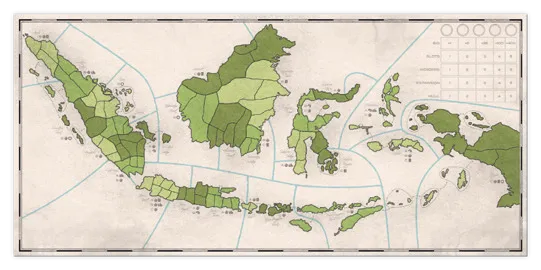
- The archipelago — provinces of land areas and the sea areas between them. Plantations fill land areas; ships sit in sea areas; cities are built on the coast.
- Company start markers show where this era’s companies can start. Each has a deed: the province, the good, and for shipping lines the most ships per era (A/B/C).
- Province symbols show what each province will offer in eras A, B and C — cities, crops, shipping. → Map symbols
- Cities start small (size 1) and grow when they get every good on the map.
Your player aid holds the five R&D tracks (Bid, Slots, Mergers, Expansion, Hull), your Bank box and the year’s phases. Your money stays behind your screen.
A year
Three eras (A, B, C), each lasting as many years as it takes. Every year has seven phases:
- New era — only when the era’s companies are used up: everyone builds a city, the next era’s deeds go on the map.
- Bid for turn order — one bid each, in order of play, multiplied by your Bid research. The money goes to your Bank: gone for spending, still yours at the end.
- Mergers — announce a merger of two companies; everyone who could own the result bids.
- Acquisitions — take free companies, one per round, if you have a free slot.
- Research — move one R&D marker up a step (or someone else’s Hull).
- Operations — one company each, in turn: ships expand; plantations sell, earn and expand.
- City growth — cities that got every good they wanted grow one size.
Show Operations before reciting the phases. Rehearse delivering one rice over one ship leg: the producer receives 20 and pays 5 to the shipping owner. Now mark the city’s demand and the ship’s used capacity. Before operating the next production company, reset the ship’s capacity, not the city’s demand (rulebook p. 7).
→ Gameplay · Mergers · Operations
How the game ends
In the New era phase, when era C would end: there are no C deeds left to take, or the ones left are all the same type. Operating earnings from the last year are doubled. Count everything — cash, Bank and the doubled earnings. Most money wins; on a tie, the player earlier in the order of play.
Ways to score
There are no victory points — money is the score.
| Money | How and when |
|---|---|
| Selling goods | Operations: each good sold earns its price — rice 20, spice 25, rubber 30, siap saji 35, oil 40. |
| Shipping fees | Operations: 5 per ship used per good, paid by the producer to the ship’s owner. |
| Selling in a merger | Mergers: the winning bid is split between the old owners by goods (or ships). |
| The last year | Operating earnings of the final year count double. |
| Bank | Turn-order bids are locked away but still count at the end. |
| Losing money | Shipping fees above a good’s price, paid expansions, winning bids. |
What each resource is for
| Resource | Why you need it | How you get it | How you use it |
|---|---|---|---|
| Rupiah | It is the score, and it pays for bids. | Selling goods, shipping fees, merger payouts; 100 to start. | Turn-order bids, merger bids, paid expansion. |
| Slots | Each company you own needs one; a merged company uses one. | Research the Slots track (1 → 5). | Taking companies in Acquisitions, bidding on mergers. |
| Ships | Every good reaches a city by ship. | Take a shipping deed, then expand in Operations. | Chains of one line’s ships carry goods to cities. |
| Goods | They are your plantations’ income. | Take a production deed; expand after selling. | Sold to cities in Operations. |
| Siap saji | The best food price (35). | Merge a rice and a spice company in era B or C. | Sold like any good; merges only with siap saji. |
| Cities | They buy the goods. | City cards in each New era; growth. | Size = how many of each good it buys a year. |
| R&D | It limits everything you do. | One step each year, free. | Bid multiplier, slots, merger size, expansion, ship capacity. |
| Bank | Turn order. | Your turn-order bids. | Counts at the end; never spent. |
Teaching tips
- Teach money and the two kinds of company first, demonstrate an operation, then the seven phases in order and the map’s quirks (arrows, seas, Maluku).
- Skip Mergers in year one — nobody can announce one yet. Explain it when someone researches it.
- Say it twice: plantations must sell every good they can, even at a loss, and a sold-out company must expand.
- More from tutorials and reviews: Tips & Strategy.