Operations
Operating companies in Indonesia — expanding shipping lines, selling goods along chains of ships, hull, shipping fees, expansion and the doubled last year.
Operating in turn
Operations run in rounds, in order of play. On your turn you operate one of your companies, then turn its deed face down. The phase ends when every company has operated once. A merged company operates as a single company.
You choose the order of your companies, but you must operate one each round while you have any left — even when it can do nothing useful, or only something that hurts you.
Shipping companies
A shipping company may expand — that is all it does.
- Add up to as many
 ships as your Expansion research, and never more than the limit
printed on its deed for the current era (A/B/C). A merged line adds its deeds’ limits together.
- Each new ship goes in a sea area where the line already has a ship, or next to one. With Expansion 2 or more, a ship may go next to a ship you placed a moment ago.
- Expanding is free and optional.
A shipping company earns its money when production companies use its ships: see income and shipping fees.
Production companies
A production company does three things, in this order:
- sells goods to cities;
- receives income and pays the shipping fees;
- expands.
A production zone is a group of touching areas of the company’s goods. Normally a company has one zone; a merged company may have several far apart.
Selling goods
The company sells up to as many goods as it has on the board. Goods are not moved on the map: for each good sold, put a goods counter on the city’s goods display.
- A size 1 city buys one of each good produced anywhere on the board this phase, a size 2 city two of each, a size 3 city three of each. A good nobody produces is not wanted.
- The city’s demand is shared by everyone for the whole phase: once its display holds a rice, a size 1 city buys no more rice this year.
Shipping chains
Every good travels to its city by sea, along a chain of ships of one shipping company:
- one of the line’s ships must be in a sea area next to the city;
- the chain must reach a sea area next to the production zone, ship by ship through touching sea areas;
- inside its zone a good moves freely to whichever coast it needs.
- A good cannot change shipping company halfway — even between two lines you own. Different goods of the same company may use different lines.
- Goods never go over land to a city, not even from an area right next to it.
- A company with several separate zones ships each zone on its own; goods cannot jump between them.
Hull
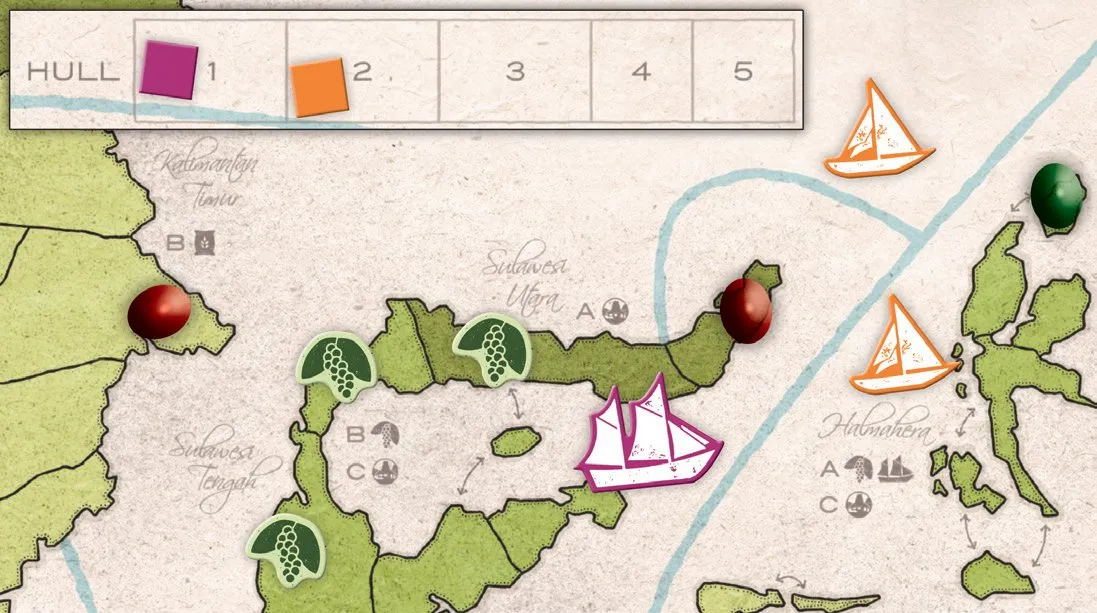
Each ship can carry one good for each production company that operates — more if its owner has researched Hull: one extra use per step. After a production company finishes, every ship is available again, in full, for the next company.
Income and shipping fees
The bank pays the production company’s owner the price of each good sold:
| Good | Price |
|---|---|
 Rice | 20 |
 Spice | 25 |
 Rubber | 30 |
 Siap saji | 35 |
 Oil | 40 |
Out of that money the owner pays 5 for each ship used, for each good, to the ship’s owner. A ship of hull 2 used twice is paid twice. Tip: put a 5-rupiah coin on each ship as you use it, then hand them out.
Expansion
After selling, a production company may grow:
- Sold all its goods (as many as it has on the board) — it must expand for free, by as many areas as your Expansion research.
- Did not sell all — it may buy expansions, up to your Expansion research, paying the price of its good for each area (20 per rice area, and so on) to the bank.
Where new areas may go:
- next to one of the company’s zones, on empty land — cities and other companies block it;
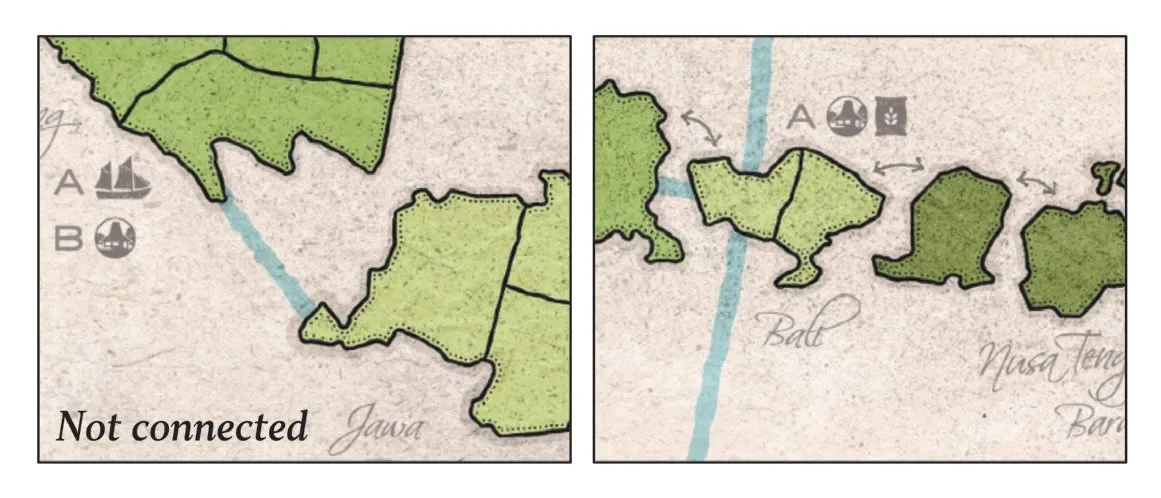
- not across the sea, unless an arrow joins the two land areas;
- never so that two companies of the same good would touch;
- a merged company expands once in total, but may place its areas anywhere around its zones.
If there is no room, the company does not expand.
Last earnings double
Because the last year’s operating earnings count double, keep the money your companies earn in Operations apart from your cash. If another year follows, move it to your cash at the start of that year. If the game ends, double it and add it to your cash.
If a company loses money (its shipping fees exceed its sales), pay from this year’s earnings pile, not your cash. If the pile is still empty, note the debt and settle it later in the phase.