Mergers
How to announce a merger in Indonesia, who may bid, how the price is split, what happens to ships, and siap saji mergers of rice and spice.
Announcing a merger
The Mergers phase runs in rounds, in order of play. On your turn you may announce one merger, or pass. Each merger is settled before the next is announced. The phase ends when nobody wants to announce another — and you may pass and still announce later in the phase, because other mergers often free up slots.
To announce a merger:
- you need Mergers research of at least 2;
- it always joins two companies — never three at once — of the same type (rice with rice, shipping with shipping…), except siap saji;
- the result may hold at most as many deeds as your Mergers level: Mergers 2 joins two single companies, Mergers 3 can add a third deed to a company merged before, up to 5 deeds;
- you must be allowed to own the result: you own one of the two companies, or you have a free slot;
- a deed can be part of only one merger a year — a company merged this phase cannot merge again until next year.
You may announce a merger of companies you own, companies others own, or one of each.
Bidding
Who may bid: every player with a free slot, and the owners of the two companies — whatever their Mergers research.
The minimum bid is the nominal value: the goods (or ships) both companies have on the board, times the value of each.
| Company | Value per good or ship |
|---|---|
 Shipping | 10 per ship |
 Rice | 20 |
 Spice | 25 |
 Rubber | 30 |
 Siap saji | 35 (a new siap saji company: 25) |
 Oil | 40 |
- The announcing player bids first — at least the nominal value, even for their own companies.
- Then the others in order of play, wrapping round. Each bids or passes; a player who passes is out of this merger.
- Every raise is a multiple of the number of goods (or ships) in the two companies.
- You may never bid more than the cash you hold.
Resolving the merger
When everyone else has passed, the highest bidder wins the new company and pays the whole bid to the old owners, split by how many goods (or ships) each company had on the board.
Put the deeds together: they are now one company in one slot. It operates once a year, and a production company changes nothing on the map.
Shipping mergers
When shipping lines merge, swap their ships for the new owner’s colour, all of the same ship type — use the neutral ships if you run short. If you own several lines, give each a different ship type so you can tell them apart.
- No ship is ever removed, even if the new line has several ships in one sea area.
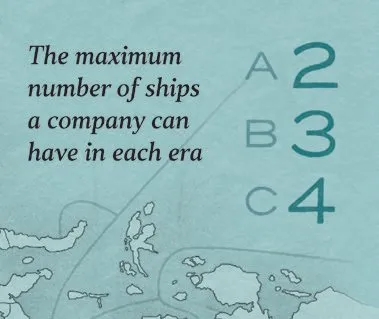
- The ship limits of the deeds add up: Lampung (2/3/4) and Halmahera (3/4/5) together may float 5/7/9 ships, placed next to any of their ships.
Siap saji mergers
A rice company and a spice company may merge into a siap saji company —
ready-made meals. It is the only merger of two different goods.
- Not in era A — only in era B or C.
- Minimum bid: (rice + spice goods) × 25.
- The price is split between the old owners by goods, as usual.
- The new owner gives up half the goods, rounded up, and empties those areas. They must come from the edges of the company’s land — never split a zone by removing from the middle. Swap the remaining rice and spice for siap saji counters.
- The two companies need not be the same size: a 3-deed spice company may merge with a 1-deed rice company if your research allows.
- A siap saji company can afterwards merge only with another siap saji company.
Why merge
The rulebook’s own list: to take someone’s company, to sell your own and raise cash, to free a slot, to use your place in the order of play, to speed the game up, to steer where shipping lines run, or to change a line’s hull size (it takes its new owner’s Hull). Fortunes in Indonesia are made and lost in this phase — keep enough cash to defend your best companies.