Gameplay
Indonesia's eras and years, and the seven phases of a year — new era, turn-order bids, mergers, acquisitions, research, operations and city growth.
The goal
Whoever has the most rupiah at the end wins: cash, plus the money in your Bank, plus the doubled earnings of the last year. You earn by starting and operating companies — production companies grow and sell goods, shipping companies carry them — and by buying and selling companies in mergers.
Eras and years
The game runs through three eras, A, B and C. An era lasts as many years as it takes for its companies to be used up, so nobody knows in advance how long. Each year has seven phases, in this order (your player aid lists them):
Several phases have rounds: players act one at a time in order of play, again and again, until the phase ends.
New era
A new era starts at the beginning of a year if no company of the current era is left to take, or if all the ones left are the same type (for example all spice). The first year always starts era A.
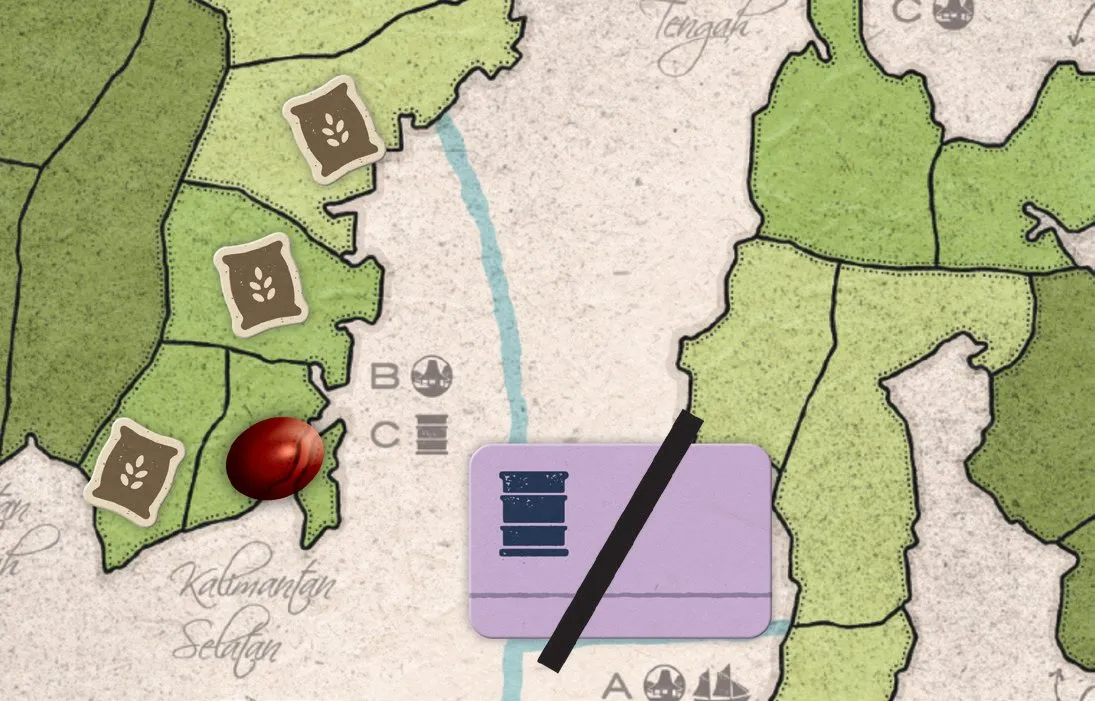
Building cities
In order of play, each player builds one city using their city card for the new era. The card names three provinces; build in any one of them:
- on an empty land area that touches the coast — no goods on it;
- only one city per province;
- the new city is size 1 (amber): put a size 1 goods display next to it, pointing at it.
If none of the three provinces has room, or the size 1 markers have run out, discard the card and build nothing.
New companies
Once everyone has built, discard the old era’s companies nobody took and lay out the new era’s deeds: put each deed’s company start marker on the province it names.
Bid for turn order
This sets the order of play for the rest of the year. In the current order, each player bids once — any amount of cash, 0 included — and puts it in the Bank box on their player aid.
- Your bid is multiplied by your Bid research (×1, ×5, ×25, ×100, ×400). You must use it.
- Highest result plays first, and so on. Ties keep their current order.
- Money in the Bank can never be spent again, but it counts for victory.
Mergers
Players who have researched Mergers announce mergers of two companies; anyone who could own the result may bid on it. The phase repeats round after round until nobody announces another. Nobody has Merger research in the first year, so skip it then.
→ The full rules: Mergers
Acquisitions
Starting a company is free, but you need a free slot: you can never own more companies than your Slots research. A merged company uses one slot, however many deeds it holds.
In order of play, each player either takes one company of the current era or passes. A player who passes is out of this phase. It goes round until everyone has passed or no company is left, so you can take several companies in one phase if you have the slots. Take the deed and remove its start marker from the map.
Production companies
Put one goods counter of the company’s type on any empty land area of the deed’s province (a wooden hut marks it as yours). It may not be next to a goods counter of the same type — rice may not touch rice. If no area qualifies, the company cannot start and leaves the game.
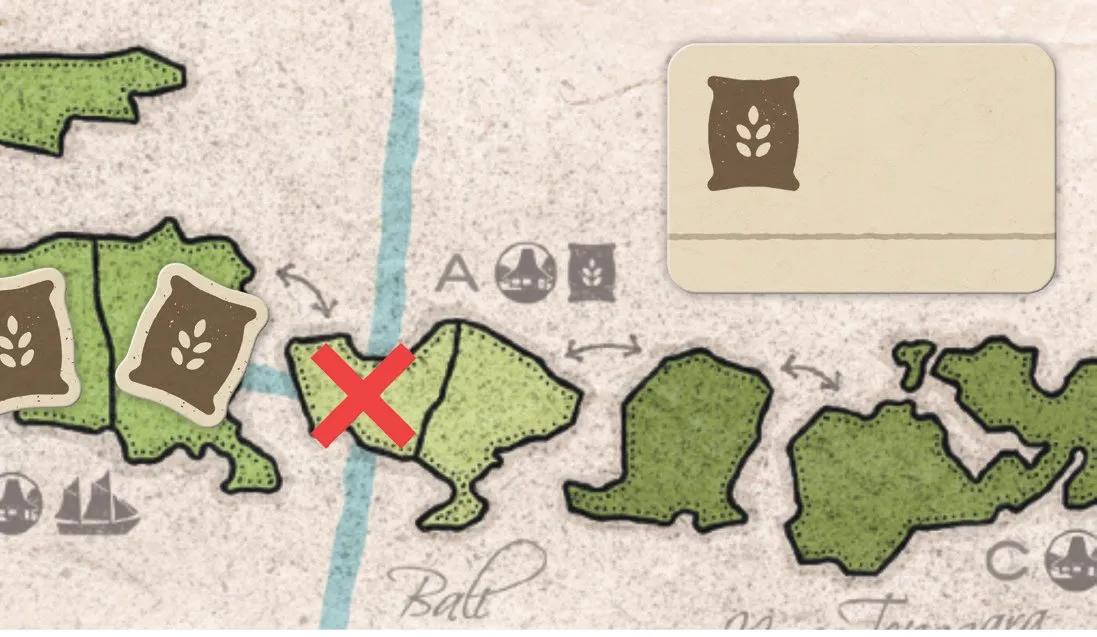
Shipping companies
Put one  ship in any sea area bordering the deed’s province. Other ships already there
make no difference.
Research and development
In order of play, each player moves one of their R&D markers one step up. Research is free.
| Track | What it does |
|---|---|
| Bid | Multiplies your turn-order bid: ×1, ×5, ×25, ×100, ×400. |
| Slots | How many companies you may own (1 to 5). A merged company uses one slot. |
| Mergers | The most deeds a merger you announce may create (2 to 5). At 1 you cannot announce mergers. It never limits bidding or owning. |
| Expansion | How many areas a plantation, or ships a shipping line, may add in one operation (1 to 5). |
| Hull | How many goods each of your ships may carry for each production company (1 to 5). |
Instead of your own track, you may move another player’s Hull up a step — useful when their line carries your goods. No other track of another player can be raised.
Operations
In order of play, each player operates one of their companies, then turns its deed face down. Rounds go on until every company has operated once. You choose which company; you must operate one each round while you have any left, even if it does nothing useful.
→ The full rules: Operations
City growth
A city grows one size if, this year, it received every good that is produced anywhere on the board, as many of each as its size: a size 1 city needs one of each, a size 2 city two of each. Goods nobody produces are not needed — early on a city may only need rice.
- Swap the city for the next marker (size 2 green, size 3 red) and its goods display.
- If the markers run out, the city cannot grow. When there are not enough for every city, the first player in order of play chooses which grow.
- Then clear all delivered goods from every city, grown or not.
End of the game
The game ends in the New era phase when era C would end: no C companies are left to take, or those left are all the same type.
- Operating earnings from the last Operations phase are doubled. Keep them apart during the year and move them to your cash at the start of the next year — if there is one.
- Add cash, Bank and the doubled earnings. Most money wins; a tie goes to the player earlier in the order of play.
Two players
Deal each player two city cards of each era. In every new era each player builds two cities, taking turns.