The Boards and the Supply Chain
Your factory and harbor districts, the two islands, and how a container travels from factory to Container Island.
Overview
Container is an economic game about running a small supply chain. Everyone makes money by producing,
selling and shipping containers — but you can never buy or ship your own containers. Others must
buy what you make, and you earn by buying theirs, reselling it and delivering it. At the end you add
your  cash to the value of the containers in your scoring area on Container Island (valued by your
secret scoring card), and the richest player wins. (Rulebook p. 4.)
Factory and harbor districts
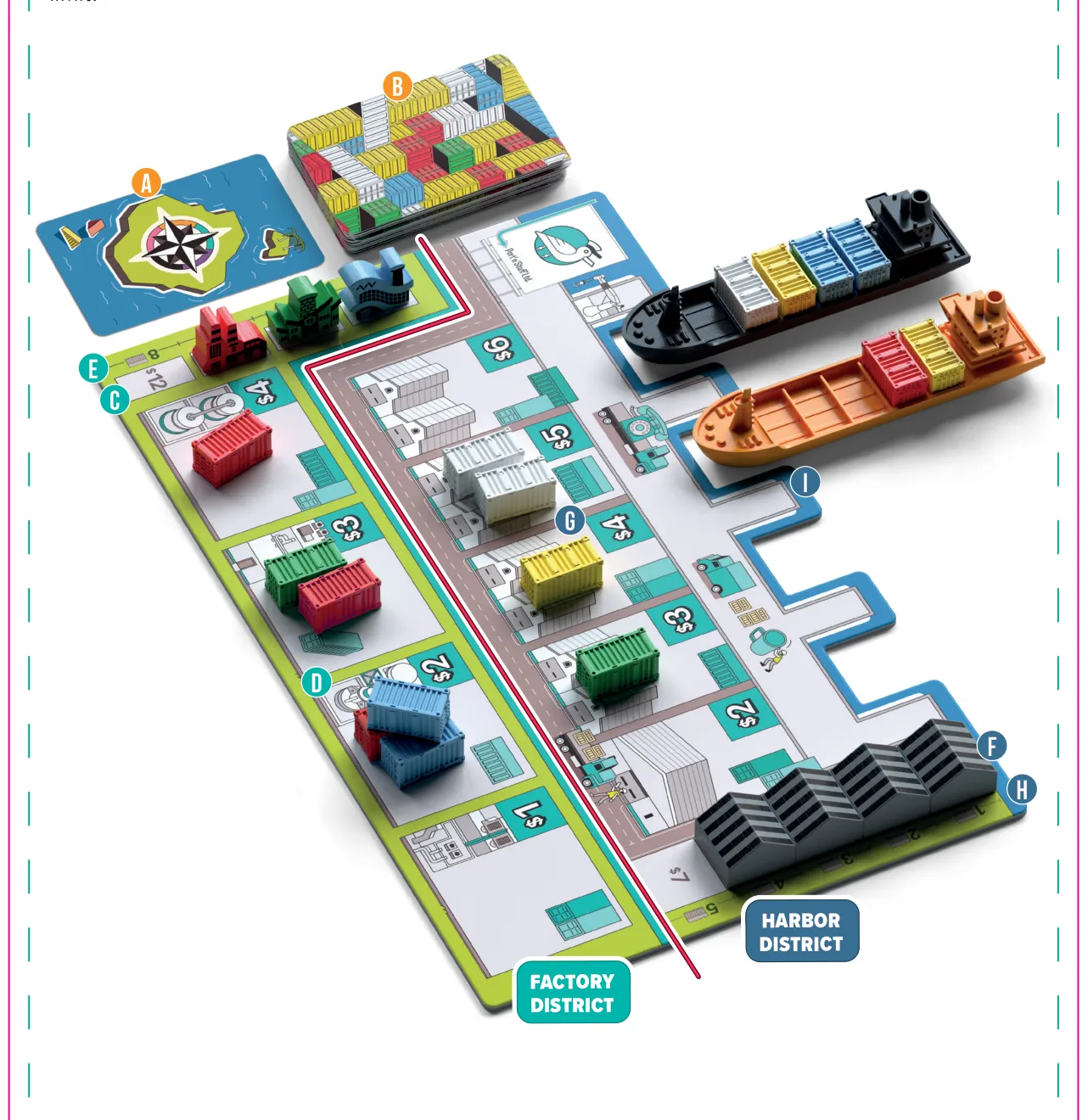
Your board has a factory district (bottom) and a harbor district (top), each with a building track, storage lots and a storage limit. The letters are the rulebook’s:
- A Final scoring card — secret; sets the value of your island containers.
- B Player hand — your cash and bluff cards, kept secret.
- C Factory buildings — each produces one container of its colour.
- D Factory storage lots — $1 to $4: where you price what you produce.
- E Factory storage limit — 2 per factory you own.
- F Warehouse buildings — each raises your harbor limit by 1.
- G Harbor storage lots — $2 to $6: where you price what you bought.
- H Harbor storage limit — 1 per warehouse.
- I Ship docks — where opponents moor to buy from your harbor.
Player cards
Your final scoring card lists what each container colour on Container Island is worth to you; keep
it secret until the end (scoring). Your hand — cash and the two $0
bluff cards — is secret too. You may make change with the cash supply at any time.
Factory buildings
Each factory you own makes one container of its colour whenever you Produce. The next empty space of your factory track shows what the next factory costs. You have room for four factories, and they must all be different colours.
Warehouse buildings
Each warehouse raises your harbor storage limit by 1; the next empty space shows the next one’s cost. You have room for five warehouses. You start with one factory and one warehouse on the FREE spaces.
Storage lots and prices
The lot a container sits in is its price. Opponents buy from your factory lots ($1–$4) with a Factory Purchase and from your harbor lots ($2–$6) with a Harbor Purchase, paying you the lot’s price per container. Any number of containers may share a lot.
Storage limits
The limit counts containers across all lots of a district. Factory district: 2 per factory (three factories → six containers). Harbor district: 1 per warehouse. You may never discard a stored container to make room. Containers you have put on the Bank’s container bid tile still count, marked by reserve tokens.
Ship docks
Opponents dock their ships here to buy and load containers from your harbor. Your own ship can never enter your own harbor.
The islands
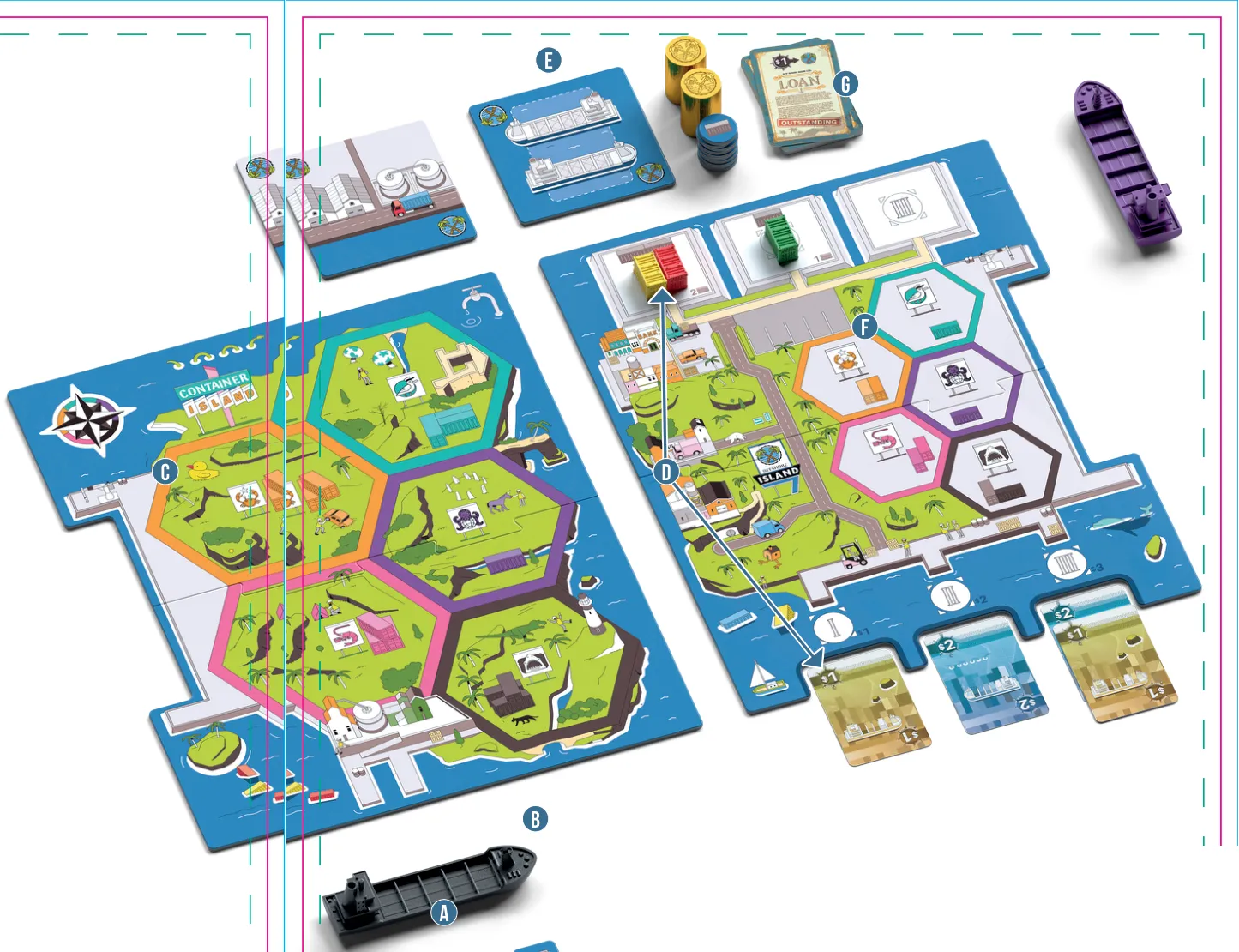
Two islands sit in the middle of the table, surrounded by the ocean. The letters are the rulebook’s:
- A Player ships — load containers and carry them to Container Island.
- B The ocean — the open table around the islands; every trip passes through it.
- C Scoring areas — one per player on Container Island, filled by delivery auctions.
- D Bank auction lots — three container lots (top) and three cash lots (bottom).
- E Bank tiles and tokens — auction tokens, the two bid tiles and reserve tokens.
- F Bank holding areas — where containers you win at the Bank wait for your ship.
- G Loan cards — $10 Bank
 loans, at most two per player.
The Off-Shore Bank (“the Bank”) is not the cash supply: cash paid to the Bank goes onto its lots
and is auctioned again; cash paid to the supply leaves play. Buildings are paid to the supply.
The route
A container’s life, in order:
- Produced in a factory — its owner pays $1 union wages and prices it in a factory lot.
- Bought by an opponent with a
 Factory Purchase — it travels by truck straight to the buyer’s
harbor, however far away, and is priced again in a harbor lot.
- Bought by a third player whose ship is docked at that harbor, and loaded on the ship (five containers at most).
- Delivered: the ship sails to Container Island and the cargo is auctioned to the other players; the winner puts it in their scoring area.
Moving between any two places takes two  Sail actions — one into the ocean, one to the destination.
Each arrival gives a free Anchor action (buy at a harbor, load at the Bank, auction at the island).
See Sail.
Storage and price changes
You may rearrange factory prices only during a  Produce or
 Reprice action, and harbor prices only during
a Factory Purchase or Reprice action. Pricing is the heart of the game: too high and nobody buys,
too low and you finance your rivals.
[More] The More Containers expansion adds gold luxury containers (made by
trading two containers from one district) and trucking companies paid on every Factory Purchase.