Teach the Game
Teach the five-round natural-history game: collect samples, research them, publish books and score through universities, gardens and expeditions.
How you win
“You are naturalists in Linnaeus’s circle. Over five rounds you explore the map for samples, research them in your library, write letters, grow a garden and send ships on voyages, then publish books from what you learned. Most points wins.”
- What you need: points, from published
 books, achievements, researched samples,
letters, gardens, voyages and the university lecture tracks.
- How you get them: each round you place three lenses on the three instruments; each placement is one action at strength 1, 2 or 3. Knowledge from research pays for books. Full rules: Gameplay.
The boards
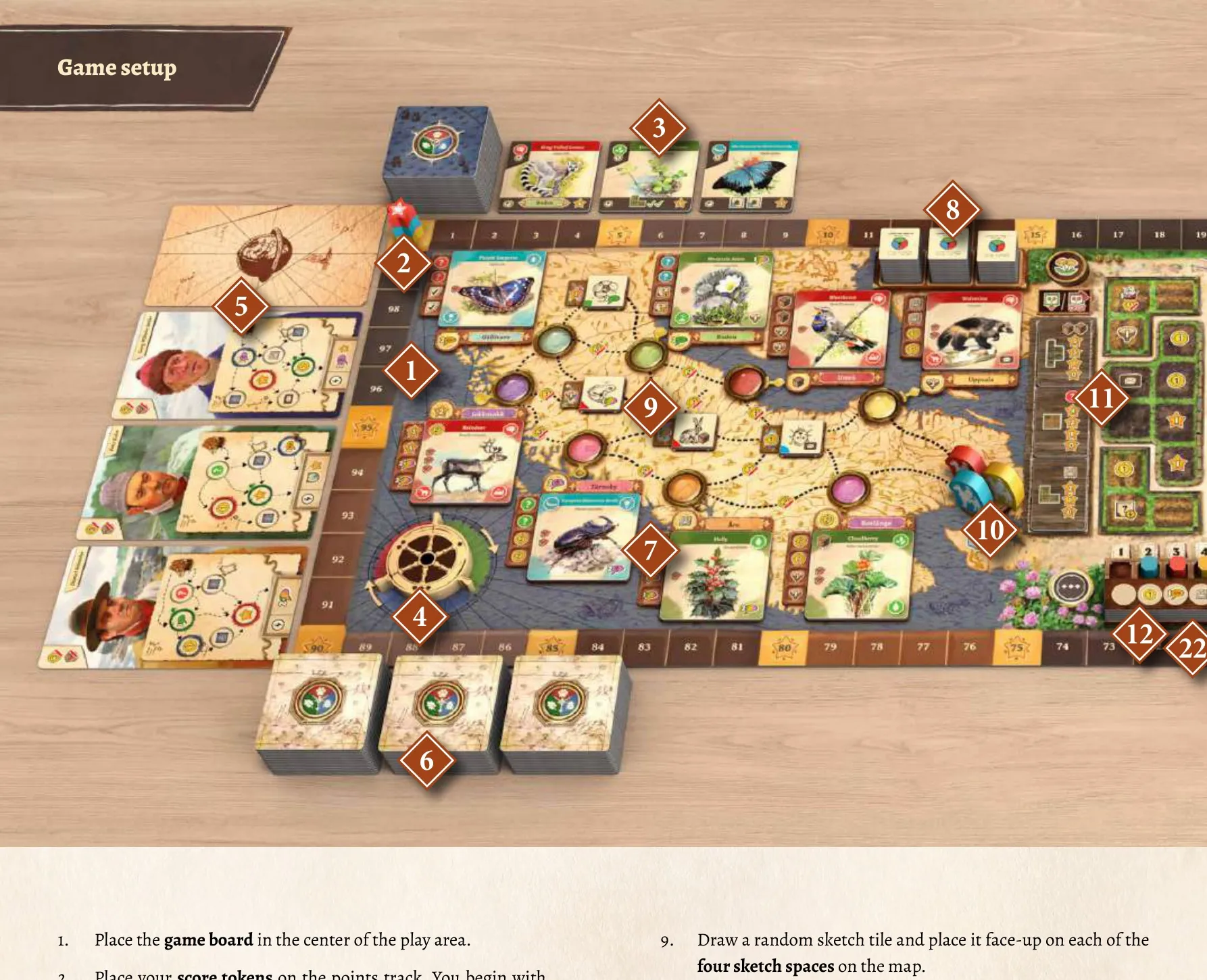
The shared map holds the  exploration locations and the
 voyage routes. Your
player board holds your library of samples (four spaces), your notebook of knowledge, and your lenses.
The garden, the university lecture tracks and the letter display sit beside the map.
Setup names every part.
A round
- Each player takes three turns: place a lens on the Glasses (strength 1,
 3
taxonomy steps), the Magnifier (strength 2, a
 tool or
 container) or
the Microscope (strength 3, a turn-order space). Details
- Do the action of that lens, then you may publish one book, then claim any achievement.
- After everyone’s three turns, the
 income phase: lenses come back, turn order changes,
finished voyages with a book pay income, and the rudder turns.
| Action | What it does |
|---|---|
| Explore | Move your explorer; take a location reward or buy its sample for containers |
 Research | Move your researcher in your library and collect the knowledge on sample corners |
 Correspond |  Take a letter, or  send up to two for their effects |
 Grow |  Plant a flower, or pay 2 tools to  cultivate one |
| Sail | Move a ship along a voyage card and take the space’s reward |
 Wild lens | Pay 1  coin to copy any basic action |
How the game ends
After five rounds and the last income phase, score the end-game categories in order. Ties go to the
player with more coins. Game End and Scoring
Ways to score
| Source | How and when |
|---|---|
| Books | When published: printed points, plus the appendix if you pay it then |
 Achievements | When claimed: the first open value on the tile |
 Exotic samples | End: 5 points per condition met |
 Researched samples | End: 2, 4 or 6 points by corners showing knowledge or rewards |
| Flower beds | During play when a bed is completed (majority); unfinished beds score at the end |
| Sent letters | End: each set of different colours |
 Lecture tracks | End: track position × times you met that track’s scoring tile (up to 5) |
| Leftovers | End: 1 point per tool, container, unsent letter and knowledge in your notebook |
What each resource is for
| Resource | Why you need it | How you get it | How you use it |
|---|---|---|---|
| Coins | Free actions, path costs, the wild lens | Rewards, income, selling a tool or container | 6 for a basic action, 3 for a tool or container, refresh a display |
| Containers | Buying samples | Magnifier, rewards, 3 coins | Pay a sample’s cost when you explore |
| Tools | Cultivating flowers, book cards | Magnifier, rewards, 3 coins | 2 to cultivate; 1 for a book card |
   Knowledge | Publishing books | Research on sample corners, exotic samples | Pay a book’s left bar; max two per phylum |
 Sketches | Publishing books | Sketch locations, cultivating flowers | One per book; a matching realm triggers its effect |
 Samples | Knowledge and end points | Explore and pay containers | Up to four in your library; researched ones score |
| Books | Points | Pay a tool | Publish after an action; pair with a  voyage for income |
 Lenses | Your three actions each round | Six to start; upgrades from taxonomy | One per instrument per round |
Teaching tips
- Start with the three instruments: the lens you place decides the action and how strong it is.
- Walk one sample from exploring to research to a published book.
- Show the knowledge limit (two per phylum) early; extra knowledge turns into points.
- Point at the achievements and lecture tracks once, then let players discover them.