Teach the Game
A read-aloud introduction to Calimala's worker stacks, actions and scoring.
How you win
In medieval Florence, your guild family trades cloth, contributes to churches and backs public art. Put workers into the city grid to take two nearby actions, and let your family members rise through the stacks into the City Council. Win by earning the most prestige when the city’s changing interests are scored.
You need Victory Points. Build cloth capacity, gather resources and send cloth into cities; contribute goods and sponsor statues where scoring tiles reward them. Watch the Council: the area on the next Scoring tile can make a seemingly small placement decisive.
The boards
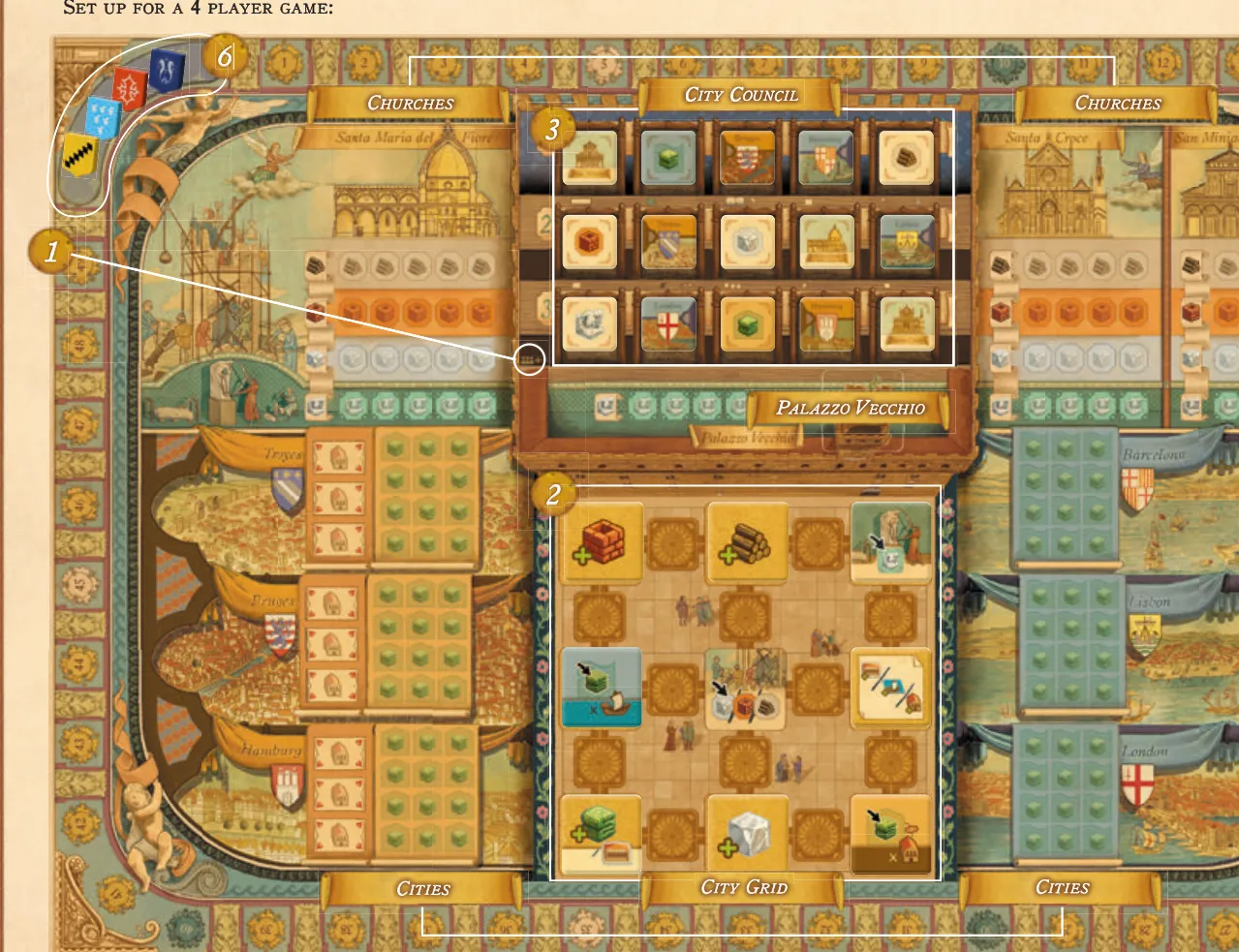
- Board side — use the side for your player count.
- City Grid — worker spaces sit between adjacent actions.
- City Council — a worker reaching a Scoring tile triggers its majority check.
- Player areas — boards hold cloth, resources, ships and workshops.
- Action tiles — each shows an action available at a grid space.
- Score track — track your Victory Points around the board.
A turn
- Place one Family Member or Contractor on a City Grid space. At least one adjacent action must be possible.
- Take both adjacent actions in either order. A Contractor gives you each action twice.
- Reactivate every Family Member under the new worker, whoever owns it, one at a time from top to bottom; each owner takes its two actions. Contractors and Hirelings never reactivate.
- If a stack of three workers was made, move its bottom worker to the next Scoring tile and score that tile.
- Pass the Active Player marker clockwise. See the full turn rules.
Two-player game. Neutral Hirelings alter stacks and add neutral cubes when their stack is activated. Follow the two-player rules as well as the base turn.
[Intrigue] With the optional expansion, take one Intrigue action after your worker actions and reactivations, before any triggered scoring. See Intrigue.
How the game ends
The game end starts when a player places their last worker or a worker reaches the fifteenth and final Scoring tile. Finish the round so everyone has had the same number of turns, resolve any remaining Scoring tiles if the last worker caused the end, then score the cards. Most Victory Points wins; use the tie-breakers to resolve a tie.
Ways to score
| Source | Points |
|---|---|
| Scoring tile | The players with the most cubes in its area earn 3, 2 and 1 VP for first, second and third place; you need at least one cube to place. |
| Scoring card | At final scoring, first, second and third place earn 5, 3 and 1 VP. |
| [Intrigue] Cardinal and Emperor areas | The more-crowded area scores 5/3/1; the other scores 3/2/1, with ties scoring 3/2/1 in both. Faction markers can add VP to matching tile scores. |
What each resource is for
| Piece | Why you need it | Get it | Use it |
|---|---|---|---|
| Family Member | Takes actions now and can be reactivated later; entering the Council triggers scoring. | Your supply at setup; workers return through scoring. | Place in the City Grid. |
| Contractor | Doubles both adjacent actions when placed. | Your supply at setup; recover a removed Contractor during Council scoring. | Place in the City Grid; it does not reactivate. |
| Hireling | In the two-player mode, adds a neutral presence and affects actions in its stack. | Each player receives five in a neutral colour. | Place only on a stack without another Hireling. |
| Cube / resource | Tracks influence in an area, cloth, or a resource warehouse. | Gain resources, weave cloth, or deliver it. | Spend resources to build; send cubes to cities, churches or statues for majorities. |
| Workshop | Raises how much cloth you can weave. | Build with 1 Wood and 1 Brick. | Gain one cloth cube per Workshop on each Weave action. |
| Ship | Sets your delivery capacity to port cities. | Build with 2 Wood. | Ship up to one cloth per Ship to Barcelona, Lisbon or London. |
| Trade House | Opens a route to a trade city. | Build with 2 Brick. | Transport one cloth to each of your houses in Troyes, Bruges or Hamburg. |
| Action card | Lets you take the action shown outside the grid sequence. | Starting selection, impossible actions, or card effects. | Play during an action activation; the active player can draw at most one for impossible actions per turn. |
Teaching tips
- Explain the City Grid as a shared action-selection system: the worker’s position determines two actions.
- Demonstrate the stack from bottom to top, then show how a stack of three sends its bottom worker to the Council.
- Point out that Contractors grant four actions total but do not reactivate later.
- Teach the base game first. Add [Intrigue] only after players understand the base action and scoring loop.