Teach the Game
A teachable overview of Brass: Birmingham: build industries, connect the Midlands, ship goods, and score across two eras.
How you win
“You are an industrial entrepreneur in the West Midlands. Across a canal era and a rail era, grow a connected network, develop factories and breweries, and earn the most victory points.”
Score points from your links and from Industry tiles that have flipped. Each era is a new scoring window: Canal links score first, then the flipped tiles still on the board. The higher total after the Rail Era wins.
The board
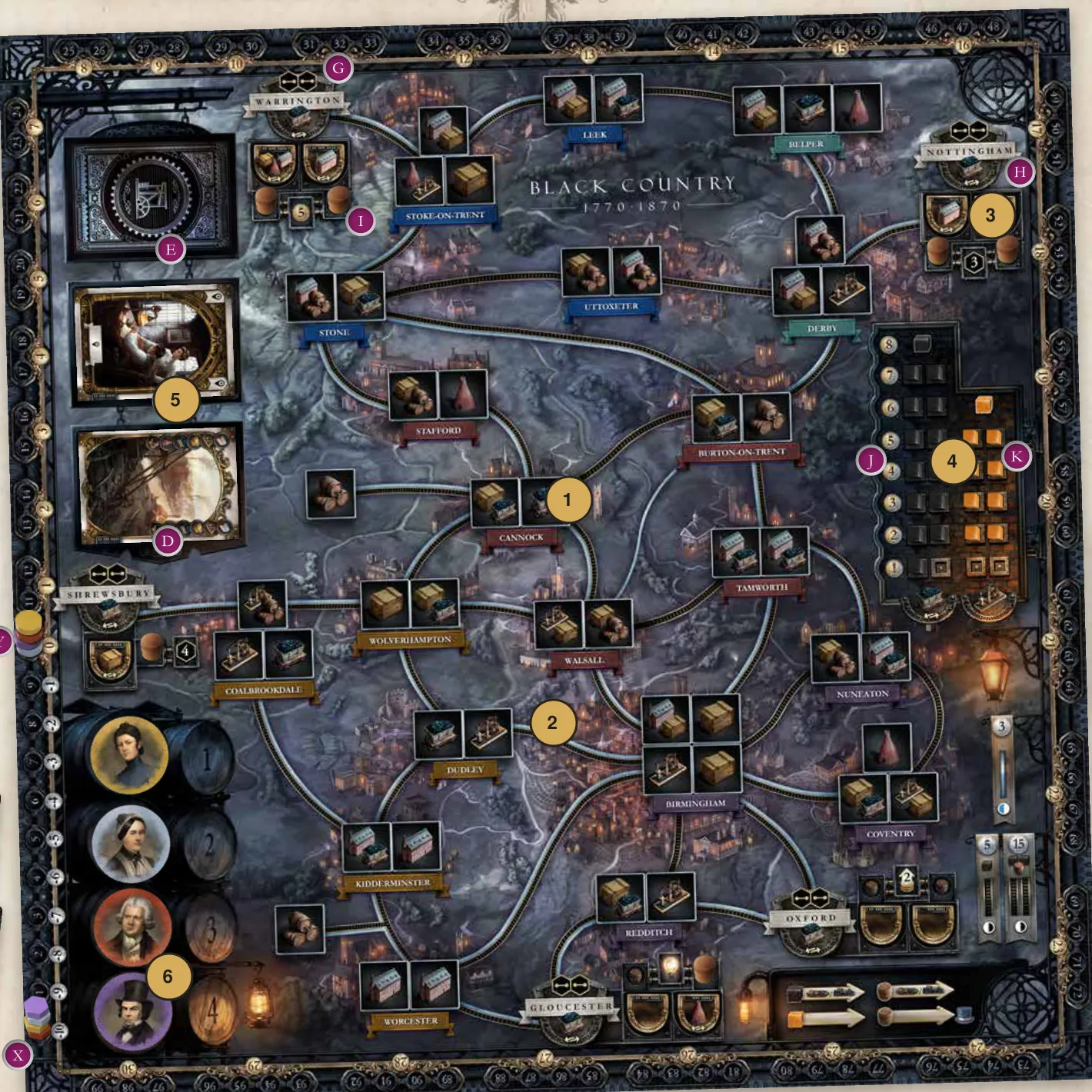
- Cities and build spaces — place matching Industry tiles here.
- Link routes — canals in the first era and railways in the second connect your network.
- Merchant spaces — their tiles show which goods each market buys and its bonus.
- Coal and Iron Markets — buy resources here when no suitable unflipped industry can supply them.
- Card Draw Areas — the Draw Deck and the two face-up Wild cards.
- Progress and turn-order tracks — track points, income, and next round’s order.
A round
- Follow the Character tiles on the Turn Order Track.
- Take two actions, discarding one card for each. In the first Canal round, take one action. Build needs a matching Location or Industry card; the other actions accept any card. FAQ
- Refill your Hand to eight cards when the Draw Deck can supply them.
- After everyone acts, the player who spent the least money goes first next round. Ties keep their relative order; then return the spent money to the Bank.
The round sequence and all six actions are explained in full.
How the game ends
There are two eras: Canal (1770–1830) and Rail (1830–1870). At the end of each era, score and remove Link tiles, then score your flipped Industry tiles. After Canal scoring, remove level 1 industries, refill Merchant beer, shuffle the discards into the Draw Deck, and deal new eight-card Hands. The game ends after Rail scoring. Highest VP wins; tie-break by income, then remaining money, then a shared win. Game End and Scoring
Ways to score
| Source | How and when it scores |
|---|---|
| Your Link tiles | At each era end, 1 VP per VP symbol in the locations adjacent to each of your links. Remove the link after scoring it. |
| Flipped Industry tiles | At each era end, score the VP value printed on each of your flipped tiles still on the board. Unflipped tiles score nothing. |
For the official one-era Introductory Game, add the money, income, and level 2+ Industry tile points after normal Canal Era scoring as described in Introductory Game.
What each resource is for
| Resource | Why you need it | How you get it | How you use it |
|---|---|---|---|
| Cards | Pay for every action; the card controls which location or industry you can build. | Draw to a Hand of 8 after your actions. | Discard one per action; Scout spends two extra to take both Wild cards. |
| Money | Pays build and link costs. | Income, bank loans, or selling a connected Coal Mine or Iron Works to a market. | Pay costs; money spent this round also determines next round’s order. |
| Coal | Required by some Industry tiles and every rail link. | Consume it from the nearest connected unflipped Coal Mine, or buy it from the Coal Market. | Return each used cube to the General Supply. |
| Iron | Required by some Industry tiles and Develop. | Consume it from any unflipped Iron Works, or buy it from the Iron Market. | Return each used cube to the General Supply. |
| Beer | Needed to sell some goods and to build two rail links in one Network action. | Your unflipped Breweries, connected opponents’ Breweries, or the Merchant you are selling to. | Return each used barrel to the General Supply. |
| Industry tiles | Your buildings produce resources, income, and points. | Take the lowest remaining tile of that industry from your Player Mat. | Build it; it may flip when sold or when its last resource leaves. |
| Link tiles | Connect locations and score at each era end. | Your own Link supply. | Place canals in Canal Era or rail links in Rail Era. |
Teaching tips
- Explain the card rule before the first turn: every action costs a card, but only Build cares what the card depicts.
- Show how a location enters your network: it contains your industry or borders one of your links.
- Make the difference between income and VPs clear: flipping raises income now; its printed VPs wait until era scoring.
- Teach beer and coal before a sale or a two-link rail action; both can stop an otherwise legal plan.