Teach the Game
A script to read aloud: how you win, the boards, a turn, how the game ends, every way to score, and what each resource is for.
How you win
“Dante’s Florence. Sin runs through every alley, and your family sees to it that sinners are accused, executed and sent below. Down in Hell, your ancestors herd their Souls through the nine circles, each to the punishment that fits its sin. The family that earns the most Infamy — before Dante finishes his descent — wins. One to four players, 45 to 120 minutes.”
To win you need Infamy points, and they come from three places in roughly equal shares:
- Souls in Hell — lay a Soul down in the circle of its own colour and score at once.
- Florence — Barrels delivered to your supply panel, Fraud cards and your reputation.
- Diplomas — at the end, each Diploma scores its circle’s fullness × your progress on that Sin Track.
The loop: in Hell you move a Soul down; where it stops tells you where in Florence you may act. In Florence you send family members out, then accuse a sinner — which feeds a new Soul to the Graveyard, pushes your Skull up its Sin Track and moves Dante one step closer to the end.
The boards
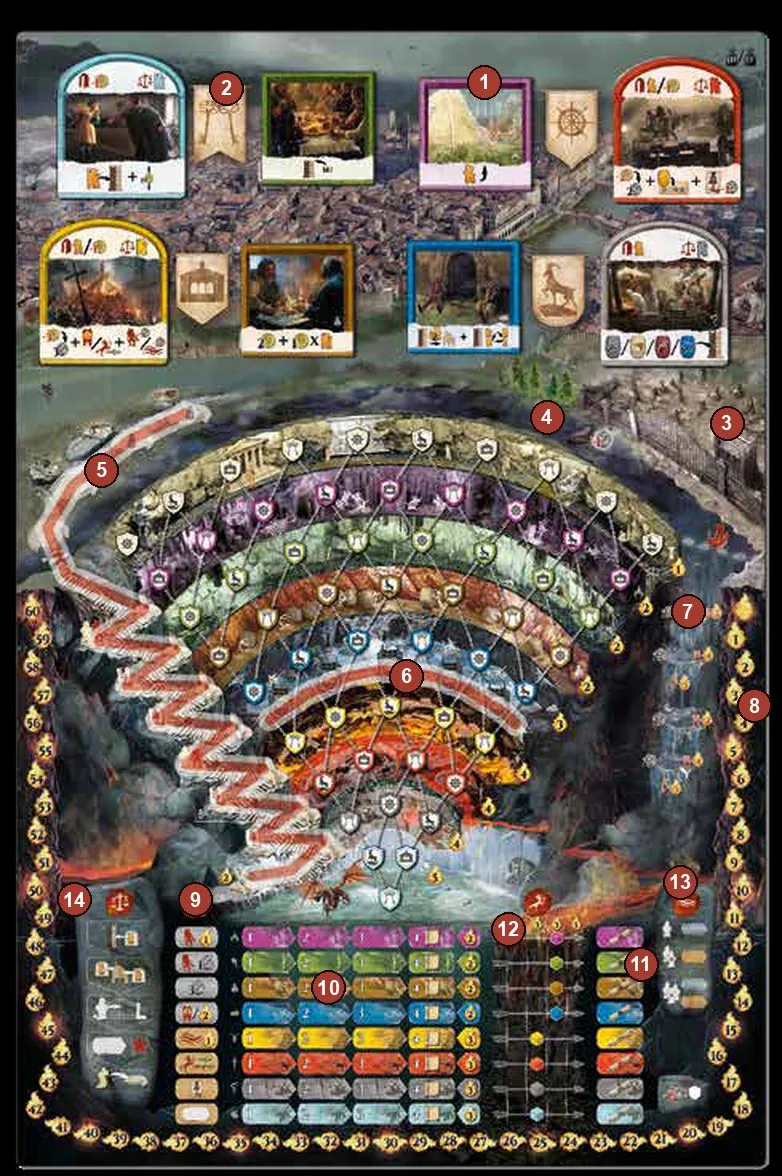
- Florence (top, 1–2) — eight locations in four quartieri: four free-access, four special.
- Hell (middle) — the Graveyard and River Acheron (3–4), Dante’s path (5), nine coloured circles of shields linked by chains, the Walls of Dis (6), the Loan track (7) and the Infamy track around the edge (8).
- The Death Log (bottom) — the bonuses (9), the eight Sin Tracks (10), the Diploma area (11), the Phlegethon multipliers (12) and the River Styx (13).
- Your player board — a Tower (rooms for Guests, Barrels and accusers), a supply panel for Barrels, and your home, where free family members wait.
Each part is explained on Boards & General Concepts.
A turn
Two compulsory phases:
- Hell — move one Soul down: a standing Soul already in Hell, or one from the Graveyard for
1
 . It jumps any occupied shield, never goes below its own circle, and needs your
safe passage to cross the Walls of Dis. In its own circle it lies down and scores.
→ Hell phase
- Florence — in the quartiere shown by that Soul’s shield (or anywhere, for 2 ):
- send a family member from home to a location and take its actions; or
- accuse with a family member already at a location: the accuser goes to your Tower, the others come home, a Soul of that colour enters the Graveyard, your Skull climbs its Sin Track, you take the track’s bonus, and Dante steps down — rewarding a pagan Soul and a Guardian, a Fraud card, or a Diploma; or
- if you can do neither, a family council (−2 Infamy and fix one thing). → Florence phase
How the game ends
When an accusation takes Dante to his final stop: that player scores 2 and takes the last Diploma, and everyone else gets one more turn. Then the final scoring: Fraud cards, Phlegethon adjustment (−1 per empty shield in each circle), extra Diplomas from ½ Diplomas, Diplomas, loans, reputation. Most Infamy wins; ties go to most Diplomas. → Game End & Final Scoring
Ways to score
| Source | How | When |
|---|---|---|
| Souls laid down | The value printed beside the circle (1 in Limbo up to 5 in Treason) | Hell phase |
 Weapons Barrel | 1 per 2 Skull spaces advanced | Delivered at the WALL |
 Bread Barrel | 2 per Diploma | Delivered at the WALL |
 Wine Barrel | 1 per Skull on the tracks | Delivered at the WALL |
 Cloth Barrel | 4, or a ½ Diploma | Delivered at the WALL |
| Sin Track past the 4th space | The points at the end of the track | Any advance |
| Bonuses and Fraud cards | Small amounts (1–3) | When played |
| Dante’s final stop | 2 | The final accusation |
| Fraud card endgame effects | Varies | Final scoring |
 Diplomas | Phlegethon value (1–5) × Skull level (1–4), up to 20 each | Final scoring |
| Reputation in Florence | Tallest Tower 4, most Guests 4, most Florins 3, most family at home 3 | Final scoring |
| [Bulls] Unplayed Papal Bull | 2 | Final scoring |
| Losses: family council | −2 | Each council |
| Losses: loans | −5 at once on the 3rd loan and each one past the 4th; −2 or −4 at the end | Loan track |
What each resource is for
| Resource | Why you need it | How you get it | How you use it |
|---|---|---|---|
 Nobles /  Urchins | Act and accuse in Florence | Family card; Urchins at the HAYSTACK | Sent to locations; only Urchins enter the MARKET, and they enter the BONFIRE and WALL without paying a Florin |
 Tower space | Room for accusers, Guests and Barrels | Floors at the BANQUET | No free space, no accusation |
 Guests | Accuse at special locations | PALACE (+Florins = floor) | Accuser goes on the Guest’s floor |
 Florins | Entry costs; turn into Drachmas | BANK, PALACE | Pay entries; change at BONFIRE/WALL |
| Drachmas | Charon’s fare, bribes, cards, Guardians, Styx | Changing Florins; loans | Pay Hell’s costs |
 Barrels | Fraud card requirements; points | MARKET (Urchins only) | Own for cards; deliver at the WALL |
| Fraud cards | Instant boosts and endgame points | Start with 2; draw one per card played | Play at the WALL, a gold bonus or a Dante stop |
| Skulls on Sin Tracks | Diplomas and their multiplier | Accusations, River Styx, cards | Lead a track when Dante reaches its circle |
| Safe passages | Cross the Walls of Dis | BONFIRE, silver bonus | Stay on the gate all game |
 ½ Diplomas | Buy a missed Diploma | 4th space of a track, Cloth Barrel, cards | Two = one Diploma at the end |
 Guardians | Twist Hell to your plan | Pagan stops, silver bonuses, BONFIRE | See Guardians |
Teaching tips
-
Teach the Soul jump with the board: a Soul from the Graveyard skips anything occupied, even in Limbo, and may zigzag — this is the most misplayed rule.
-
Stress that you can accuse at any time, with only one family member out — and that only an accusation gives a track’s bonus.
-
Explain the end scoring early: a Diploma is worth nothing unless its circle is full and your Skull is high. One or two well-filled circles beat a fistful of Diplomas.
-
For a first game use the first-game setup (I/II side, Apprentice cards, Medusa and Minos, no bonus tiles): it saves about 45 minutes.
-
For a special-location accusation, show the matching Guest and an empty space on its exact Tower floor before moving the accuser. Practice example.