Teach the Game
A script to teach Dominant Species: Marine at the table — how you win, the board, a turn, the end, every way to score and what each piece is for.
How you win
“Sixty-odd million years ago the oceans are a battlefield. Each of us is a class of sea animal — Reptiles, Cephalopods, Fishes or Crustaceans — spreading species over a growing sea floor. An asteroid is coming; when it hits, the animal with the most victory points is the Dominant Species. Two to four players, two to three hours.”
You score by having the most species on tiles when they are scored, by evolution cards, by bonus actions (new tiles, Vents, Survival) and by the special pawns you control at the end.
The loop: place a pawn, do its action at once — add elements, add species, move them, attack, score a tile — and keep your species next to elements they eat, or they die in the next Extinction.
The board
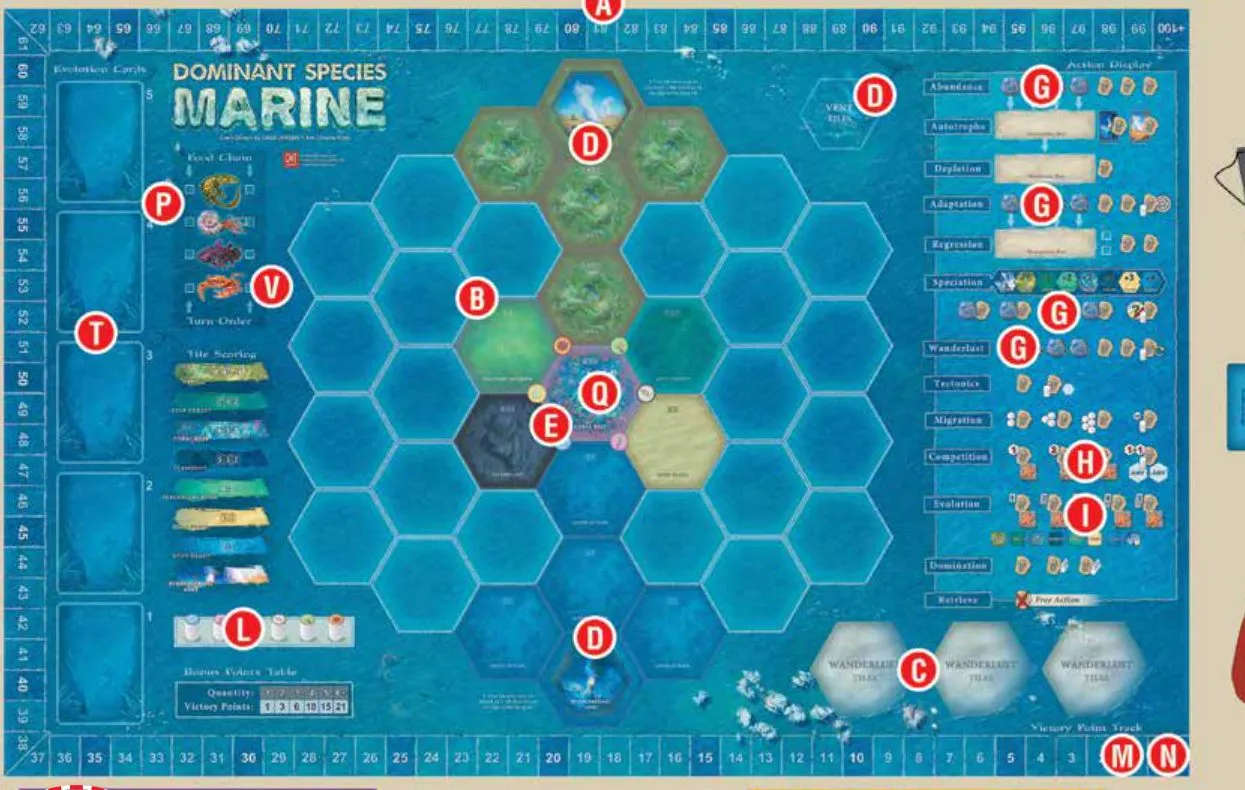
- Earth (centre, B) — the sea floor of hex tiles. Element disks sit on tile corners; species (cubes) sit on tiles.
- Action display (right, G–I) — twelve rows of action spaces, top to bottom.
- Evolution cards (left, T) — five face-up cards; the deck is the game’s clock.
- Food chain (P) — turn order upwards, tie-breaks downwards. Under it the Tile Scoring and Bonus Points tables, and the six white special pawns (L).
- Animal display — your needs (elements), your trait card and your Gene Pool of 35 cubes.
A turn
Crustaceans start; play goes up the food chain. On your turn either:
- Place one pawn on a free action space and do that action now. Basic pawns must go after all your placed pawns — lower down, or to the right in the same row (Pawn placement). White special pawns go anywhere and can bump.
- Or Retrieve all your pawns. When every animal has retrieved, the round ends with a Reseed that refreshes the display (Reseed).
The actions, top to bottom:
| Action | What it does |
|---|---|
 Abundance | Put an element on earth |
| Autotrophs / Depletion | Remove or swap elements on earth |
| Adaptation / Regression | Gain an element / protect yours at the Reseed |
| Speciation | Add species around one element |
| Wanderlust | Add a tile, score bonus VPs, everyone may move in |
| Tectonics | Turn an edge tile into a  Vent |
| Migration | Move species |
| Competition | Eliminate opposing species |
| Evolution | Score a tile, then take an evolution card |
| Domination | Claim a special pawn |
Details: Element actions, Earth actions, Evolution and Domination.
Survive: a species is endangered if its tile has no element matching your display. New cards
with a  dead fish wipe out every endangered species; a
 live fish
pays the animal with the most species on Vents (Events).
How the game ends
The Asteroid is in the last five evolution cards. Once someone takes it, finish the round (skip the Reseed), run a last Extinction and Survival, score every tile, then add the target values of the special pawns you control (Endgame). Most VPs wins; a tie goes to the animal higher on the food chain.
Ways to score
| Source | How | When |
|---|---|---|
 Tile scoring | Most species: Land 8, Kelp 7, Reef 6, Seamount 5, Seagrass 4, Sand 3, Ocean 2, Vent 1; 2nd and 3rd smaller | Evolution action; every tile at the end |
| Evolution cards | Points on the card (per tile, per species, bonus VPs…) | When you take it |
 Wanderlust | Bonus VPs for the new tile and same-terrain neighbours | When you add a tile |
| Tectonics | Bonus VPs for the new Vent and adjacent Vents | When you place a Vent |
| Survival card | Bonus VPs for Vents you occupy | Each Survival event |
 Special pawns | The target number of each pawn you control | End |
| Traits | E.g. Solitary, Cannibal, Prey Switching | During play |
| Losses | Disease, Gene Expression: VP lost per endangered species | When those cards act |
Bonus VPs: 1, 3, 6, 10, 15, 21 for a count of 1 to 6+ (table).
What each resource is for
| Piece | Why you need it | How you get it | How you use it |
|---|---|---|---|
 Elements on your display | Your species only live where they match | Printed 3; Adaptation; cards | Keep species thriving; multiply dominance |
 Elements on earth | Food supply for everyone | Abundance, Wanderlust, cards | Speciation centres; keep tiles alive |
| Species cubes | Majorities score tiles | Speciation, Tectonics, Wanderlust moves | Win tile scorings; claim cards (if thriving) |
| Basic pawns | Your actions | 4, 5 or 7 at the start | One action each; retrieve to reuse |
| Special pawns | Flexible actions and end VPs | Domination | Any space, bump, special spaces; score target |
| Target numbers | Gate for special pawns | Raised by each Domination | Beat it to claim; worth VPs at the end |
| Evolution cards | Big swings | Evolution with a thriving species | Resolve at once; slot = how far you can reach |
| Trait card | Your animal’s power | 1 of 3 dealt at setup | Ongoing ability (traits) |
| Survival card | VPs at Survival events | Most species on Vents | Scores Vents occupied |
Teaching tips
-
Point to the lowest placed pawn and ask where the next basic pawn can go, counting special pawns too (rehearsal).
-
Teach endangered vs thriving first: everything else follows from “stay next to food”.
-
Walk one dominance calculation on the table (elements × tiles must beat the target).
-
Stress that fish events fire when a card is dealt, so the card row is a warning.
-
First game: standard length; mention the Tectonics edge rule and the order rule for basic pawns.