Turns, Pawns and Dominance
Dominant Species: Marine core rules — the board, earth and elements, endangered and thriving species, dominance, the food chain, pawn placement and retrieving.
Overview
Four sea animals — Reptiles, Cephalopods, Fishes and Crustaceans — spread their species (cubes) over a growing map of ocean tiles called earth. Each turn you place one pawn on the action display and do that action at once, or you retrieve all your pawns. Points come from scoring tiles, card effects, bonus actions and the special pawns you control. The game ends after the round in which someone takes the Asteroid evolution card.
The board
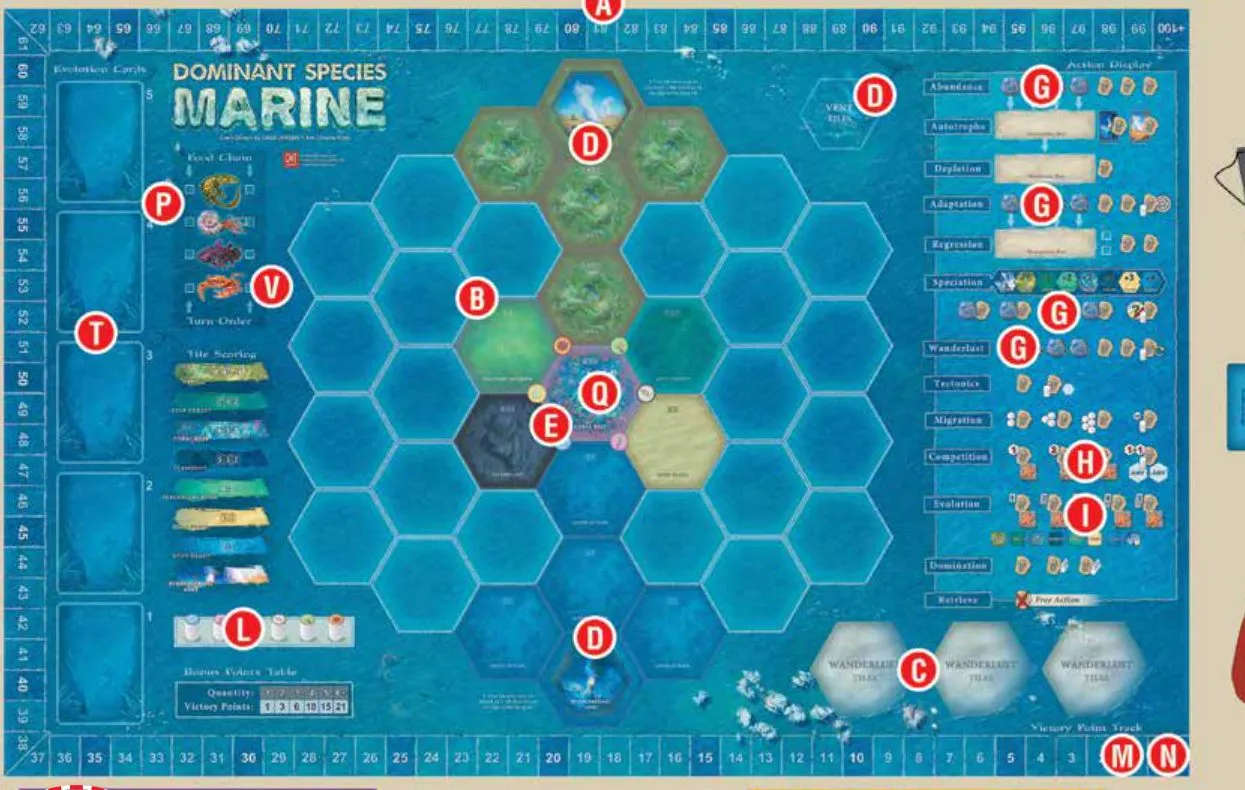
- Earth — the hex grid in the middle (letter B), where tiles are added.
- The action display — the boxed rows on the right (G, H, I).
- Evolution cards — the five card slots on the left (T); they are also the game’s clock.
- Food chain — turn order and tie-breaks (P).
- Tile Scoring table and Bonus Points Table — left, under the food chain (tile values, bonus VPs).
- Special pawns and their control markers — bottom left (L); target markers on the VP track (M).
- Wanderlust tile stacks (C) and the Vent stack (D, top right).
Earth and adjacency
Earth is every tile on the board. Large tiles come in seven terrains:  Land,
 Kelp Forest,
 Coral Reef,
 Seamount,
 Seagrass
Meadow,
 Sand Plain and
 Open Ocean. Small
 Hydrothermal Vent tiles
are laid on top of large tiles and turn them into Vents for the rest of the game.
- Tiles sharing an edge are adjacent. A Vent counts as touching whatever the tile under it touched.
- New large tiles join the outside of earth through Wanderlust; Vents arrive through Tectonics.
- Short names (Vent, Sand, Reef…) mean the same as the full names.
Elements
Six element types:  sun,
 worms,
 plankton,
 sponges,
 gastropods and
 algae.
- On an animal display an element is a need; on earth it is a supply.
- On earth, elements sit on tile corners, so one disk serves up to three tiles at once.
- “Element” means one disk; “element type” means all disks of that kind.
- Each animal starts with three printed elements that can never be removed, and holds at most six.
| Animal | Printed elements |
|---|---|
| Reptiles | |
| Cephalopods | |
| Fishes | |
| Crustaceans | |
Species and the Gene Pool
Your 35 cubes start in the Gene Pool of your display; new species always come from there. A species eliminated from earth goes back in the box, not to the Gene Pool, unless a rule says it is returned. You are never out of the game: an animal with no species still keeps its score.
Endangered and thriving
A species is thriving when at least one element on its tile matches an element on its animal’s display. It is endangered when none does.
- Endangered species die in the next Extinction.
- You claim an evolution card only with a thriving species on the scored tile (Evolution). The rulebook’s p. 7 says “Domination actions” here; GMT’s correction sheet changes it to Evolution actions.
Dominance
Dominance decides who may claim a special pawn. For one element type:
- Count that type on your display (printed and added disks).
- Multiply by the number of tiles that hold both one of your species and at least one disk of that type.
- If the result is higher than the type’s
 target number on the VP track, you
dominate it. Several animals can dominate the same type at once.
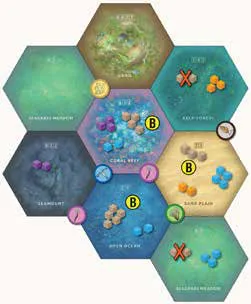
The value only matters when someone takes the Domination action.
Food chain
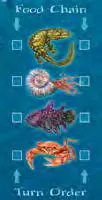
From the top: Reptiles, Cephalopods, Fishes, Crustaceans. Read down, it breaks ties (Reptiles win them). Read up, it is the turn order: Crustaceans play first, then Fishes, Cephalopods, Reptiles, and round again. Each animal has a cube on the food chain that shows whether it has retrieved this round.
Sequence of play
On your turn do exactly one:
- Place one available pawn in an
 action space and do that action at once, or
- Retrieve all your pawns from the display (Retrieve). If you have no available pawn, you must retrieve.
An action is optional: you may forfeit it after placing, but then you skip all of it, never just part. Whenever a card contradicts the rulebook, the card wins.
Pawn placement
Coloured pawns are basic; white pawns are special and are won (and lost) through Domination.
Basic pawns
A basic pawn goes into an empty, non-special space that comes after all your placed pawns: either in a section below all of them, or to the right of your lowest pawn in the same section. Your placed special pawns count too.
Special pawns
A special pawn ignores the order rule. It may go in any empty space — including the
 spaces marked with a white cylinder, which only special pawns can use — or on a
space holding an opponent’s basic pawn, which goes back to its owner as available. A special pawn
can never be bumped (except while the Adaptability card is in play).
Retrieve
Take back all your pawns, basic and special, as available pawns. Slide your food chain cube from the left box to the right box. When the last cube reaches the right column, the round ends and a Reseed happens at once.
- Retrieving is your whole turn. On later turns you play as normal, whichever box your cube is in.
- A round therefore lasts until every animal has retrieved at least once.
The Survival card
Whoever has the most species on Vent tiles (alone) takes the Survival card at once; on a tie nobody holds it. During each Survival event the holder scores bonus VPs. Its back lists the six special-pawn-only actions.
Bonus points table
Many effects pay bonus VPs: count what the effect asks, then read the table.
| Count | 1 | 2 | 3 | 4 | 5 | 6+ |
|---|---|---|---|---|---|---|
Bonus  | 1 | 3 | 6 | 10 | 15 | 21 |