Teach the Game
Brick & Mortar rules and reference.
How you win
“We run competing shopping streets. We choose what the market supplies and wants, buy stock, sell it for a margin and invest those profits in points. Most points after Store values, empty spaces and debt wins.”
You need a profitable mix of Stores and enough working cash to stock them and pay utilities. Buying points changes turn order and can trigger the ending.
The boards
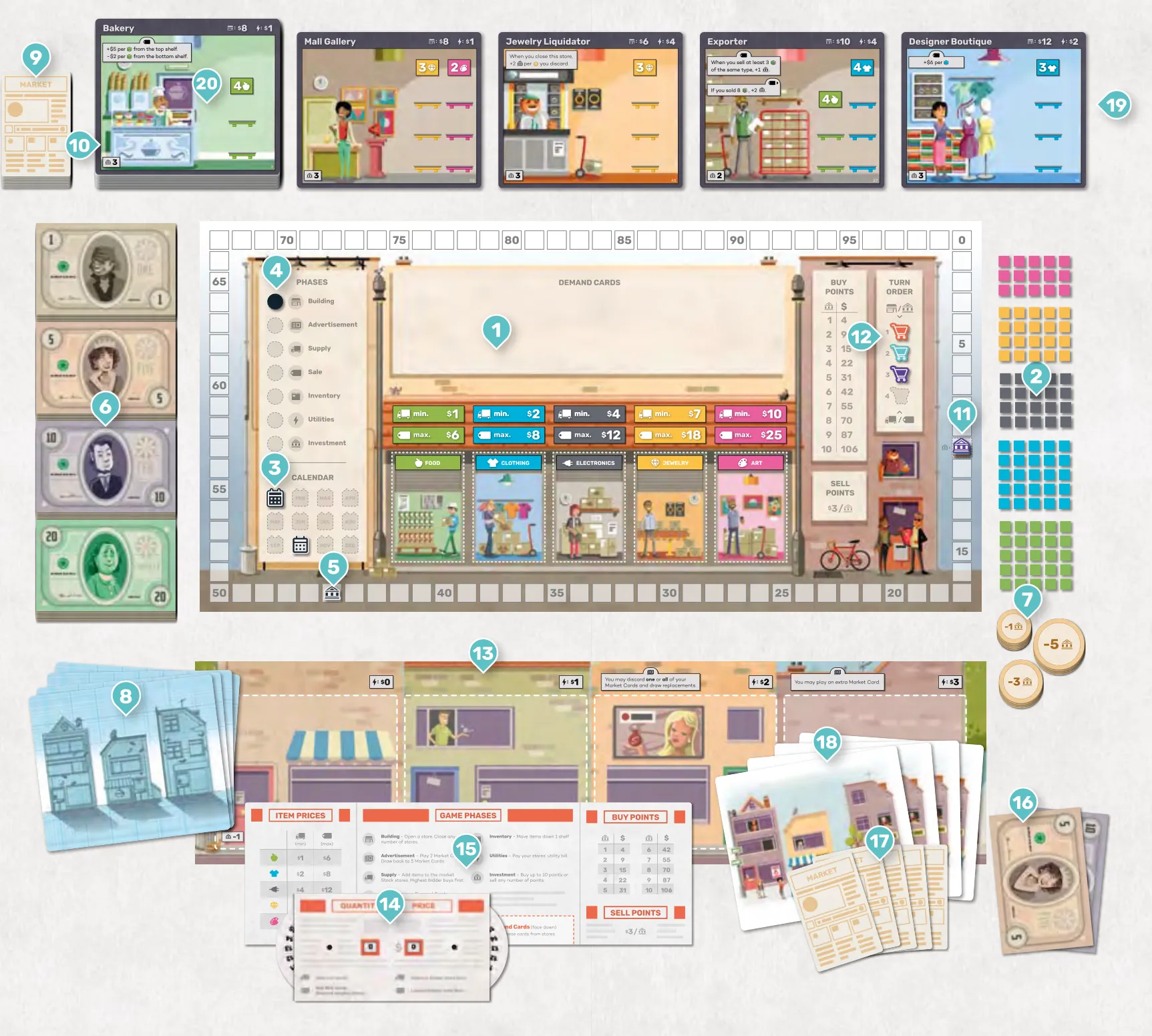
- Market and phase order — shared crates, demand and calendar.
- Price limits and bidding — the five item types run left to right.
- Your building — open Stores in the leftmost empty slot; shelves age stock.
The setup picture’s numbered markers link from the Setup checklist.
A round
- Building: buy at most one Store, close any number, slide left and open the new one. In January, choose and fill a free Starting Store instead.
- Advertisement: secretly play 2 Market Cards as supply or demand. Draw back to 5.
- Supply: add the supplied crates, then buy one item type at a time. Shortages mean highest-price-first bids.
- Sale: reveal demand and sell one type at a time. Shortages mean lowest-price-first bids; committed surplus is discarded.
- Inventory: stock drops one shelf; bottom-shelf goods expire.
- Utilities: pay Store and building-slot costs.
- Investment: buy up to 10 points or sell points, then check the ending.
How the game ends
Reaching 45 points in 2–3 players or 35 in 4 players triggers the final month. Otherwise October (2–3) or September (4) is last. Always finish all phases of that month. Most final points wins; earlier turn order breaks a tie.
Ways to score
| Source | How and when |
|---|---|
| Score track | Start at 10. Buy points during Investment or earn them through Store effects. Selling points lowers this score. |
| Open Stores | Add their printed point values at game end. |
| Empty building slots | Subtract each empty slot’s printed penalty at game end. |
| Debt | Subtract 1 point per debt point at game end; no immediate track movement. |
What each resource is for
| Resource | Why / get / use |
|---|---|
| Money | Working capital. Get it from sales, selling points or debt; spend it on Stores, stock, utilities and point investments. |
| Crates | Stock to sell. Buy from the market or gain via abilities, hold within capacity and deliver to demand. |
| Market Cards | Shape the round’s opportunity. Play faces as supply and backs as demand, then refill your hand. |
| Store Cards | Your economic engine. Draft a starting hand, buy from hand or auctions, and open/close to change your business. |
| Turn order | Priority in Store buying and simultaneous decisions; being later wins equal supply/sale price bids. Change it by passing other scores. |
| Debt | Emergency cash: $2 per point, paid back only as a final score penalty. Never use it to buy points. |
Teaching tips
- Explain one Store’s capacity, shelves, utilities, phase icon and final points before the first choice.
- Use the preset hands and rehearse one supply bid and one sale bid aloud.
- Say: “Price chooses priority; quantity commits us only in Sale.”
- Host game rehearsal: with 5 demand spaces and bids for 4 and 2 crates, show the last crate becoming surplus. Then show that 5 crates against exactly 5 demand needs no bid.