Teach the Game
A script to teach Bone Wars at the table — how you win, the board, a turn and a round, the end, every way to score and what each piece is for.
How you win
“America, 1877 to 1897. Othniel Marsh and Edward Cope hate each other, and we are the fossil hunters working for them. We dig up bones, discover species, publish papers for one patron and debunk the other’s. Four rounds, about an hour and a half. The most reputation points wins — and almost all of them come from two scorings, after round 2 and after round 4.”
At each scoring you score both patrons:
your loyalty to the patron × that patron’s credibility
 Loyalty — your own marker on each patron’s track. You raise it by publishing,
debunking and claiming awards for your current patron.
- Credibility — how many shelves of that patron’s half of the bookshelf hold at least one paper. Everyone shares it: every paper anyone publishes for Marsh helps everyone loyal to Marsh.
The loop: play cards to dig up bones and find species, then spend the bones to publish or debunk papers — and switch patrons at the right moment, so your loyalty sits where the shelves are full.
The boards
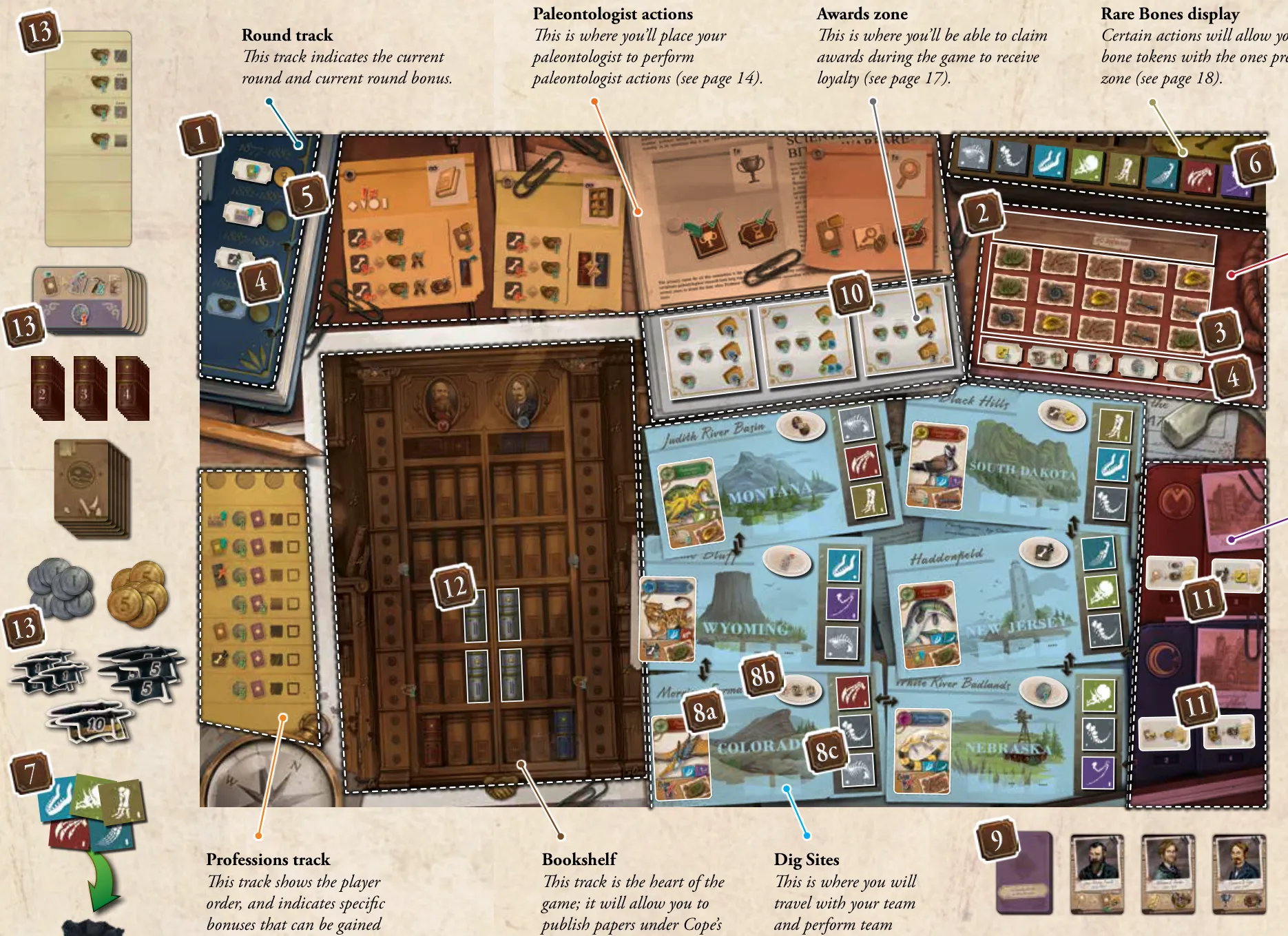
- Dig sites (bottom right) — six territories linked by arrows: Montana, South Dakota, Wyoming, New Jersey, Colorado and Nebraska. Each holds a species card, three bones stacked by depth and a dig site action. Your team works here.
- Paleontologist actions (top) — four action spaces: Publish Papers, Debunk Papers, Claim an Award and Make a Minor Find. Your paleontologist works here.
- Bookshelf (middle) — Marsh’s papers on the left, Cope’s on the right, with each player’s loyalty track beside each half.
- Awards zone, minor finds area and rare bones display (top right) — goals, one-off finds with bonuses, and bones you can buy into.
- Universities (right) — one for each patron. You start and end every round there; the spot you pick sets your patron and your grant.
- Round track and profession track (left) — the round bonus, and the turn order with its passing bonuses.
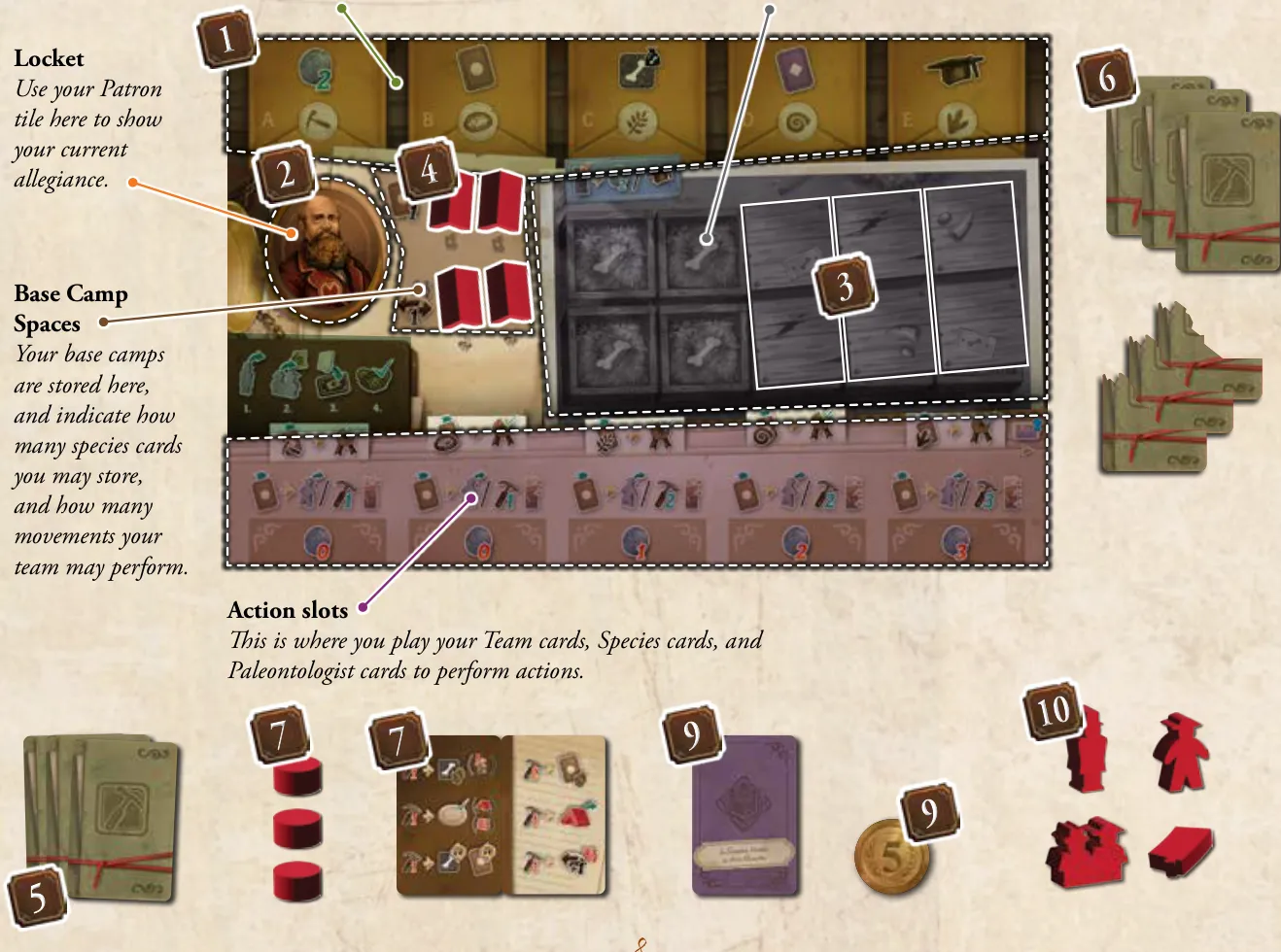
- Your player board — archive envelopes for species cards, base camps, bone crates and five action slots.
A turn
Players take turns in order until everyone has passed. Details.
- Play a card from your hand into your leftmost empty action slot and pay the slot’s cost
plus the card’s cost.
 Team card → team actions with its action points: move, dig for bones,
discover a species, build a base camp, use a dig site’s action. Team actions
 Paleontologist card → move your paleontologist to one
paleontologist action and get the card’s bonus if it matches.
Paleontologist actions
 Species card → either of the two, with the strength the slot shows.
- Or pass: pick a new profession (and its bonus), go back to a university (it may change your patron and your grant) and collect a loyalty bonus. Passing
A round
- Everyone plays cards, one per turn, until they pass.
- When all have passed, refresh the board: bones slide up and are refilled, dig sites get new species, team cards come back to your hand, played species and paleontologist cards are discarded. Resetting the board
- After round 2: mid-game scoring. After round 4: final scoring.
How the game ends
After the 4th round, score the bookshelf a second time and add up your reputation tokens. The highest total wins; a tie goes to the most species cards in the archive, then to the biggest head. Final scoring
Ways to score
| Source | How and when |
|---|---|
| Loyalty × credibility, Marsh | After rounds 2 and 4: your loyalty value (0–7) on Marsh’s track × Marsh’s credibility. |
| Loyalty × credibility, Cope | Same, for Cope — you score both patrons every time. |
 Loyalty beyond the top | Each loyalty step you would gain at the top of a track gives 1 reputation instead. |
 Archive envelopes | Some envelopes pay reputation each time you archive into them, multiplied by the cards there. |
 Cover tiles | Each one you remove gives $2 or 1 reputation. |
What each resource is for
| Piece | Why you need it | How you get it | How you use it |
|---|---|---|---|
 Dollars | Every card costs its slot’s price plus its own | $5 at the start, professions, dig site actions, bonuses | Pay to activate cards; run dry and you must pass |
 Bone tokens | Publish and debunk papers | Dig at dig sites, draw from the bag, rare bones display | 2–4 different parts to publish; 2–4 identical tokens to debunk |
| Species cards | The skeleton you publish, the card you archive, and a flexible action | Discover at a dig site (2 action points), bonuses | Publish (archived), make a minor find (archived), or play as an action |
| Paleontologist cards | The only way, besides species, to do paleontologist actions | 1 at the start, the display or deck through bonuses | Play into a slot; its bonus works on its matching action |
| Team cards | Your field work | 3 basic in hand; upgrade to advanced | Play into a slot for action points and digging depth |
 Base camps | More free moves or bigger archive envelopes, remote dig site actions | Build one at your dig site (1 action point) | Stays for the game |
| Loyalty | Your multiplier at each scoring | Publishing, debunking, awards, bonuses | Score; each track goes from x0 to x7 |
 Awards | Big loyalty in one go, plus the round bonus | Claim one when you meet its condition | Each player, one marker per award tile |
Teaching tips
- Lay out three different bones to publish and three identical bones to debunk (rehearsal).
- Teach the scoring first: loyalty × credibility, on both sides. Every later decision hangs on it.
- Point out that publishing helps your rivals on the same side, and debunking hurts the other side while moving the paper to yours.
- Show the action-slot costs ($0 to $3) before the first turn — money runs out fast.
- Base camps unlock free moves only from your next turn (ruling).