Teach the Game
A short read-aloud introduction to the four Ayar journeys and the clan’s Sun and Moon scores.
How you win
Your clan helps the four Ayar pairs travel from Tiwanaku to Cusco, building the skills and settlements that please the Sun and Moon. Across four rounds you develop pottery, weaving, terrace farming and reed bundling. At the end, your lower score between Inti’s Sun and Mama Quilla’s Moon is your result; the highest result wins.
Each round you use Step markers to move Ayar, build Tambos and perform activities. The activities reveal Suns for repeated Inti scoring and Moons for one-time scoring; keep the two tracks close because only the lower counts.
The boards
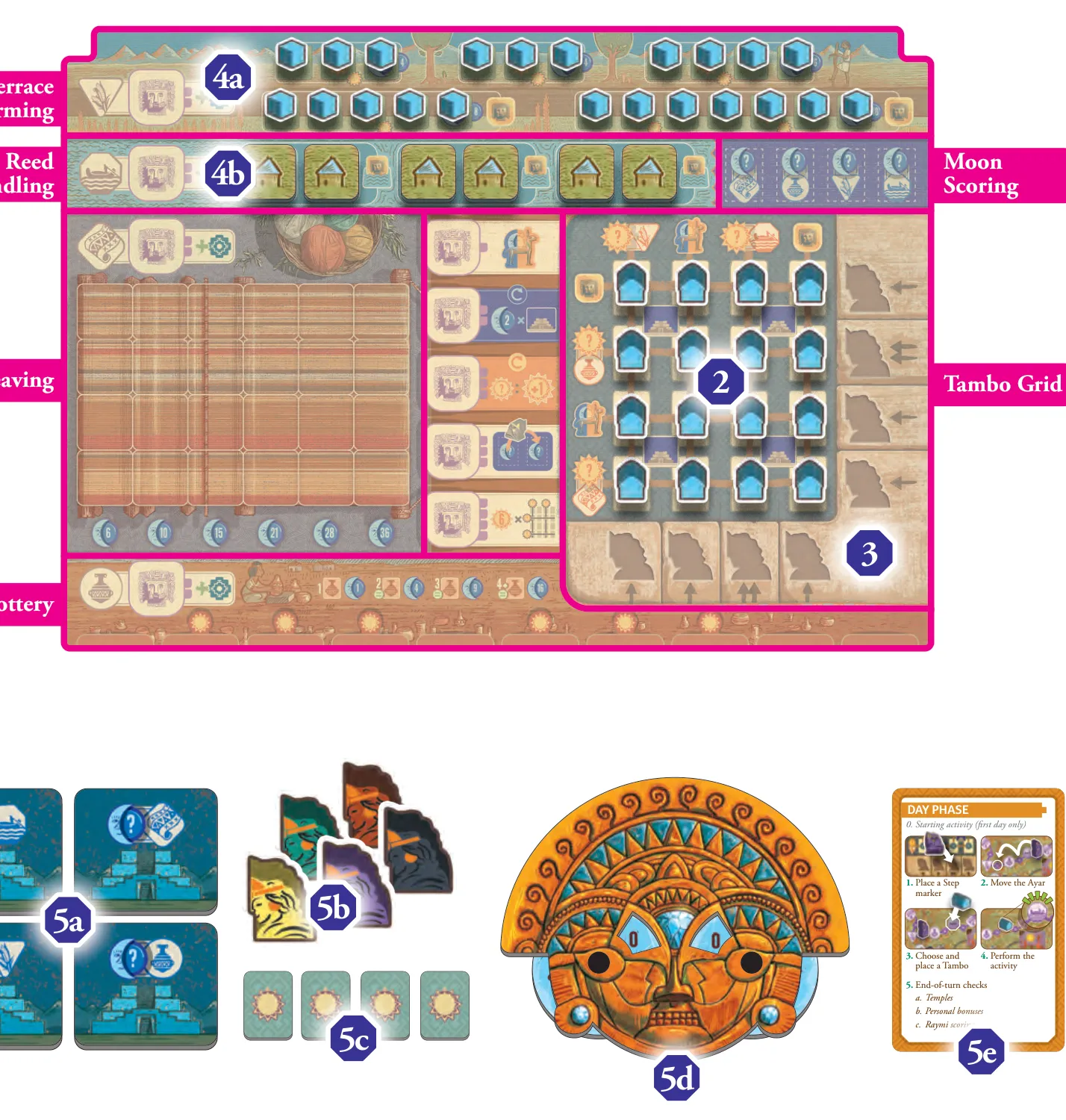
- Tambo grid — remove one of these Tambos each Day turn.
- Step spaces — cover spaces for unused player colours with the matching side of your Step tile. 4a. Maize — remove it to reveal terrace values. 4b. Islands — remove them to reveal reed-bundling values. 5a–5e. Player pieces and reference card — keep your Temples, Step markers, Bonus markers, Inti dial and Reference card beside the board.
The Main board has four coloured Ayar paths, four Temple rows, Raymi tiles and one shared score track. The Lake board holds the four activity areas, markets and Boat routes. Your Player board tracks Tambos, activity pieces, the Inti dial and Moon patterns.
A round
There are four rounds. Each has a Day phase followed by a Night phase.
On the first Day only, each player removes one Tambo and performs a power-1 activity. Then players take turns until they have used every available Step marker:
- Lay an available Step marker on an empty slot beside the Tambo grid. Its row or column must still contain a Tambo.
- Move the matching Ayar by the exact number of arrows printed beside that marker slot. The gold Wild marker may move any Ayar.
- Remove one Tambo from that row or column and place it on an empty building slot behind the moved Ayar. Choose an activity you can perform.
- Perform that activity at a power equal to the number of empty spaces in the row or column. You may use less power.
- Resolve any newly emptied 2×2 quadrant, row or column, and any Raymi tile crossed by the Ayar. See Day and Night and the activities.
At night, one Ayar retires, the terrace is harvested, its female partner scores Temples, and every player scores the Step marker of that colour. Then everyone scores their current Inti dial value and stands their remaining markers upright.
How the game ends
After the fourth Night, assign your Llamas to the Sun and/or Moon using the conversion key on the Main board. Compare the lower of your two scores. Highest lower score wins. Ties go to the player whose other score is closest to that lower score; if still tied, the tied players share the win. See Game End and Scoring.
Ways to score
| Source | What it adds, and when |
|---|---|
| Inti dial at Dawn | Its current value is added to Sun points every Night; the dial never resets. |
| Raymi tile | When an Ayar reaches or passes its linked space, every player adds Suns for that activity to their dial; a player meeting the tile’s threshold also takes a Llama. |
| Personal Sun bonus | Emptying a marked row or column adds that activity’s Suns to the dial; mark the bonus as used. |
| Activity Moon values | A retired Step marker scores the chosen activity’s current Moon value once. |
| Temples | When their row’s female Ayar scores, each Temple adds its activity value plus the column bonus. |
| Cuzco | When an Ayar reaches space 30, choose two different activities; add their Suns to the dial and take a Llama for each with at least six Suns. |
| Llamas | At game end, convert them between Sun and Moon points to help the lower score. |
What each resource is for
| Piece or track | Why you need it | How you get or use it |
|---|---|---|
| Step markers | Choose an Ayar and the row/column that determines activity power. | Lay one each Day; the retiring Ayar’s colour scores once at Night. |
| Tambos | Waystations that let you act and open board bonuses. | Move one from your grid to an eligible path slot each turn. |
| Maize | Develop terrace farming for Suns and Moons. | Plant it from left to right; when a box empties, gain its Viracocha if shown. |
| Islands and Boat | Advance reed bundling and raise its Moon value. | Move the Boat along the lake and place Islands in empty slots. |
| Textiles | Form complete columns for Moon points and show Suns for Inti. | Take from the power stacks and cover exactly two empty textile spaces. |
| Pots | Make colour sets for Moon points and collect visible Suns. | Take from the market; facedown Pots are wild. A Viracocha symbol grants that bonus token. |
| Viracocha | Unlock personal bonuses. | Place immediately on an unfilled bonus space; tokens cannot move later. |
| Llamas | Flexible final points that balance Sun and Moon. | Earn from Raymi thresholds and bonuses, then allocate at game end. |
| Sun and Moon markers | Track the scores that determine your result. | Only move at Night or final scoring, as described in scoring. |
Teaching tips
- Point out that the Tambo grid is both an action-power puzzle and a source of personal bonuses; removing one piece changes future options.
- Explain the repeated Sun dial first: early Inti gains score again at each later Dawn, but only the lower final track matters.
- Show how an Ayar’s path can trigger shared Raymi scoring and affects which Temple row scores at Night.
- For a first game, use the fixed first-game tile arrangement and remind everyone that a low or zero Moon score early can preserve a valuable activity for later.