Vehicles
Cars and tanks in Ambush!: attributes, facing, movement, accidents, firing at and from vehicles, German vehicle cards, mines and running soldiers over.
Two kinds of vehicle appear: cars (jeep, Kübelwagen, staff car) and tanks (Panzer IV, Jagdpanther, Sherman). Some briefings assign you one; others are met during play. German vehicles act from cards; US vehicles act as you wish (rulebook p. 29). The full Vehicle Summary with every Hit Chart is on p. 40.
Attributes
| Attribute | Meaning (p. 30) |
|---|---|
| Size | Large vehicles are easier to hit than small ones (Fire Combat Modifiers Chart). |
| Armour | Light, medium or heavy per part; fire only matters if the penetration result equals or exceeds the armour of the part hit. Cars are unarmoured. |
| Open / closed | Open: every occupant can be hit. Closed (armoured vehicles only, Closed marker): nobody can be hit. Changing is free in Operations, one action in Rounds. |
| Occupants | Cars carry a maximum including the driver; only the driver drives. Tanks carry no passengers; the crew never leaves. |
| Speed | Slow and fast . Fast risks an accident; a closed tank or a car with a shot tyre cannot go fast. |
| Hit Chart | One per vehicle type, rolled after every successful fire; grenades and satchel charges do not use it. |
| Vehicle | Size | Occupants | Slow / fast MPA |
|---|---|---|---|
| Jeep / Kübelwagen | small, open | 4 | 5 / 9 |
| Staff car | small, open | 5 | 5 / 10 |
| Panzer IV / Sherman | large, armoured | crew 5 | 3 / 6 |
| Jagdpanther | large, armoured | crew 5 | 3 / 6 |
(Vehicle Summary, p. 40.)
Facing
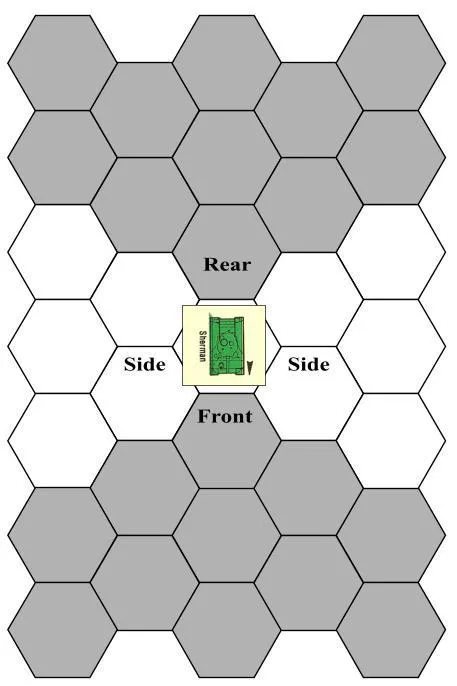
The counter’s arrow marks the front. A vehicle moves forward into the hex it faces or backs into the hex behind it; turning costs nothing. On entering a hex it faces the hexside opposite the one it crossed. Which side an attacker hits, front, side or rear, comes from this diagram; an attacker in the same hex chooses (random for Germans) (p. 30).
Movement
- Operations: a vehicle with an active driver or crew moves hex by hex with a Paragraph Check per hex, into anything but buildings, rubble and rivers; large vehicles never enter woods. No Accident Checks. At most two vehicles, disabled ones included, per hex (p. 30).
- Rounds: the driver spends a turn on Drive Vehicle; a tank crew spends Crew Points. Pay the vehicle’s cost per hex from the Movement Point Cost Chart, up to the slow or fast allowance in use; German vehicles spend as much as they can. The moment a vehicle exceeds its slow MPA it is moving fast and makes an Accident Check. Any number may pass through a hex, two may end there (p. 30).
- Never drive into a crater on purpose; a movement reference that forces it costs 3 MPs and an immediate Accident Check (p. 31).
Drivers, passengers and crew
Stack car occupants under the vehicle counter, driver on top, then Passenger 1, 2 and so on; soldiers outside the car sit on top of it. Changing seats or getting in or out is free in Operations and costs one Movement Point in Rounds. Stance is ignored inside a vehicle. Tank crews are part of the tank: the number of active crew sets its IN, PC, WS and DS, and nobody can board a tank (p. 31).
Car occupants obey command and can receive turns from a commander. Tank crews never do, and panic only when their IN has fallen to 0 or 1 and the Action Round roll is 0–2. A car driver panicked by combat makes an immediate Accident Check; panic from the Action Round Track just stops the vehicle (p. 31).
Fire against vehicles
A vehicle and its occupants are one target; no occupant can be singled out. Resolve the fire as usual with the size modifier, then roll one die on the vehicle’s Hit Chart to see what was hit (p. 31):
- Passenger: damage on the weapon’s row; only aimed automatic fire can hit more than one. A bazooka uses its Personnel result on him and the Grenade Inside row, prone, on everyone else; the car is then disabled.
- Driver: damage as above; panic or wound forces an Accident Check, incapacitated or killed is an automatic accident.
- Tank crew: an open tank exposes three crew. A hit removes one crew member, no damage roll; a bazooka kills the one hit and rolls Bazooka Inside, prone, for the other exposed crew.
- Vehicle part: see the Damage Effects of that vehicle (tyres stop fast driving, a penetrated body disables, a penetrated turret or mount disables or destroys a weapon, a penetrated tread immobilises).
A German will not shoot a closed tank with a weapon that cannot penetrate it, whatever his paragraph says. Explosive hits on a vehicle do not hurt soldiers outside it in the same hex. A soldier outside a vehicle in its hex counts as in cover unless his terrain is better (p. 31).
A disabled (knocked out, inactive) vehicle is flipped for the rest of the mission; a tank can be immobilised without being disabled. When a car is disabled its occupants are placed prone outside it and lose the rest of the turn (p. 31).
Fire from vehicles
A car passenger fires his personal weapon aimed or snap at −2; the driver gets one snap fire at −2. No bazookas, grenades, satchel charges or crew weapons from a car unless a briefing says so. Tanks fire their built-in weapons without the −2 (p. 32).
Tanks
A tank receives turns like a soldier and spends up to one Crew Point per active crew member per turn, each task at most once (p. 33):
| Task | Crew Points | Limits |
|---|---|---|
| Aimed fire, cannon | 2 | Must be loaded; never jams or runs dry; not with the coaxial MG in the same turn |
| Load cannon | 1 | Not in a turn the cannon or coaxial MG fires |
| Aimed / snap fire, bow MG | 2 / 1 | Target in front only; can jam, never runs dry |
| Aimed / snap fire, coaxial MG | 2 / 1 | Not with the cannon |
| Move slowly / fast | 2 / 3 | Fast only when open |
| Open or close | all | Nothing else that turn |
Panzer IV and Sherman: turret cannon and coaxial MG fire in any direction, one of them per turn; the bow MG fires only to the front but may fire in the same turn. Jagdpanther: both cannon and bow MG fire only to the front, and an immobilised Jagdpanther’s cannon fires only down the hex row it faces. A Panzer or Sherman can fire cannon or coaxial MG into its own hex; a Jagdpanther cannot fire into its own hex (p. 33).
German vehicles
A German tank’s actions come from its card: roll one die, read the row for its current crew size, and perform that paragraph’s actions in order, as far as the available Crew Points and the tank’s state allow. A German car acts on its driver’s driving column. A tank told to fire at a soldier inside a building fires its main gun at the wall at +4; it uses its machineguns on a visible soldier behind a stone wall and the main gun on a known but invisible (prone) one. A vehicle ordered to Move Fast that only uses its slow allowance pays only the Move Slow Crew Points (p. 32).
Accident Checks
Made when a vehicle exceeds its slow MPA, when a car’s driver, wheels or body is hit, or when the driver is panicked or wounded by combat (p. 32). Roll one die: at or below the driver’s or crew’s nothing happens; above it, roll again on the Accident Table of the Chart Reference Screen.
Mines and vehicles
- Tanks ignore minefields and boobytraps; the boobytrap is eliminated, the minefield stays. Mission 7’s anti-tank mines are the exception: they go off only under a tank, immobilising it (a car is disabled) (p. 32).
- Cars detonate a minefield automatically, with no check: the car is disabled and every occupant panics. In a boobytrapped hex the driver makes a Perception Check; failure disables the car and panics the occupants (p. 32).
Grenades and satchel charges
- Into an open tank as through an aperture (the non-adjacent penalty applies unless thrown from the tank’s hex): a grenade inside kills the crew and disables the tank. Closed tanks are immune to grenades. A satchel charge landing in the tank’s hex disables it on an incapacitated or kill result on the Satchel Charge Outside row (p. 32).
- Into a car: a grenade inside disables it and the occupants roll Grenade Inside as prone; a grenade in the car’s hex disables it on an incapacitated or kill result on Grenade Outside, then roll once per occupant. A satchel charge into or next to a car always disables it (p. 32–33).
- Scatter when the throw into a vehicle fails: from the vehicle’s hex, 6–9 drops the grenade in that hex outside the vehicle and the thrower may react without a check; from an adjacent hex, 6–9 lands in the vehicle’s hex; from further away use Diagram A or B. A grenade never scatters back into a vehicle (p. 33).
Running over soldiers
Entering a hex with soldiers calls for an Accident Check: against friends you pass it to miss them, against enemies you pass it to hit them. Each active soldier in the way then makes a Perception Check to dodge; those who fail, or are inactive, are hit. A tank kills; a car rolls bolt-rifle damage and then rolls once more on the Accident Table for itself. To try again in the same turn a US vehicle must leave the hex, turn sharply for 1 MP, pass another Accident Check and come back (p. 33).