Line of Sight
Tracing a line of sight in Ambush!: elevations, embankments, crests, woods, buildings and apertures.
To fire at a target or make many Perception Checks, a soldier must see the hex (rulebook p. 17). Lines of sight are reciprocal. Seeing a hex is not always seeing the soldier in it: a target out of sight cannot be fired at directly, although a penetrating hit on a building can still injure him, and grenades and satchel charges can be thrown at unseen hexes.
Tracing the line
Draw a straight line from the centre dot of the sighter’s hex to the centre dot of the target’s hex (p. 17). If it crosses any part of a blocking hex or hexside, it is blocked; if it runs exactly along the edge between two hexes, one blocking and one clear, it is clear. Terrain fills its whole hex: the hexsides matter, not the artwork. A hex with any woods is woods; otherwise the majority terrain counts.
At the same elevation, any blocking terrain between the hexes at the same or higher level blocks. At different elevations, terrain lower than both hexes never blocks; terrain at the level of either hex, or higher than one, may block depending on where it sits (p. 17).
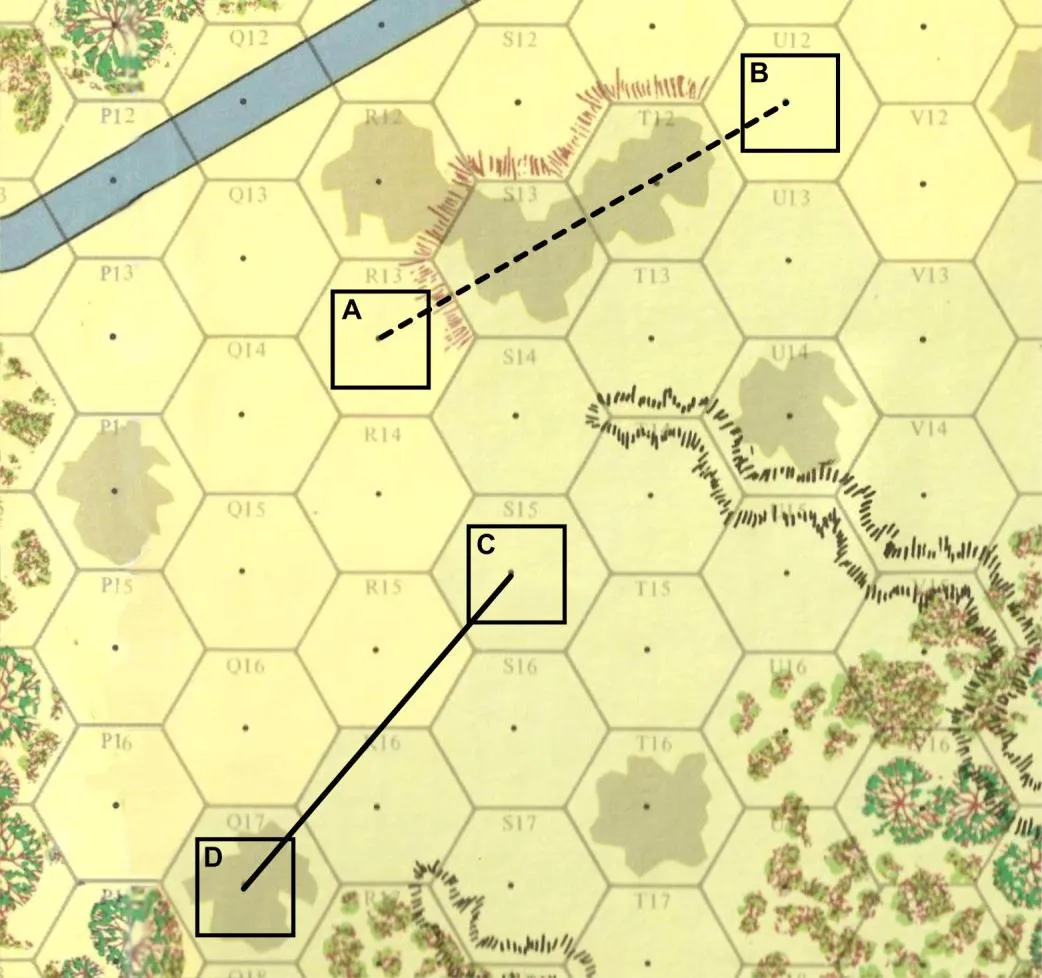
The rulebook’s first diagram: A to B is blocked because the hexes between them are higher than both; C to D is clear because everything between them is lower or level, with no blocking terrain (p. 18).
Elevation and crests
- Elevations 1 to 3 are colour-coded. A hex higher than both sighting hexes blocks. A slope itself does not block (p. 17).
- Embankment hexsides count as the higher of the two levels they border. Between hexes on the same level they do nothing. Between different levels, the embankment blocks if it is higher than the lower hex and not adjacent to the higher hex; adjacent to the higher hex, it does not block (p. 17).
- Crest hexsides always block (p. 18).
Woods, brush, rubble and rough
At the same elevation these hexes always block: you can see into one but not through it (p. 18). Between different elevations, such a hex blocks only if it is adjacent to the sighter or the target and at the same level as that hex; a lower adjacent hex is looked over.
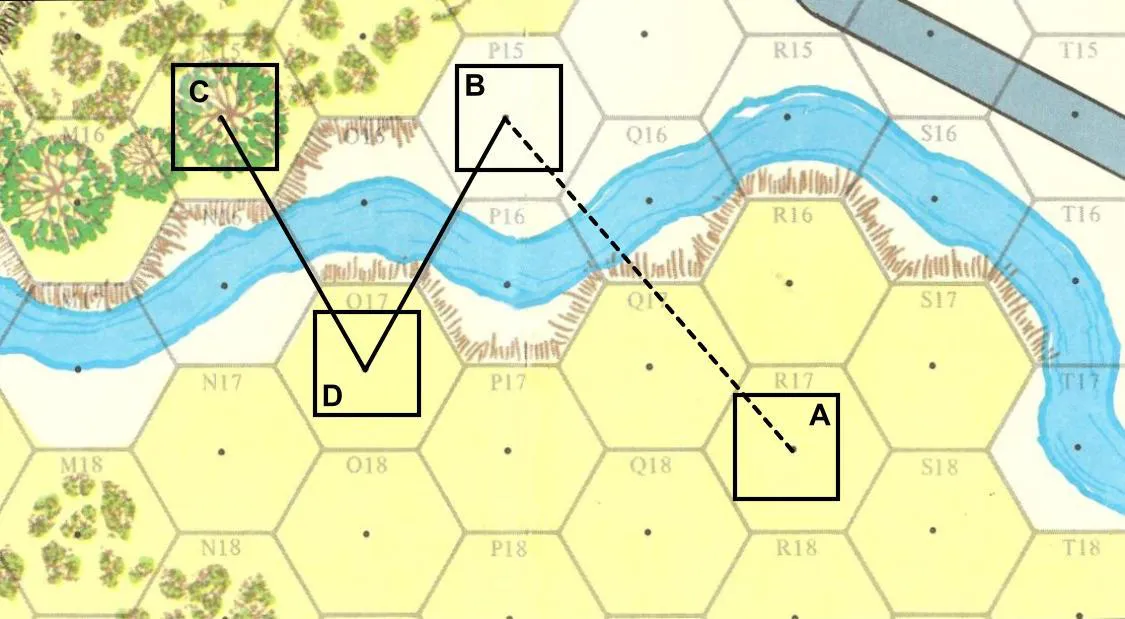
The embankment diagram (p. 19): A to B is blocked because the embankment at Q16/Q17 is higher than B and not adjacent to A; D to B is clear because the embankment is adjacent to D.
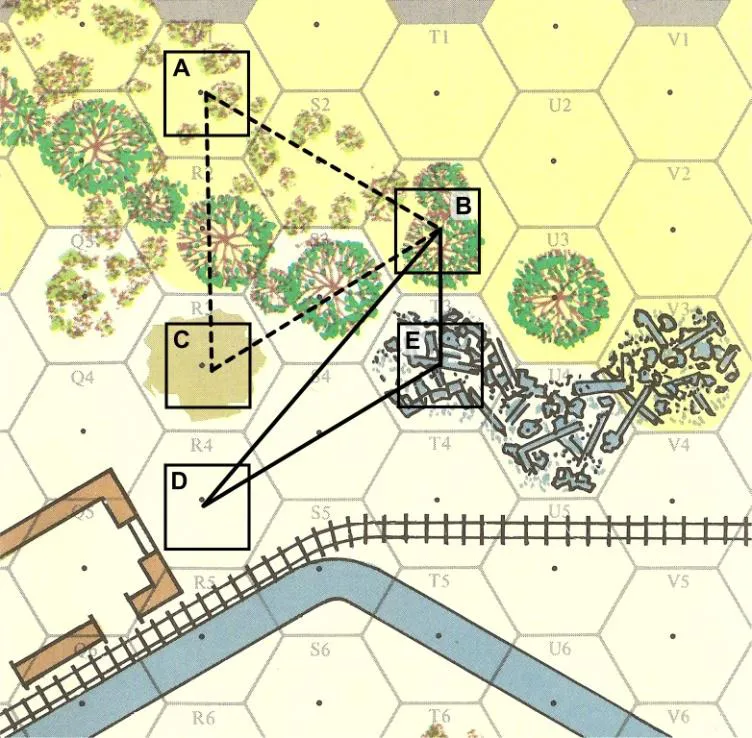
The village diagram (p. 20): brush at the same level blocks A to B; woods adjacent to and higher than C block A to C and B to C, while B to D passes over the woods; lines into a blocking hex, such as to E, are clear.
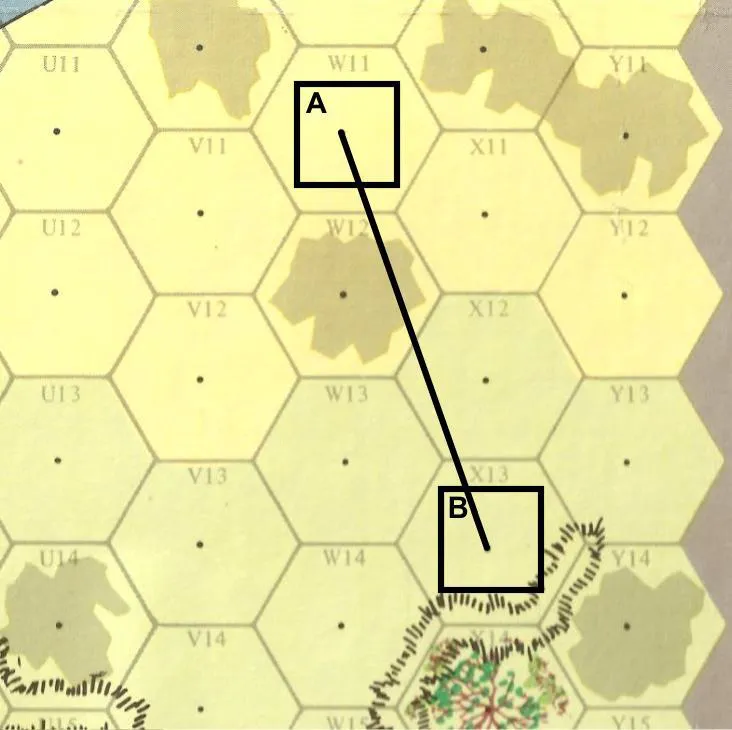
A simple slope does not block A to B; it would if the hexside were an embankment (p. 20).
Buildings and apertures
Buildings are seen into and out of only through apertures: doors and windows (p. 18).
| Situation | Rule |
|---|---|
| Prone inside | Never sees through a window, nor is seen through one; only sees an adjacent hex through a door. |
| Crouching at a window | Cannot see, nor be seen by, a crouching or prone soldier in the hex right outside that window. |
| Standing at a window, or any stance at a door | Sees the aperture’s whole field of view. |
| Non-adjacent aperture | A line may cross it only one hex deep. |
| Non-aperture hexside | No line of sight; fire may still penetrate the wall. |
| Through a building | Never at the same elevation as both hexes; between levels, blocked if the building is nearer the lower soldier or equidistant. |
| Two buildings | Both soldiers must be in each other’s field of view. |
The church steeple in S13 on Map B is two levels tall and blocks lines between Level 2 hexes (p. 18).
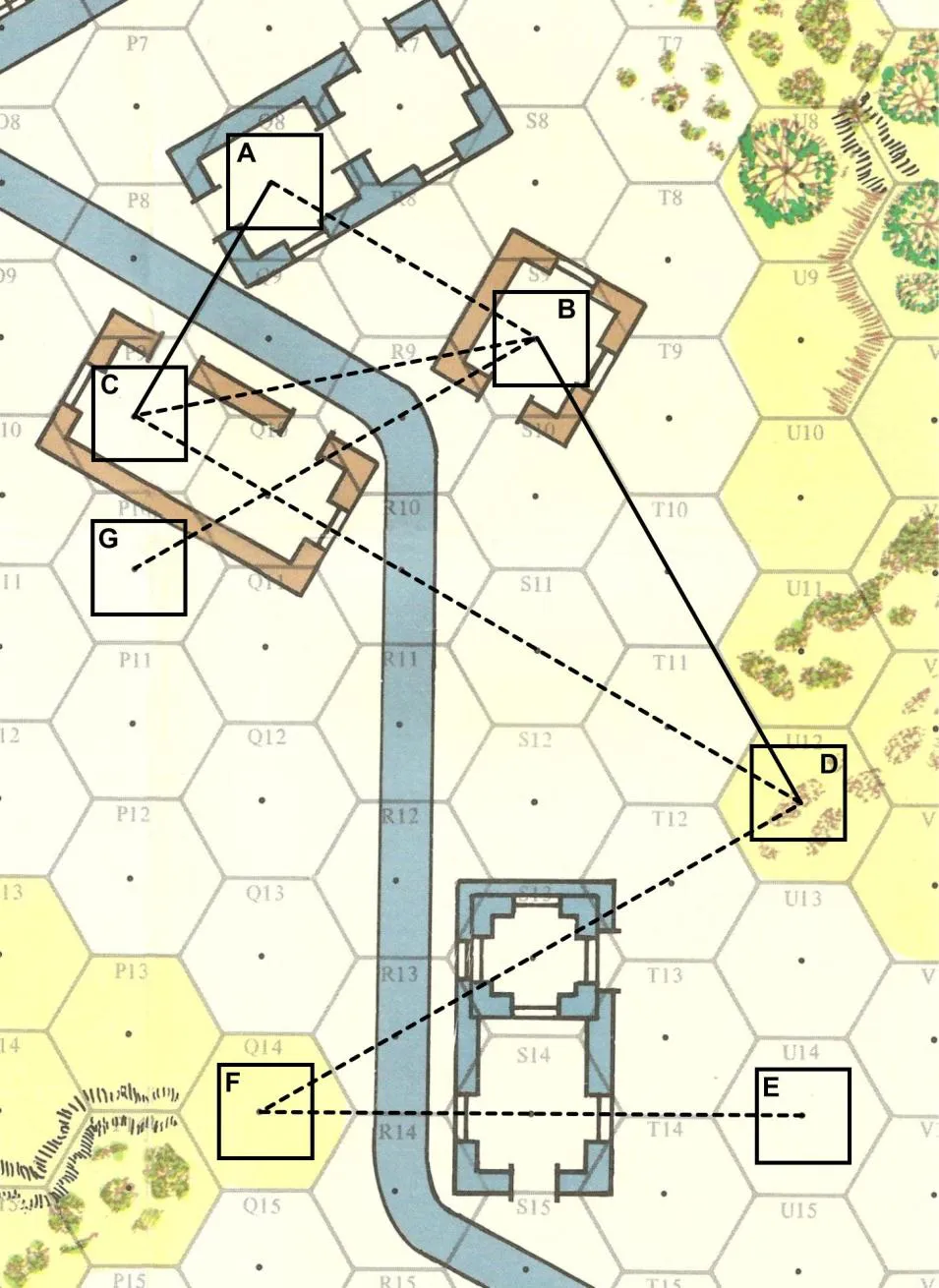
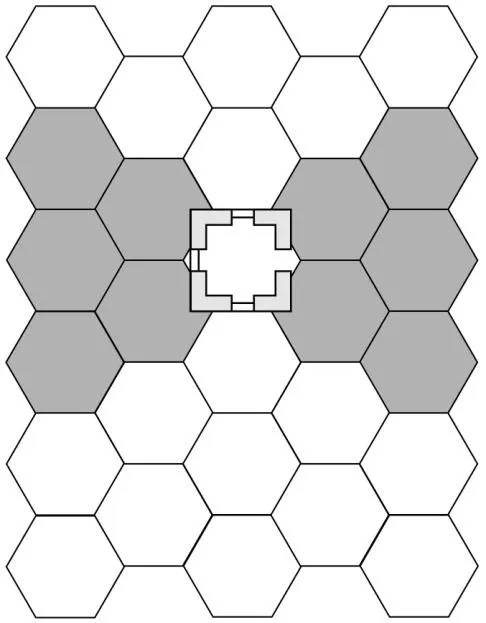
The shaded hexes are those a soldier inside the building can see through its apertures (p. 19).
Vehicles
Open or closed makes no difference to sight from a vehicle. From an adjacent vehicle, a soldier in a doorway hex is seen in any stance; a crouching soldier behind a window only from a large vehicle; a prone soldier behind a window never. Non-adjacent vehicles see like soldiers (p. 18).
Anything else
Soldiers, vehicles and all other terrain do not block, except landmarks a briefing or paragraph declares blocking. When the rules do not settle a case, the rulebook tells you to use common sense or a die roll (p. 18).