Grenades, Assault and Mines
Grenades and satchel charges, assault and capture, minefields and boobytraps in Ambush!.
Grenades
A standing or crouching soldier with a grenade may prepare and throw it as one action; a prone soldier cannot (rulebook p. 23). Grenades differ from fire in three ways: the target is a hex, not a soldier; the hex need not be in sight; and everyone in the hex is hit.
- Target hex: up to six hexes away standing, three crouching. Never the thrower’s own hex (except into a vehicle there), never through a wall without an aperture. Upstairs and downstairs in the church steeple count as adjacent.
- Range: adjacent uses the Adjacent base chance; otherwise count hexes to the target and read short, medium or long on the Weapon Chart.
- Hit chance: the base chance modified by the Grenade/Satchel Charge Combat Modifiers Chart only: −3 if the hex is not in sight, −2 for a wounded thrower (p. 23, 26). The target’s stance and terrain do not matter.
- Roll one die: at or below hits the hex; above, the grenade scatters. 0 always hits, 9 always misses.
- Damage: roll percentile dice; 05 or less is a dud. Otherwise roll once per soldier in the hex, friend or foe, on the Grenade row, Inside or Outside as the hex is. Some results are only panic for prone soldiers.
Cross off a grenade Ammo Box when thrown. A soldier can never move and throw in the same turn (p. 14).
Grenade Strike check
When a grenade or satchel charge lands, every aware soldier in the hex who is not in a vehicle makes a Perception Check (p. 23). A standing or crouching soldier who succeeds and still has a turn this Round may spend it to toss the grenade clear; an unwounded soldier who succeeds with no turn left may drop prone for free. Failure, unawareness or panic means no reaction. Germans make this check too.
Scatter
A missed grenade lands in a hex chosen on the scatter diagram: Diagram A normally, Diagram B when the line from thrower to target runs exactly between the two hexes adjacent to the target (p. 23). Roll one die and read the hex; a throw from an adjacent hex still lands in the target on 6–9. The grenade explodes where it lands.
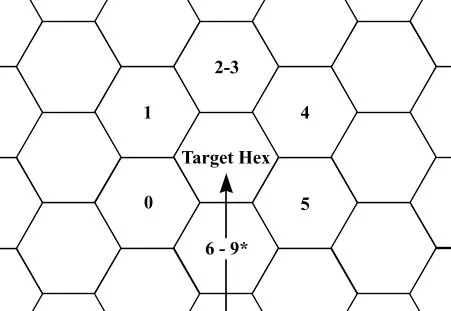
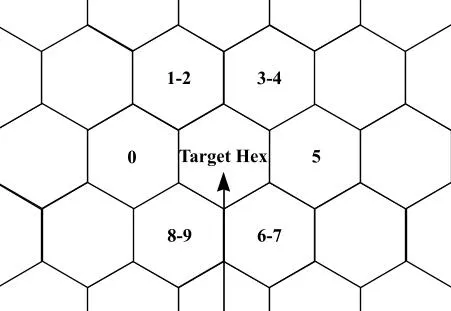
A grenade thrown through an adjacent aperture always ends up inside the building. A scatter that would cross a wall without an aperture bounces back to the nearest hex towards the thrower; grenades never scatter through a window or back into the thrower’s hex, but may through a door (p. 24).
Satchel charges
A satchel charge is a large grenade with these differences (p. 24): it fills a Port Box, must be prepared first (and stays prepared while carried), is thrown only standing and at most three hexes, and is more destructive. Instead of throwing it, a soldier may place it with one action and set a delay of 1 to 4 turns; it explodes at the start of that turn without scattering.
Assault
A standing soldier in the same hex as an enemy may assault him; from another hex he uses Move/Charge Assault, spending at most half his (rounded down) to enter first, at −3 (p. 24–25). Assault uses no ammunition and targets one soldier. You cannot assault into a tank or Jagdpanther; a target in a wheeled vehicle must be reached by entering it for one Movement Point.
- Target: your choice. A German must assault the US soldier in the worst stance: prone or wounded first, then crouching or standing, ties at random.
- Capture or kill: your choice; Germans always kill.
- Hit chance: the fixed base chance on the Weapons Chart, plus the attacker’s , minus the defender’s if it is +1 or +2 and he is neither panicked, wounded nor unaware; −2 if the attacker is wounded; −3 for a charge; −1 with only a captured weapon (p. 25).
- Roll one die: at or below hits; 0 always, 9 never.
- Damage: roll on the Kill or Capture row of the Assault Table. Some results become captures when the target is prone or wounded.
An unaware soldier who is assaulted becomes aware afterwards (p. 25).
Minefields and boobytraps
A paragraph may reveal that a hex holds a boobytrap: the first US soldier in (highest in a group) makes a Perception Check. Success disarms it; failure explodes it on everyone in the hex, each rolling as if hit by a grenade indoors. Either way, place the marker: the trap is gone (p. 25).
A minefield is permanent: place the marker, and every US soldier who enters, now or later, makes his own Perception Check; each failure hurts only that soldier, as a grenade indoors (p. 25). Vehicles have their own mine rules; see Vehicles.