Gameplay
Ada’s Dream turn structure, Partner cards, Assignments, Research, resources, Innovation and discs.
Overview
You are assistants competing to build the best section of Babbage’s Analytical Engine for Ada Lovelace. The game is a series of single turns, starting with the first player and going clockwise — usually 18 turns each. When a player places their 9th die in the Mill of their Player board, play continues until everyone has had the same number of turns, then all Prestige  is scored on the scorepad (End and Final Scoring).
Your turn
On your turn choose one of two turn types:
- a Workshop turn — take a die from the Workshop into your Store (only if your Store has an empty slot);
- an Actions turn — move a die from your Store into your Mill and take the action of its colour.
At the end of the turn you may either spend a Book to take the Publish action of the area you used, or build one Gear — or neither. Then the next player clockwise takes a turn.
Displays
The Programs and Assignments in Ada’s Study and the Partner cards in the Meetings area are displays that move from left to right.
- When you take the main action of that area, the item in the rightmost space (if any) leaves the game after you choose, the rest slide right and the empty spaces on the left are refilled. This happens once per action, however many rewards you take.
- When any other effect lets you take an item from a display, just slide the rest right and refill; nothing is removed.
Partner cards
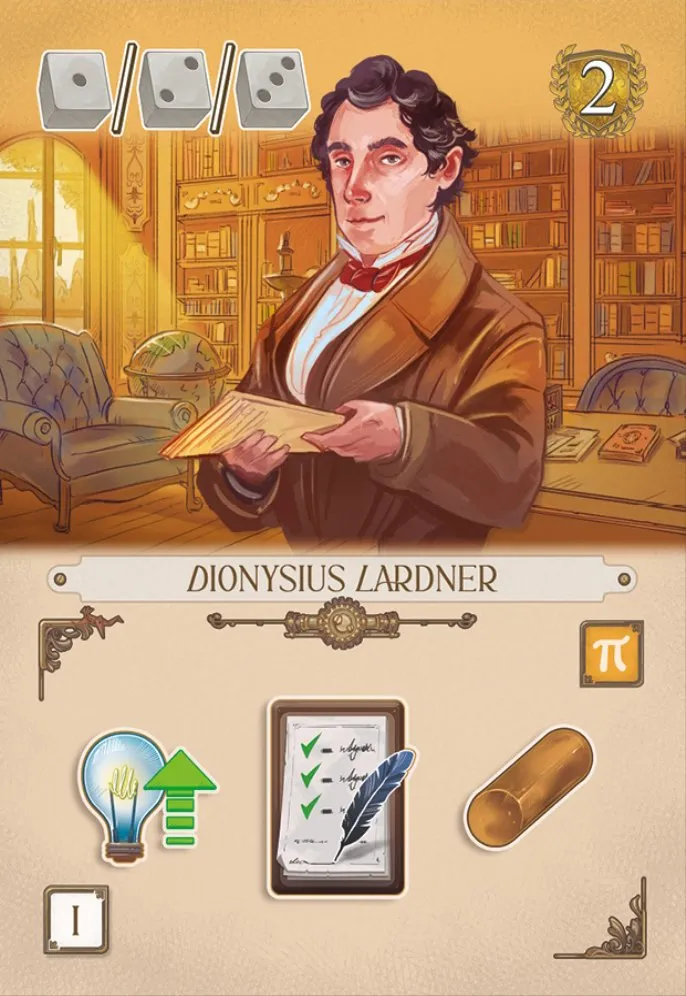
Partner cards are the people of the time. Each belongs to one of four Sciences —  Mathematics,
 Physics,
 Astronomy,
 Engineering — or has no Science (a Sponsor).
- Name and picture.
- Requirement or cost (top left). Dice faces: on a Workshop turn you may play it only if the die you collected shows one of those values.
 lower the active die by 1 (not possible with a 1).
 pay £ equal to the active die.
- Science icon (right).
- Prestige (top right), scored at the end.
- Effect (bottom). Do as much of it as you can; an effect that needs a payment gives nothing if you do not pay.
Your supply is always exactly eight cards (deck above the right of your board, hand, and discard pile to the left of the deck). Whenever you gain a new Partner card, remove one card of your hand or discard pile from the game. If you must draw and your deck is empty, shuffle your discard pile into a new deck. At the end of your turn discard down to five cards in hand.
You play Partner cards from your hand: one on a Workshop turn if your active die meets its requirement, or whenever an effect shows  (then you ignore the requirement and cost). A played card goes to your discard pile after you resolve it.
Assignment cards
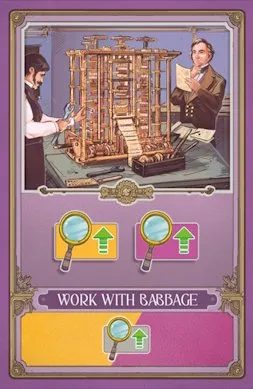
Assignments are tasks from Ada. When you gain one, take its effect, then tuck it into the matching colour column below your Player board. A two-colour card goes in either column; a card with no colour goes in any column — the effect and the column are chosen separately. Some Assignments ask you to discard Partner cards from hand; if you cannot, you cannot take that Assignment.
When you collect a coloured die on a Workshop turn, gain 1 Research of that colour for each Assignment in that colour’s column. Grey dice trigger nothing.
Research
Each action area has a Research track and you have a token at the bottom of each.
- Breakthroughs — when your token reaches or passes a space marked !, gain the reward printed there (or on the Breakthrough token placed near the top of the track). There are three such spaces on each track.
- Advanced actions — two of the ! spaces are marked I and II. Once your token has reached a level, you take that area’s advanced action after its main action on every Actions turn there (advanced actions). Reaching a level during a Workshop turn gives the Breakthrough at once, but the advanced action only on a later Actions turn.
- Top of the track — take the top Assignment Scoring token of that colour: the first player takes the 2-point token, later players a 1-point one. You may hold only one token per colour. At the end each token scores its value × your Assignments in that colour’s column.
- A full track takes no more Research: if you could choose, choose another track; if the Research was for that colour only (an Assignment, a coloured reward), it is lost.
Resources and Innovation
The resources are  money,
 Coal,
 Brass and
 Books. You may hold any amount; a cost must be paid in exactly that resource. The supply is unlimited — use a substitute if something runs out.
 Innovation is tracked on your Player board (0 to 6). Gain moves the marker up, spending moves it down. You can never have more than 6. Whenever the marker reaches the top space, you may at once spend 2 Innovation to gain one Workshop bonus of your choice; if you gain several Innovation, decide each time you reach 6. At the end, a marker on the space for 5 scores 2 and on 6 scores 4 .
Discs
Many actions place one of your discs on the main board. Take it from a Gear space of your Player board — each disc you remove opens a space where you can build a Gear. If you must place a disc and have none left on your board, move one of your discs already on the main board (not one that is meeting the requirement of an Objective you are about to claim).
Reference numbers
Some components and board spaces carry a small reference number. The solo rules and the appendix (Universities, Small Cities, Institutions, Partner cards, Assignments) use these numbers — see Cards & Components.