Teach the Game
A script to teach 18 India at the table — how you win, the map and market boards, the Stock Round / Operating Round rhythm, why trains never rust, the end, every way to make money and what each piece is for.
How you win
“India, the railway boom of the 1800s. We are investors: we buy shares in railway Companies, and whoever owns the most of a Company runs it — builds track and stations, buys trains and decides whether to pay dividends. About three hours. At the end, the richest player — cash plus the value of their shares — wins.”
You need money and valuable shares. You get them by:
- owning shares in Companies that pay dividends (each pay-out also raises the share price);
- running Companies well so their price climbs — and buying their shares cheaply first;
- Private Company and Royal Bond income.
The loop: one Stock Round (sell once, then buy in turn) followed by two Operating Rounds (every floated Company lays track, places a station, runs its trains and pays or withholds), again and again until the bank runs out or a share reaches ₹400.
What makes 18 India different from other 18xx games: you draft secret stock options at the start, shares are bought from your hand, from three IPO rows or the Open Market, trains never rust, and all tile colours are available from the start.
The boards
The map
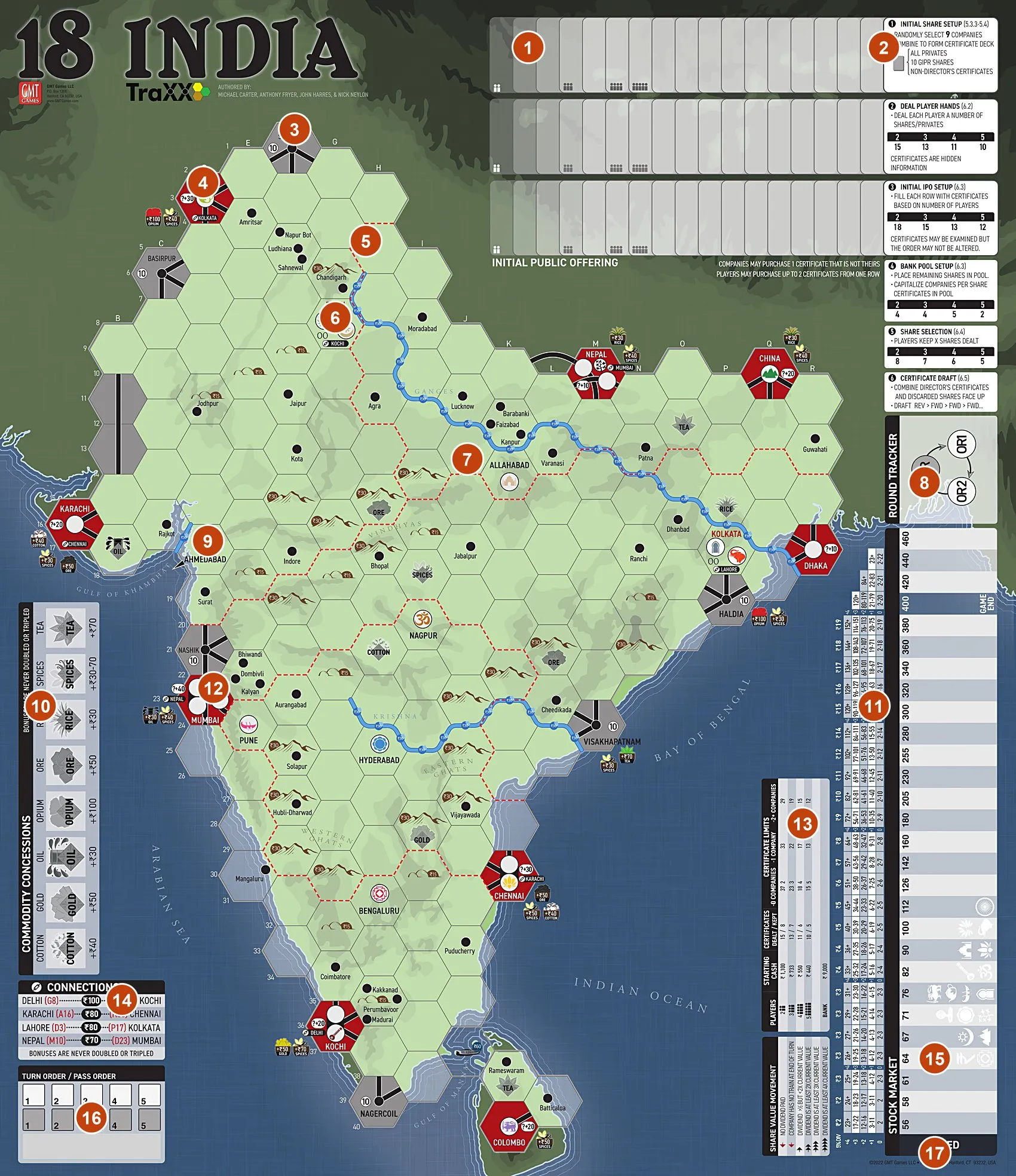
- Initial Public Offering — three rows of certificates, bought from the top only.
- Setup reminders — deal, keep and draft numbers per player count.
- Pre-printed gray hexes — fixed track; never upgraded.
- Red off-board cities — Lahore, Karachi, Nepal, China and others: high revenue, some variable.
- Gauge change lines — dashed red lines; crossing them adds a ₹0 stop.
- OO city (Delhi) — two separate stations in one hex.
- Commodity sources — Opium, Ore, Tea…; deliver them for a concession bonus.
- Round tracker — SR, OR1, OR2.
- Home locations — each Company’s logo marks its home city.
- Commodity concessions — the markers and their bonuses.
- Payout chart — how far a dividend moves the share price.
- Mumbai — two stations, but one stop for a train.
- Certificate limits — by player count and closed Companies.
- Connections — route bonuses between two named cities.
- Stock Market — one row of share prices, ₹56 to ₹460; operating order.
- Turn order / pass order — first to pass acts first next Stock Round.
- Closed — a Company whose price drops here closes.
The market board
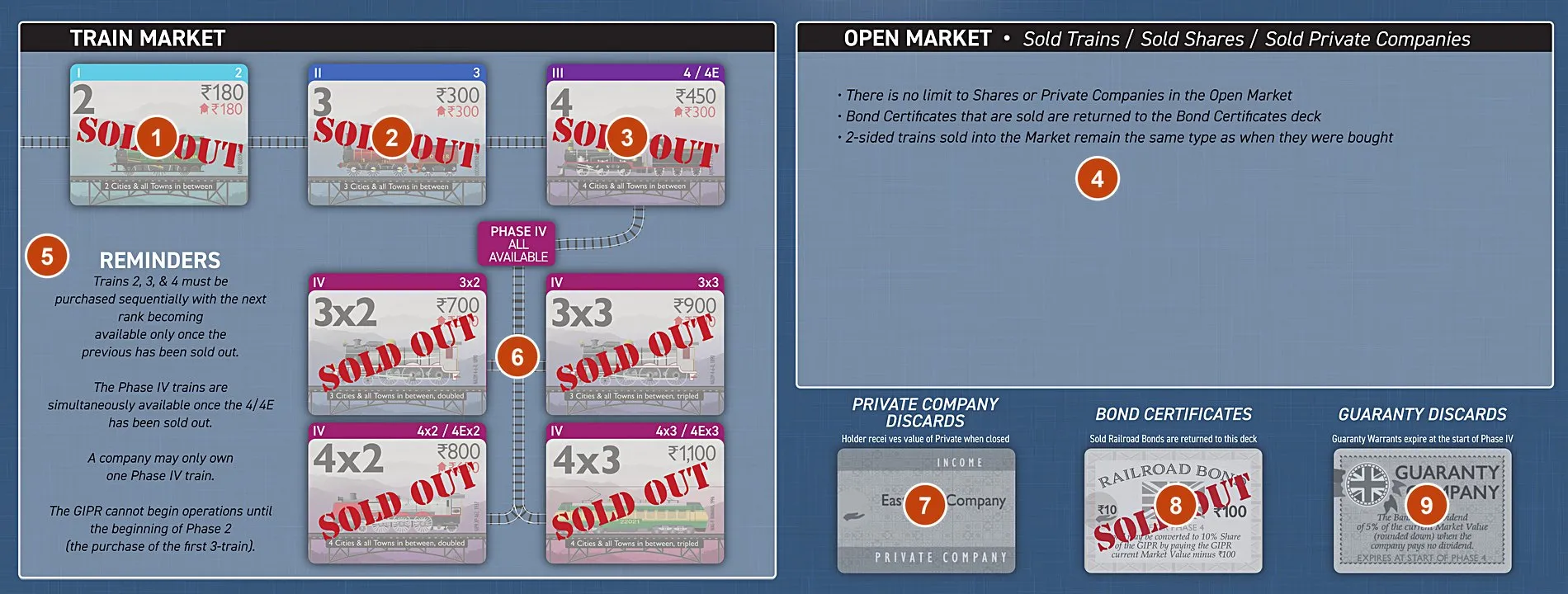
- 2-trains — Phase I.
- 3-trains — the first one starts Phase II.
- 4 / 4E-trains — Phase III.
- Open Market — sold shares, trains and Private Companies.
- Reminders — train order and the one-Phase-IV-train limit.
- Phase IV trains — 3×2, 3×3, 4×2/4E×2, 4×3/4E×3, all at once.
- Private Company discards.
- Royal Bonds — sold bonds come back here.
- Guaranty discards — warrants expire at Phase IV.
A round
The full rules are in Sequence and Phases.
- Stock Round — in pass order, each player gets one selling turn (the only chance to sell this round). Then, in turn order, each turn: one purchase — any number of matching certificates from your hand, the top 1–2 of one IPO row (from the second Stock Round), one Open Market share, one Royal Bond, or (Phase IV) a bond conversion — or pass. Ends when all pass.
- Operating Round ×2 — Private and Bond income; then each Company, highest share price first:
How the game ends
At the end of the Operating Round in which a share price reaches ₹400, or at the end of the set of Operating Rounds in which the bank (₹9,000) breaks. Each Company’s final share value is its market price plus 10% of its assets (trains, cash, shares, bonds, privates). Richest player wins (details).
Ways to score
| Source | How and when |
|---|---|
| Dividends | Each OR a Company pays, every 10% share earns a tenth of its revenue |
| Share price rises | Paying at least half the price moves it up 1–4 steps; your shares are worth more |
| Selling shares | At market price, only in your selling turn |
| Private Company income | ₹5–25 every Operating Round; get its face value back when used or sold |
| Royal Bond income | ₹10 every Operating Round; convertible to GIPR shares in Phase IV |
| Guaranty dividend | A Guaranty Company that does not pay still pays 5% of its price (until Phase IV) |
| Company assets | At the end, +10% of each Company’s assets per share |
| Losses | Withholding or no train: price drops; a trainless Company drops twice; at “Closed” the Company is gone |
What each resource is for
| Piece | Why you need it | How you get it | How you use it |
|---|---|---|---|
| Money (₹) | Buying shares | Start, dividends, income, selling | Pay into Company treasuries or the bank |
| Hand of certificates | Exclusive stock options | Deal, keep and draft at the start | Buy them whenever you like, at face value |
| Director’s Certificate | Control of a Company (20%) | Draft | Floats the Company at once |
| 10% shares | Dividends, control | Hand, IPO, Open Market | Three in play float a Managed Company |
| Company treasury | Track, stations, trains | Share purchases, withheld revenue | Spent only by the Company — never by players |
| Station tokens | Right of way, route start | Charter (home free, then ₹40, ₹100) | One per Operating Round |
| Track tiles | Routes | Supply | Up to 4 yellow or 1 upgrade per OR |
| Trains | Revenue | Bank, Open Market, other Companies | Max 2, only one Phase IV train; never rust |
| Private Companies | Income and one special ability | Hand, IPO, Open Market | Use once (then refunded) or sell back |
| Royal Bonds | ₹10 income, GIPR shares later | Buy for ₹100 | Convert in Phase IV |
| Commodity concessions | A permanent route bonus | First delivery | Every later delivery by that Company |
Teaching tips
-
Rehearse the operation in order: trains run before new trains are bought, using only Company money (rehearsal).
-
Start with the certificate draft — it is the most unusual part, and the decisions there shape the whole game: aim for about 4 options in one Company.
-
Say clearly: players never put their own money into a Company, and trains never rust — there is no forced train purchase.
-
Explain Managed Companies: three 10% shares in play float a Company even without its Director.
-
Teach the payout chart on the map: it saves all the arithmetic of price movement.