Your Turn
Paragliders turn by turn: your pilot on the map and the Altitude Track, taking off, normal moves and hard turns, altitude, acceleration, Skill Move cards and the flying rules.
Game round and time marker
Players take turns clockwise from the first player. After the last player’s turn they move the Time Marker one space (20 minutes) and, on a new hour, update the weather (Weather change). The first player checks it was moved before starting the next round — give the last seat to the player who knows the game best.
Rounds go on until every pilot has landed or the time marker reaches the end of the track (20:00).
Your paraglider
Your pilot has two halves: the pawn on the map (where you are) and the Altitude Marker on the Altitude Track (how high above the ground). Together they place you in the sky.
- Direction: the chevron on the pawn’s wing points forward. Keep the pawn’s base lined up with the hexagons so it clearly faces one neighbour.
- Altitude: you start on the mountaintop. When your marker reaches the bottom of the track, you have landed — ideally at the end of the day, after all three antennas.
The Altitude Track pieces have an easy side and a difficult side (marked ”!”): the difficult side lowers the mountain, so the mountaintop is nearer the ground.
Taking off
You start with the pawn in your hand. On any turn you may put it on one of the two take-off hexagons in the centre of the map and make your first move — or skip your turn and take off later, for example to follow exactly the path of a pilot ahead of you. Once in the air, you must move every turn until you land.
Move your paraglider
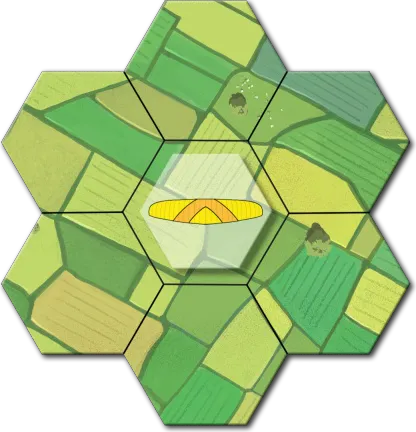
Each turn you must move to an adjacent hexagon; staying put is not allowed. Turn in steps so the pawn always lines up with the hexagon under it, and after moving keep your back to the hexagon you came from.
- Normal move: straight ahead, or turn one step left or right, then move forward.
- Hard turn: turn two steps left or right, then move forward — and lose 1 altitude.
- Never move to the hexagon behind you.
Rotating first on your own hexagon, then moving straight ahead, avoids mistakes.
Adjust your altitude
On the hexagon you reached, add up: the hard-turn penalty (if any) and the four weather modifiers of that hexagon — thermal value, sun, wind and clouds. Move your Altitude Marker by the total.
Accelerate
After adjusting altitude you may accelerate: lose 2 altitude and move one more hexagon straight ahead, without turning. The weather of this second hexagon is ignored.
Skill Move cards
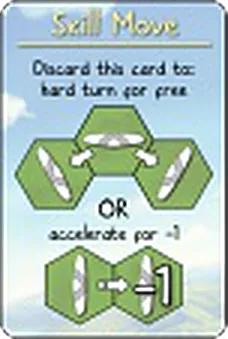
Players later in turn order get Skill Move cards at setup (2nd and 3rd player one each, later players two). Each is single use, played on your turn: discard it to make a hard turn for free, or to accelerate for only 1 altitude. You may play two in one turn (one for each).
Flying rules
- No collisions: you cannot end a move on the same hexagon and at the same altitude as another pilot. If that would happen, accelerate; if you already have, undo and move another way. If no way is left, you are crash-landed.
- Mountains are walls unless your altitude is at least the mountaintop before you move onto them. A gain you would get on a mountain hexagon only counts if you could enter it.
- Over a mountain you may never end below the mountaintop: no hard turn, acceleration or resisting the wind that would take you lower.
- Crash landing: touching the ground in a forest or a lake, or being trapped in a dead end between
mountains, costs 10
 at once (move your score marker back). You may take off again
(Landing prematurely).
- Losing more altitude than you need to reach the ground is fine.
- Cloud level is the ceiling: extra gains there are lost.
- The three weather hexagons printed on Map Edge A are not part of the map: you cannot fly over them and they are ignored when counting distance to the edge.