Teach the Game
A London trade game of workers, goods, bells and export contracts.
How you win
“London’s churches ring out as we grow from carrying one good by hand to running a trading business.” Across roughly twelve turns, place workers at numbered locations, gather goods and money, then turn them into transport, loans, shares, bells and completed cargoes. The player with the most points after the final cargoes are gone wins.
The board
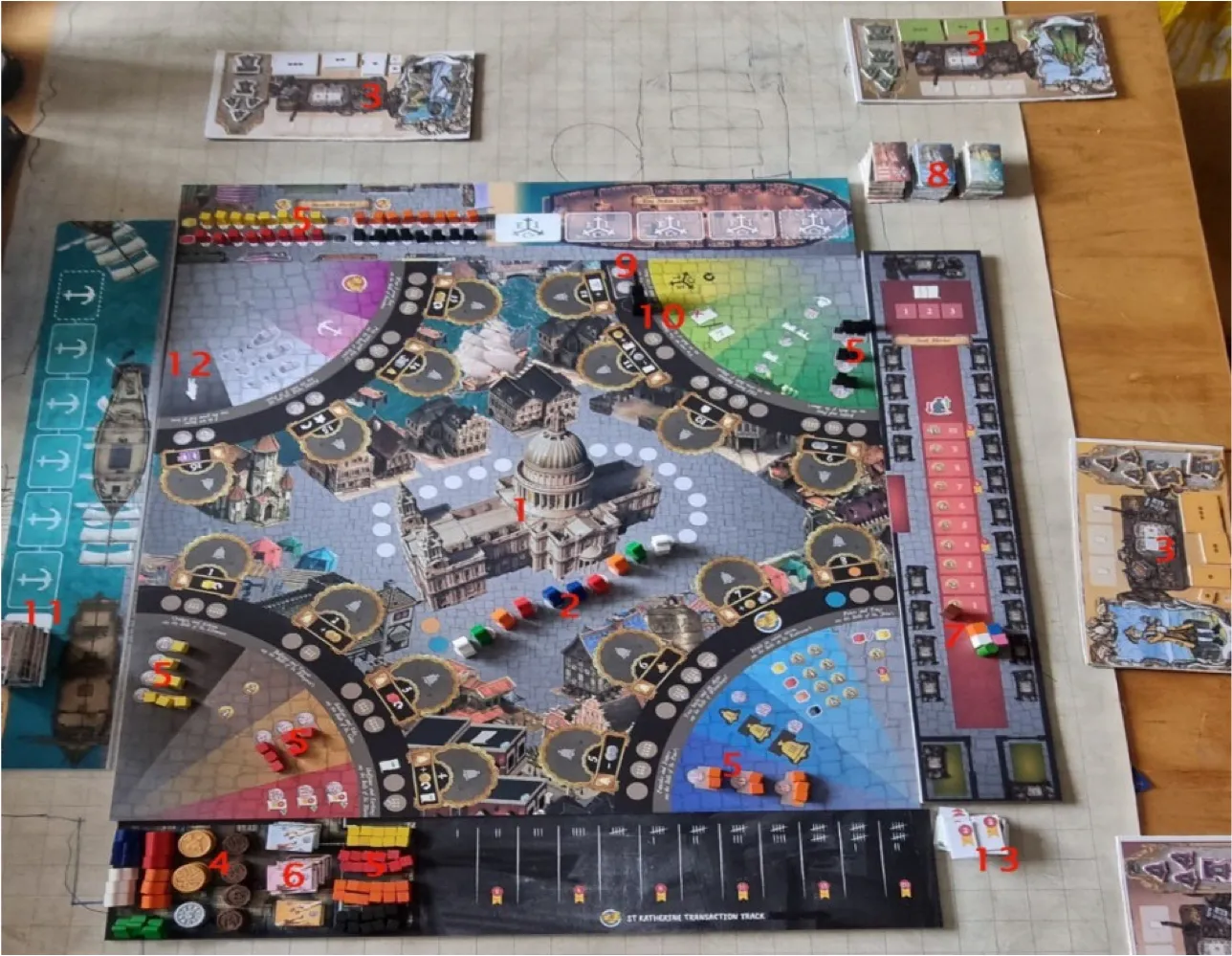
The sixteen locations form the action loop around the main board. Alongside them are the East India Company docks, Stepney cargo berths, Shoreditch market, share-price track, loan office, transaction track and worker-order track. Each player board tracks storage, transport upgrades, workers and bells.
A turn
- In worker order, place your available workers on open spaces. Some spaces require payment; pay when you place.
- Resolve locations 1 through 16. Within a location, resolve workers from left to right. Location 12 always runs its ship and share-price procedure, even when no worker is there.
- Return resolved workers to the order track. Refill the four resource locations, receive bell and loan income, clear ship goods into storage or market, then refresh cargoes.
See Turn and Locations for the full location list and timing.
How the game ends
When the cargo stack runs out, finish the turn in which the final cargo is drawn, then score. If any cargo remains in the stack after a refill, play another turn. A typical game lasts about twelve turns.
Ways to score
| Score source | What counts |
|---|---|
| Votes, loans, cash, shares, cargo, bells and goods | Add their printed or rules-defined values. |
| Storage and transport | Score the revealed upgrade values; the ship also gives income during play. |
| Transaction track | Score the space reached. |
| Category majorities | Earn first/second bonuses in eight end-game comparisons. |
The scoring page gives the categories, ties and share decision.
What each resource is for
| Piece or resource | Why it matters | How you use it |
|---|---|---|
| Gold | Pays for upgrades, bells, loans and investments; also scores at game end. | Earn it from actions, sales, loans and ships. |
| Goods | Fill export contracts, recruit workers and score if left in storage. | Buy, trade, receive from ships or earn from cargoes. |
| Workers | Give you access to locations. | Place in order; recruit more at St Paul’s. |
| Bells | Score points and grant a location power. | Buy in level order at Whitechapel and place at another location. |
| Shares and ship tiles | Shares change in value as ships arrive; ships can grant goods or income. | Buy/sell shares at St Helen’s and invest at Old Bailey. |
| Cargoes and votes | Provide points and contest end-game majorities. | Complete contracts at Stepney; draw votes at Bow. |
Teaching tips
- Explain that worker placement happens first, then every location activates in number order.
- Stress the one-cube starting capacity and the need to plan a route from goods to a cargo or sale.
- Show how a bell grants both printed points and a lasting location bonus.
- Remind players that the Old Bailey ship procedure changes the share price every turn, even without a worker there.