A Turn
Opera Magna's game flow: move a Merchant, change a City's Trade Cards, pay its Cost and take its Profit, then refill your Buildings and buy a Trade Card from the Market.
Game flow
A game lasts 9 rounds. The first player starts and play goes clockwise; the order never changes. On your turn you play four phases, in order:
- Merchant — move one Merchant and change one City Area’s Trade Cards.
- City Activation — pay that City’s Cost, take its Profit.
- Refined Goods — build, send Goods to the Opera, convert.
- End of Turn — refill your Buildings, take a Trade Card from the Market.
The Market decks are the clock: when the last Trade Card is revealed, the last round begins.
The City boards
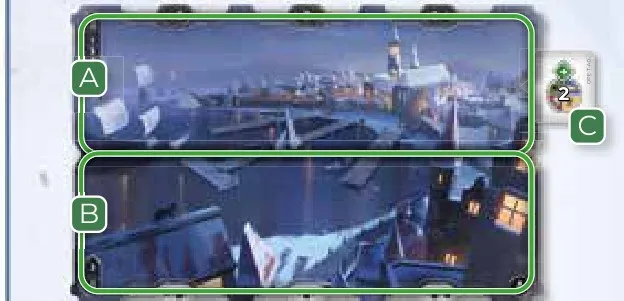
- A Cost Area — the upper row of three Trade Cards: what you pay to activate the City.
- B Profit Area — the lower row of three Trade Cards: what you gain.
- C City Power token — linked to the Cost Area.
Each Trade Card is tucked under the board so that only half shows: its upper (cost) half in the Cost Area, its lower (profit) half in the Profit Area. Every card has both halves, so the same card can be a price or a reward depending on where it is played.
Merchant phase
Moving a Merchant
Move one of your three Merchants to an Area (Cost or Profit) of any City, as long as that Area does not already hold one of your Merchants. Moving between the two Areas of the same City is allowed.
Updating the Trade Cards
Then change the three Trade Cards of the Area you moved into:
- Slide them all one space to the left; the leftmost card is discarded.
- Put a Trade Card from your hand in the empty rightmost space, the right way round for that Area.
So you always change a City before you use it: the card you play can lower its price or improve its reward — or spoil it for the next player.
City Activation phase
You now activate the City where you just moved — whichever Area your Merchant entered.
Pay the cost
Pay every Raw Good shown on the three cards of the Cost Area, on your Shop Board: move that Good’s token one space left per icon.
- Discounts first. Your Shop Board has a starting discount of 1 on one Raw Good, and every Building on the left of your board adds its own. Discounts add up.
- Missing Goods. For each Raw Good you cannot pay (its token is already on 0), move that Good’s Certificate one space left instead.
Certificates and Victory Points as payment
A Certificate can never move left of column 3. If you still owe a Good after that, lose 1  for each step you cannot make. You never drop below 1 point: stop at 1 and the payment still
counts as made.
City Power
If the Merchant that activated the City stands in its Cost Area, you may use that City’s Power token once this turn, at any moment after paying the Cost. The six tokens are listed in Cards & Components.
Obtain the profit
Gain every Good shown on the three cards of the Profit Area:
 Raw Goods — move that token one space
right per icon, pushing the Certificate ahead of it if it is in the way.
 Refined Goods — put one of your Player
Tokens on that Good’s space on your Shop Board. Refined Goods last only for this turn: use them
in the Refined Goods phase.
End of Turn phase
Unless it is the last round, do these two steps.
Replenish buildings
If you have fewer than 2 Buildings under construction, take face-up Building Cards from the Opera Board until you have 2 again. Each time you take one, reveal a replacement from the same deck so that 2 Small, 2 Medium and 2 Large are always on offer. If that deck is empty, reveal from the next larger deck; if that is not possible, from the nearest smaller one that still has cards.
Draw a Trade Card
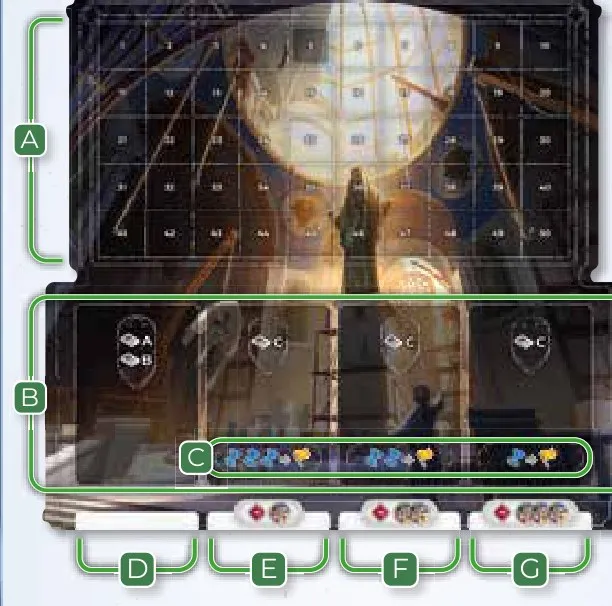
- A Victory Points track — everyone starts on 5.
- B Trade Card decks — B under A on the first space, then C split into three piles.
- C Remaining rounds — the icons count down to the end.
- D Free space — the leftmost card costs nothing.
- E 1 Raw Good, F 2 Raw Goods, G 3 Raw Goods — the price of the card above, in Goods of any type.
Take one of the four Market cards into your hand, paying its space’s price in Raw Goods. No discounts apply, and you cannot pay with Certificates or points. If you cannot or will not pay, take the free leftmost card — it is always available.
Market supplies
The cards to the right of the one you took slide left, and the empty 3-Goods space gets a new card from the leftmost deck that still has cards. When a deck runs out, draw from the next one.
The last round
When the last Trade Card of the last deck is revealed onto the Market, the last round is triggered. The decks are sized for every player count so that this happens on the last turn of round 8, making round 9 the last round. In the last round nobody draws new Trade Cards or Building Cards. The game ends after the last player’s turn; then score.