Teach the Game
A script to read aloud: how you win Opera Magna, the boards, a turn, the end, every way to score and what each Good is for.
How you win
“We are Renaissance workshop masters supplying the building of Florence’s cathedral. Over 9 rounds we send Merchants to Venice, Constantinople and Antwerp to buy raw materials, refine them in our workshops, build Buildings that improve our shop, and send the finished goods to the cathedral’s Worksites. Most points wins — about an hour.”
- You need: completed Buildings in many positions of your Shop Board, high Certificates, and tokens on the Opera’s Worksites — more of them than your rivals.
- You get them by: playing a Trade Card into a City to change its price or reward, paying its Cost in Raw Goods, taking its Profit, and spending the Refined Goods at once on Buildings or the Opera.
The boards
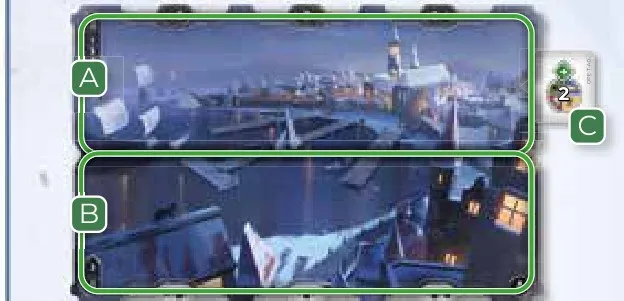
- A Cost Area — three cards: what activating this City costs.
- B Profit Area — three cards: what it gives.
- C City Power — a bonus for the player whose Merchant activates from the Cost Area.
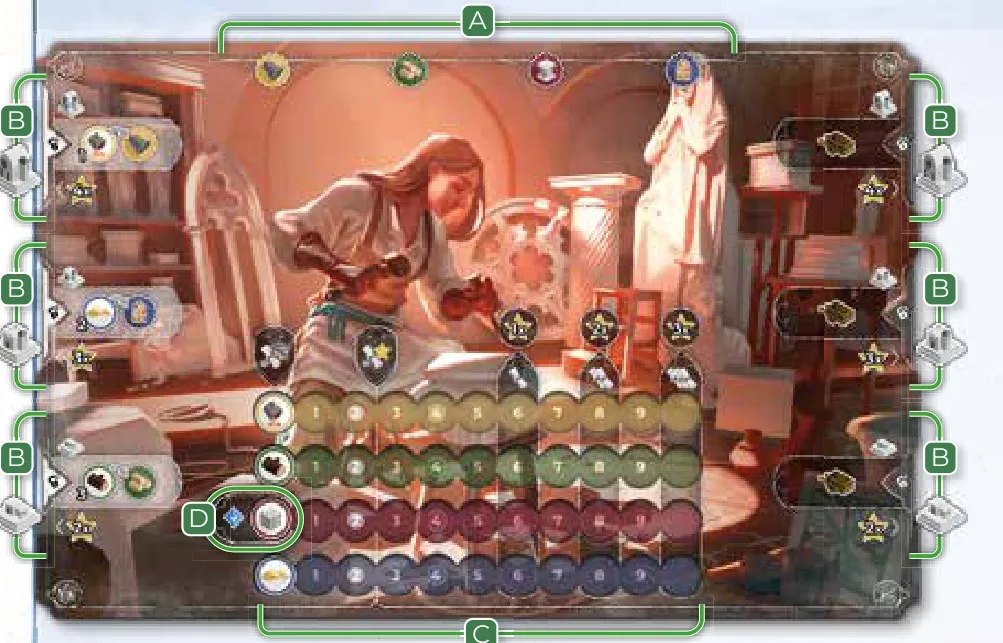
- A Refined Goods — what you have this turn only.
- B Building positions — left for discounts and Conversions, right for effects and Carts.
- C Goods and Certificate tracks — your Raw Goods (0–9) push your Certificates up.
- D Starting discount — different on every board.
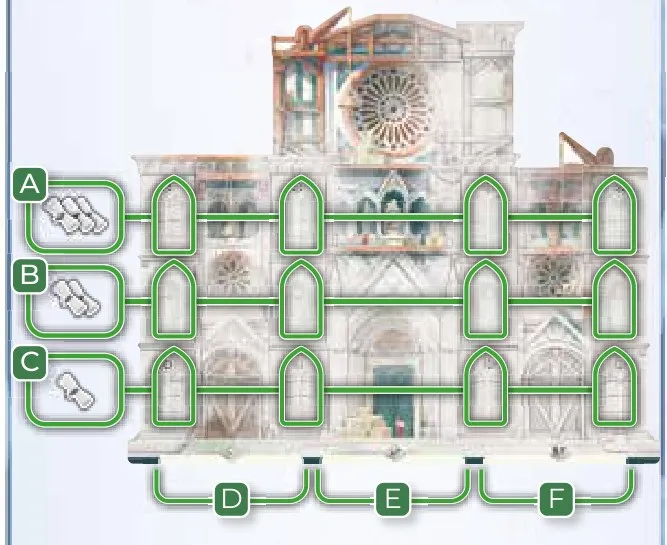
- A–C Worksites — levels 3, 2 and 1; fill a column from the bottom.
- D–F Building decks — Small, Medium and Large, two of each face up.
The Market Board (details) holds the score track and the Trade Cards you buy at the end of your turn; its decks are the game’s clock.
A turn
Everyone takes one turn per round, in a fixed order (full rules):
- Merchant — move one of your 3 Merchants to a City Area without one of yours; slide that Area’s cards left (the leftmost is discarded) and add a card from your hand on the right.
- City Activation — pay every Raw Good in the City’s Cost Area (discounts first; missing Goods cost Certificate steps, then points), use the City Power if you are in the Cost Area, then take every Good in the Profit Area.
- Refined Goods — use them now or lose them: put them on your Buildings, send one per Cart to the Opera, or convert them back to Raw Goods.
- End of Turn — refill to 2 Buildings under construction, then buy one Market card into your hand (the leftmost is free).
How the game ends
- When the last Market card is revealed, the next round (the 9th) is the last; nobody draws cards in it (details).
- Then add the eight scoring boxes (final scoring).
- Ties: most tokens sent to Worksites, then higher-level Worksites, then most Raw Goods.
Ways to score
| Source | How and when |
|---|---|
 Effects | During the game: City Power, Worksite and Building effects |
| Completed Buildings | End: Small 2, Medium 3, Large 4 |
| Shop Evolution | End: positions with a Building — 2 → 1, 3 → 2, 4 → 4, 5 → 7, 6 → 10 |
| Certificates | End: each Certificate scores its level, 1–3 |
| Blue Buildings | End: their own scoring effect |
| Refined Goods on unfinished Buildings | End: 1 each |
| The Opera | End: 2 for each other player with fewer tokens on the Opera than you |
| Worksites | End: each of your tokens scores its Worksite’s level, 1–3 |
| Losses | During the game: 1 per Certificate step you cannot pay when activating a City (never below 1) |
[Eagle] With an expansion Opera Board, the Opera majority is scored per Opera or Section (The Eagle & The Lion).
What each resource is for
| Resource | Why you need it | How you get it | How you use it |
|---|---|---|---|
    Raw Goods | Pay City Costs and Market cards; raise Certificates | City Profits, effects, converting Refined Goods | Spend on Costs, Market cards and Conversions; gaining them pushes Certificates |
    Refined Goods | Build Buildings and supply the Opera | City Profits, Conversions, effects | This turn only: Buildings, Worksites, or convert back |
| Certificates | Unlock higher Worksites; points at the end | Pushed up as you gain that Raw Good | A Good can go to a Worksite of its level or lower |
| Trade Cards | Change Cities in your favour | 3 at the start, one from the Market each turn | Play one into a City every turn |
| Merchants | Choose which City you activate and whether you get its Power | 3 at the start | Move one per turn; you can never put two in the same Area |
| Buildings | Discounts, Conversions, Carts, effects, points | 2 drafted at setup, refilled each turn | Fill with Refined Goods; place left or right when complete |
| Carts | The only way to send Goods to the Opera | First Building in each right-side position | 1 Refined Good per Cart per turn |
Teaching tips
-
Start with the colour pairs: Lead → Bell, Wood → Planks, Marble → Column, Sand → Glass. Every Building and Worksite asks for one colour.
-
Show one Trade Card in both halves — cost on top, profit below — before explaining the Cities.
-
Stress that Refined Goods vanish at the end of the turn, and that you have no Carts until your first Building on the right.
-
Point at the Market decks: everyone can see how many turns are left, and which Refined Goods are draining out of the Cities.
-
Show one unused Glass: convert it to Sand during the phase or discard it at phase end; it does not convert itself. Practice example.