Teach the Game
Explain the two roles, visibility deduction, and the race between arrest and escape.
How you win
One player is Jack, who knows which of the eight characters is his disguise. The Detective moves investigators and reasons from each witness call. Jack wins by escaping through an open exit after being declared invisible, by surviving through round eight, or when the Detective accuses the wrong character. The Detective wins by moving an activated character onto Jack and accusing correctly.
The board
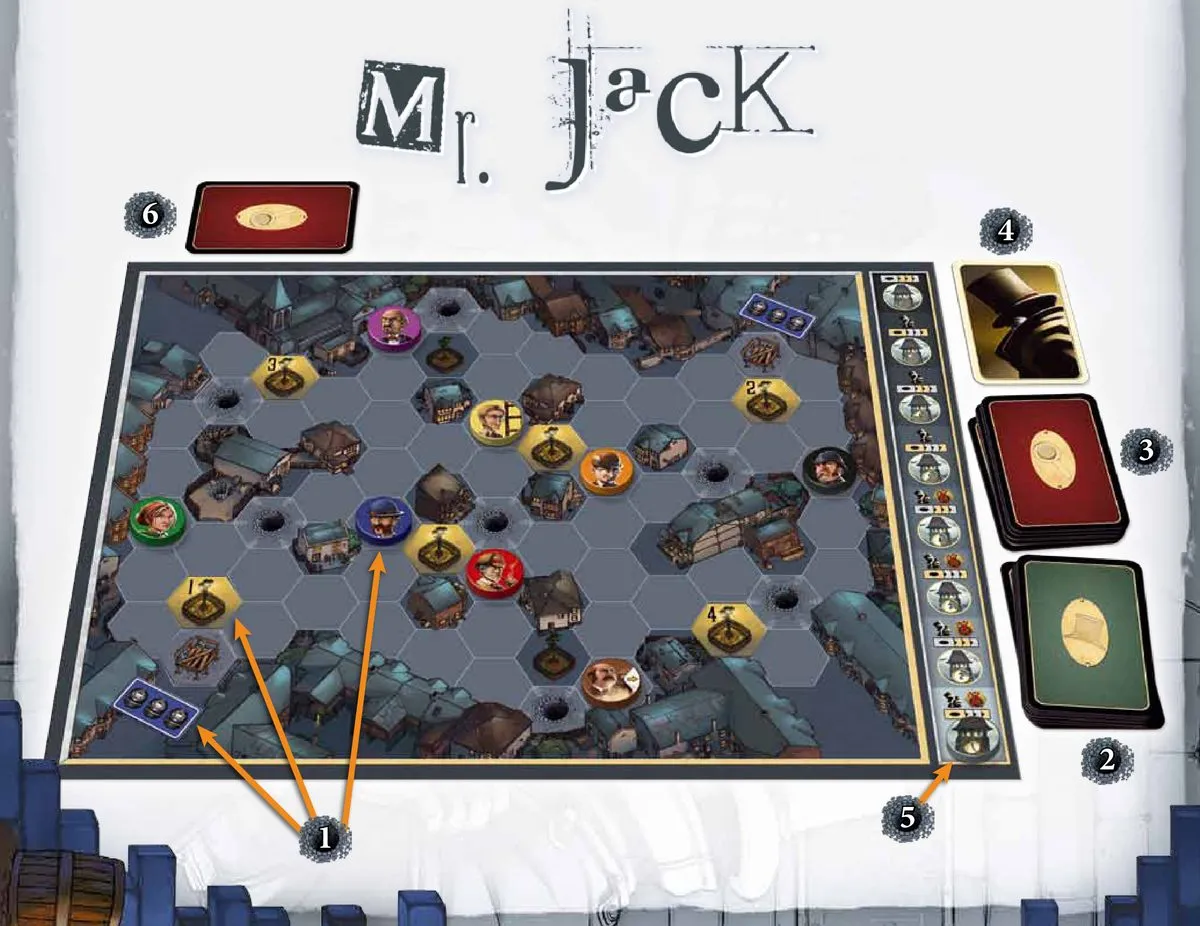
- Starting pieces — characters, lamps, covers and cordons.
- Character deck.
- Alibi deck.
- Witness card.
- Round counter.
- Jack’s hidden identity.
Whitechapel is a hex map of streets and buildings. Only street hexes are normally passable. Lit gaslights illuminate adjacent street spaces; characters beside each other can also see each other in the dark. Watson’s lantern adds a line of light that ends at an obstacle. Police cordons close two exits, and open manholes connect parts of the map through the sewers.
Setup
The Detective sits at the yellow edge and sees the board upright; Jack sits at the grey edge. Put the eight character tokens, gaslights, and manhole covers in their pictured positions, with all tokens on the suspect side. Shuffle the eight character cards and separately shuffle the alibi cards. Set the Witness card to Visible and the round marker to one. Jack draws and looks at one alibi card to learn his identity, then hides it from the Detective. The Erratum warns that the printed alibi-card edges can reveal their colors, so use the box tray arrangement pictured there to conceal the deck’s edges. [Extension] replaces fixed character setup with a draft and staged placement; see its page.
A round
Each round activates four characters, two for each player. Odd rounds begin with the Detective; even rounds begin with Jack. The first player chooses and uses one character, the second player uses two of the remaining characters, then the first player uses the last. A used card is turned face down. Each character moves and/or uses its printed ability; the ability can be mandatory or optional, and may happen before, during, or after movement.
After four activations, Jack declares whether his disguised character is visible. If visible, the Detective clears every invisible character; if invisible, the Detective clears every visible character. Cleared tokens turn to innocent and stay where they are. Remove the numbered gaslight matching rounds one through four, advance the round marker, and reshuffle the character deck after even rounds.
How the game ends
A correct accusation wins for the Detective; a wrong accusation, a legal escape, or survival through round eight wins for Jack. There is no points score (Game End and Scoring).
Ways to score
| Outcome | Winner |
|---|---|
| Correct accusation | Detective, immediately. |
| Incorrect accusation | Jack, immediately. |
| Escape while the Witness card is Invisible | Jack, immediately. |
| Jack remains uncaptured after round eight | Jack. |
What each resource is for
| Piece | How you use it |
|---|---|
| Character cards | Select which character moves and uses an ability; four are activated each round. |
| Alibi cards | Hide Jack’s identity and give Holmes private clues. |
| Character tokens | Track positions and cleared suspects. Both players move any character. |
| Witness card | Record the last visibility declaration and whether Jack may attempt escape. |
| Gaslights, covers and cordons | Change lighting, sewer access and exits through character powers. |
Teaching tips
Start by teaching the opposing win conditions, then demonstrate how a lit space or an adjacent character makes someone visible. Show the odd/even 1–2–1 character draft before explaining individual powers. The Detective benefits from balancing the group between visible and invisible; Jack can spoil that split. Holmes’s alibi draw is private information: the player who draws it looks at it, while the opponent does not. Players may sit side-by-side if that makes the board easier to read.
For the labeled setup diagram, see Cards & Components. Character powers and the revised extension setup are on the component page and 2018 Extension page.