Teach the Game
A short teaching script for Mood Swings.
How you win
“We are building a changing set of moods. Play a card each turn, use its effect to reshape the table, and finish each round with the highest total. Win three rounds first to win the game.” A round keeps your earlier moods in play, so a small move can change several scores at once. The rules are quick; the card abilities create the variety.
The boards
There is no board. Everyone shares a draw deck and discard pile; each player has a private hand and a visible area of moods. Keep space for score and round wins.
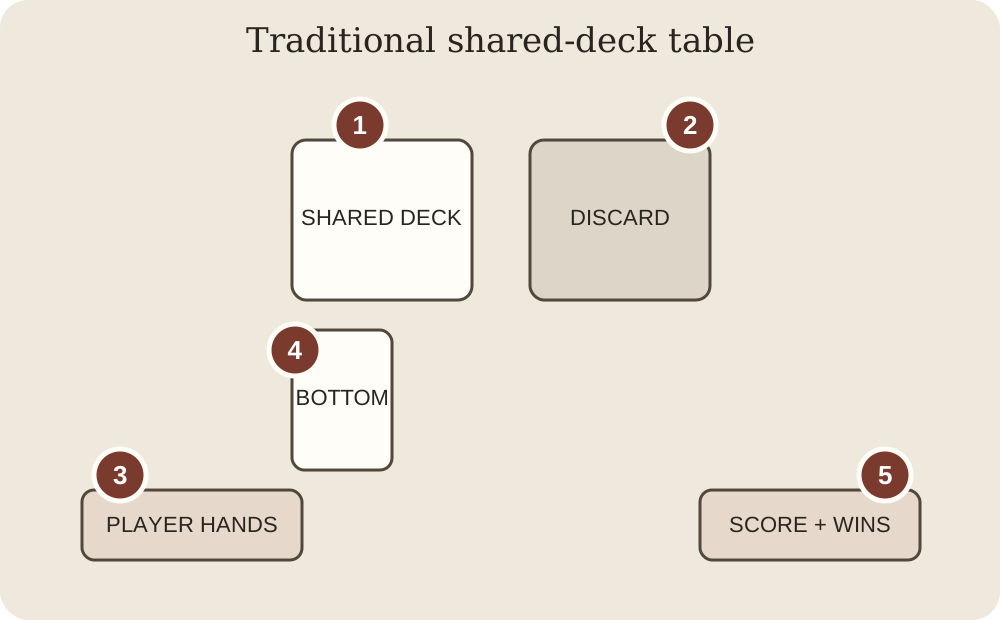
- Shared deck — draw from here and put cards on its bottom when effects say so.
- Discard pile — shared cards that leave a hand or play go here unless a rule says otherwise.
- Player hands — hidden cards you may play from on your turn.
- Revealed bottom card — its emotion helps choose the first player.
- Score and win trackers — track scores and each player’s round wins.
A round
On your turn, play one card from your hand or pass. Pay any play cost first, then apply ongoing effects, then resolve its after-play effects. Recheck ongoing scores when cards move. After everyone acts, compare totals. The complete sequence is on Gameplay.
How the game ends
After scoring, the first player to reach three round wins takes the game. Otherwise, resolve after-scoring effects, have each losing player draw a card, award the lowest scorer the extra-play helper in games with three or more players, then start another round with the round winner first.
Ways to score
| Source | How and when |
|---|---|
| Mood values | Add each mood you control after all current modifiers; highest total wins the round. |
| Round wins | The round winner gains one. The first to three wins the game. |
| Tie-break | The player who played earliest this round wins an equal total. In 3–4 player games this means earliest actual play, not simply the turn order leader. |
| Card-specific effects | Some moods change values or award cards; resolve their wording before scoring and before drawing for the next round. |
What each resource is for
| Resource | Why it matters | How it is used |
|---|---|---|
| Mood cards | Your hand gives you future choices; cards in play form your scoring tableau. | Play from hand, then leave in play unless an effect moves them. |
| Shared deck | Supplies new choices. | Draw at setup and after losing a round; card effects may draw or bottom cards. |
| Discard pile | A shared pool that some moods inspect or reuse. | Put cards here when discarded or removed, unless an effect specifies another zone. |
| Score record | Holds each round’s total for comparison and effects. | Add current mood values at the scoring step. |
| Round-win markers | Track progress toward the finish. | Give one to the round winner; three wins end the game. |
| Hurt Feelings helper | Gives the lowest scorer a catch-up play in a 3–4 player game. | Use it on that player’s next turn, then return it to the supply. |
Teaching tips
- Start with the three card timings: play cost, ongoing while in play, and after playing.
- Tell players to keep the whole tableau visible; values can change as new cards arrive.
- Demonstrate one variable value and one card that moves cards between zones.
- In a first game, use the shared deck and leave optional formats and deck customization for later.