Teach the Game
A script to read aloud: how you win Leader 1: Hell of the North, the peloton tile and energy table, a game turn, the finish, what counts in a stage race and what each resource is for.
How you win
“We each run a cycling team on a course we build from hexagon tiles — flats, hills, mountains, descents and the cobbles of the north. A race takes about an hour. Whoever gets a cyclist across the finish line first wins; in a stage race, the fewest turns lost over all the stages wins.”
- You need: a cyclist ahead of everyone at the line — with enough energy left to get there.
- You get it by: sheltering in the peloton while it is cheap, breaking away at the right moment on the terrain your rider is good at, drafting behind others, and spending energy on extra squares only when it counts.
The boards
There is no board: the course is a row of route hexagons. Each player keeps a sheet from the energy table pad, and everyone shares the peloton tile.
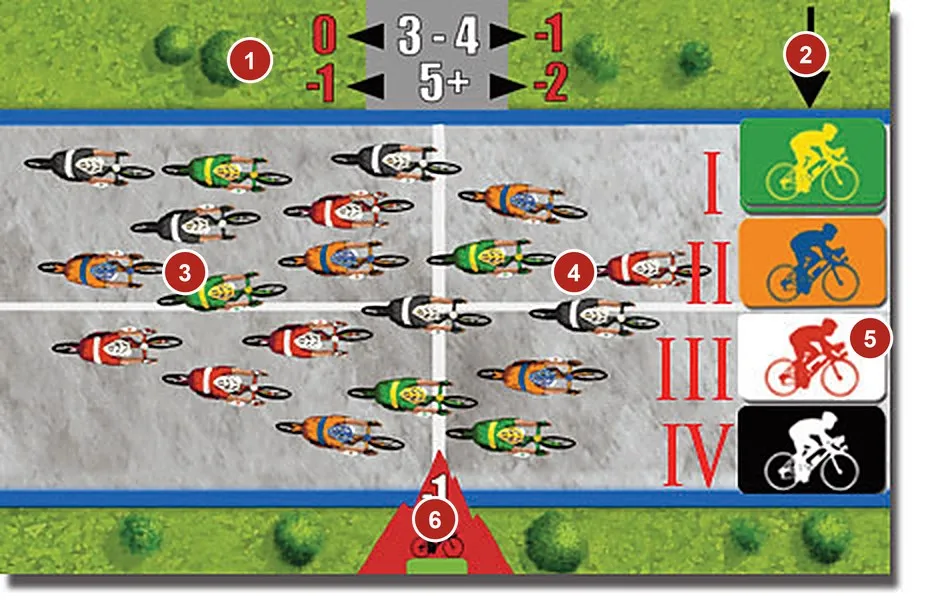
- Peloton energy costs — what riders in the back and front pay after a move of 3–4 or 5+.
- Lead position — the support-rider token beside the arrow leads the peloton and rolls the die.
- Back of the peloton — the cheap seat; you cannot break away from here.
- Front of the peloton — costs more, but only these riders can attack.
- Support-rider order — the four team tokens, top to bottom: the order for peloton actions.
- Mountain reminder — rouleurs pay 1 more when the peloton starts on a mountain.
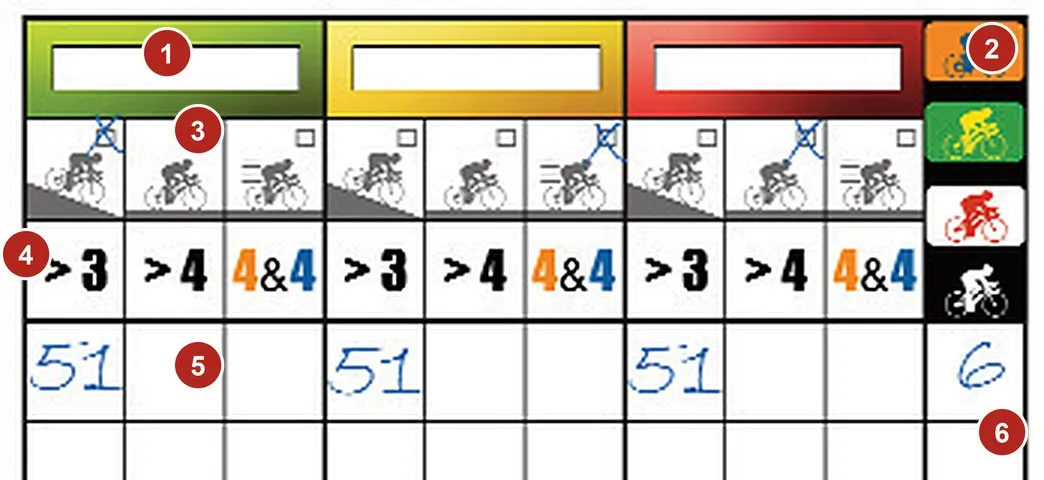
- Rider name — one column each for your rouleur (green), leader (yellow) and climber (red).
- Team colour — your support riders.
- Qualities — cross descender, fighter or sprinter, one per cyclist.
- Risk line — each risk taken crosses the next box: >3, then >4, then only a 4 orange or 4 blue.
- Energy — the starting total; cross it out and write the new value as you pay.
- Pursuits — 6 at the start; one is spent each time your team speeds up the peloton.
A turn
Every turn has five steps, always in this order (full rules):
- Breakaway riders move, from the race leader back: a free base move set by rider type and terrain, then extra squares paid in energy.
- Breaking away — starting with the team second in the peloton order and ending with the first, riders in the front of the peloton may attack with a move of at least 4 squares.
- Moving inside the peloton — switch between back and front, or drop off the back.
- Pursuit and peloton movement — one team may spend a pursuit (+1 square); the leading team rolls the peloton die; everyone in the peloton pays by position.
- Dropped riders move, after the peloton.
Along the way: slipstreaming, cracks and falls, punctures, cobbles and weather.
How the game ends
- One-day race (classic): the first cyclist to cross the finish line with any part of the bike wins (details).
- Stage race: play every rider to the line; each counts the turns lost to the stage winner. Lowest total after the last stage wins (details).
Ways to score
| Source | How and when |
|---|---|
| Crossing the line first | Wins a one-day race; wins the stage in a stage race |
| Stage win | 2 turns taken off your general classification time |
| Second in the stage | 1 turn taken off |
 Bonus time line | The first cyclist across it gains 1 turn |
| Turns behind the winner | Each turn you finish after the stage winner adds 1 turn to your time |
| Elimination | More than 22 turns behind the classification leader: out of the race |
What each resource is for
| Resource | Why you need it | How you get it | How you use it |
|---|---|---|---|
| Energy | Every square beyond the free move, every peloton turn and every penalty costs it | Starting total = the course’s milestone values; feed zone tiles; 1 back per unused free square | Cross it off your energy table; at 0 you can only ride your free moves or get dropped |
 Feed zone tiles | +2 to +5 energy at the right moment | Draw one per cyclist passing a feed zone (and one each before a classic) | Add at once, or keep it face down and add it later |
| Pursuits | Speed the peloton up to catch a breakaway | 6 per team per race (4 from the second stage on, plus up to 2 carried) | +1 square to the peloton roll; your team moves to the lead |
| Free moves | The squares you get for nothing each turn | Rider type and starting terrain, +1 for a quality on its terrain, +1 for slipstreaming | Move them, or skip some to win back 1 energy each |
| Qualities |    Make your riders different | Chosen at the start, one per cyclist | +1 downhill, safer on bad asphalt, +1 in sprint zones |
| Support riders | Your faceless team-mates in the peloton | One token per team on the peloton tile | Their order sets who acts first; they make your pursuits |
Teaching tips
-
Build a short course first: 6–8 hexagons with every terrain colour, one intermediate sprint and the final sprint.
-
Show the paying-squares table early: 1 extra square costs 1, but 6 cost 15. Small steady efforts and drafting beat one big burst.
-
Walk one turn slowly with the peloton tile in view: who breaks away, who switches area, who pursues, then the roll and the energy each rider pays.
-
Leave weather out of the first race.
-
Show that moving from back to front in phase 3 prepares a breakaway for the next turn; the current breakaway phase has already passed. Practice example.