Preparing the Race
Build a Leader 1: Hell of the North course from route hexagons, place the race tokens, pick teams, energy and qualities, and organise the peloton.
Race configuration
There is no fixed map: you build the course by laying route hexagons end to end, so every race is different. The box has no printed list of courses — copy a real race profile, shuffle the tiles, or use a course shared on BoardGameGeek’s files page. Any terrain may come before a mountain.
Route types
The colour of a road’s edge tells you its terrain. A rider’s free move depends on the terrain of the square where the move starts (free movement). The starting square sets the terrain bonus even if the move crosses into another hexagon. FAQ
| Picture | Terrain |
|---|---|
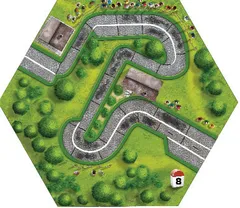 | Flatland — green edge. Rouleurs are fastest here. FAQ |
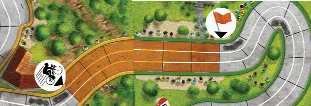
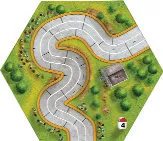 | Hill — orange edge. Every rider type gets 2 free squares. FAQ |
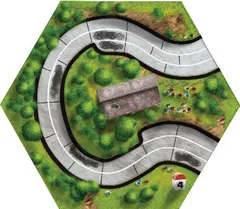 | Downhill — black edge. Every rider type gets 4 free squares. FAQ |
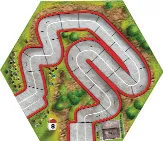 | Mountain — red edge. Climbers are fastest; a climb category token sets the crack risk. FAQ |
Each hexagon has a milestone post with a number: add them up for the riders’ starting energy.
Road surface
| Picture | Surface |
|---|---|
 | Normal asphalt (light grey) — no risk. |
 | Treacherous asphalt (dark grey, the “blackened” squares) — a fall risk when crossed with paid squares. |
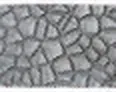 | Cobbles — dark cobbled squares can cause a fall or a puncture. On paid blackened cobbles a rider may risk a fall or puncture, and a 5-square move can break slipstream. FAQ FAQ |
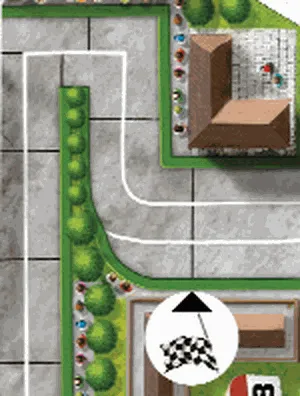
Where the road has dotted squares (on some bends), the peloton follows them.
Tokens on the course
 Put the start line token at the beginning and the finish line token at the end.
 In a stage race, place one or two bonus time tokens along the course.
 Place a sprint zone start token on one of the two last hexagons before the finish, and one on the hexagon before each bonus time token. Never place one when that finish or bonus line is on a mountain hexagon. The squares from the token to the line form the sprint zone, where sprinters get an extra free square.
 Place one mountain climb category token at the start of each mountain: 1 is a very difficult climb, 2 difficult, 3 medium, 4 easy. It is the most paid squares a rider may climb in one move without risking a crack.
 Place the feed zone tokens: one for a stage race of about 10 hexagons or for a classic, two for a stage race of 15–20 hexagons.
- Shuffle the 36 feed zone tiles into three face-down piles by colour: green, yellow and red.
 Optionally, place weather tokens face down (weather).
The riders
The box holds 12 cyclists in four teams. A team is:
- three cyclists in one jersey colour. The base colour gives the rider type: rouleur (green base, the flat specialist), leader (yellow base, the all-rounder) and climber (red base);
- one support-rider token of the team’s colour: the team-mates who work in the peloton.

All players run the same number of cyclists: 1, 2 or 3. With one cyclist each, the race is full of deals and alliances around the table; with two or three, each team plays its own tactics.
The peloton
The peloton is a token in a stand that moves along the course, and a tile where the riders inside it sit.
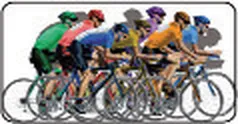
- The token moves by the roll of the peloton die.
- The tile holds every rider in the peloton. Support-rider tokens always stay on it.
- The tile has a back and a front area. Cyclists may sit in either; support riders only in the front.
Energy and pursuits
- Every cyclist starts with the same energy: the sum of the milestone values of all the course’s hexagons.
- Every team starts with 6 pursuits for its support riders.
- Each player writes on an energy table sheet the starting energy of each of their cyclists, the 6 pursuits (right-hand column) and the riders’ names. The sheet stays in view of everyone.
Cyclists’ qualities
Each player gives their cyclists one extra quality, crossing its box on the energy table. One quality per cyclist, and two cyclists of the same team never share one.
| Quality | Effect |
|---|---|
 Descender | +1 free square on every move that starts downhill |
 Fighter | Only risks a fall from the second treacherous square crossed with paid squares |
 Sprinter | +1 free square on every move that starts in a sprint zone |
Organising the peloton
Put the peloton token on the start line; every rider starts on the peloton tile.
Who goes first: in a stage race, the team leading the general classification; in a classic, the team of the player who last rode a bike.
Support riders: the first player puts their token in first place on the tile, beside the arrow; the others go below. This order is the order of all peloton actions, and the leading team takes the die.
Cyclists: in that order, each player places their cyclists in the back or the front of the tile.
Aim of the game
The winner is the first cyclist to cross the finish line with any part of the bicycle. In a stage race, the riders’ delays add up over the stages (Game End and Scoring).