Teach the Game
A short teaching script for Jaipur.
How you win
“You are merchants competing for the Maharaja’s favor. Each week, trade goods at the market, sell them for rupees, and claim the Seal of Excellence. Win two weeks to become the Maharaja’s personal trader.” Build value by taking scarce high-value goods, making larger sales for bonus tokens, and using camels to trade efficiently.
The boards
Jaipur has no game board. The shared table has a five-card market, a draw deck and discard pile, six face-up goods-token piles, three face-down bonus piles, and three Seals. Each player keeps a hand and a separate face-up camel herd.
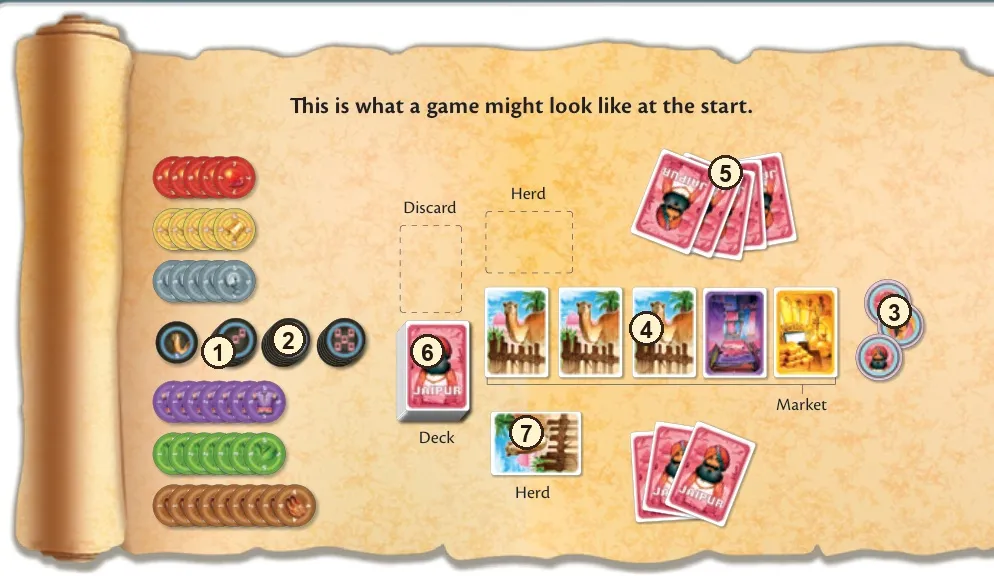
- Goods token piles — top values are taken first.
- Bonus piles — shuffled by sale size.
- Seals — award one to each round winner.
- Market — five face-up cards.
- Starting hand and camel herd — camels are kept separately.
- Draw deck — refill the market from here.
- Starting player — choose who takes the first turn.
A round
On your turn choose one action: take cards or sell one type of goods. Taking means a single good, an exchange of at least two cards, or all market camels. Selling means discard any number of one goods type, take the matching top tokens, and possibly take a bonus. See Taking and Selling Goods.
How the game ends
A week ends when three goods-token piles are empty or the deck cannot refill the market to five. The player with more camels takes the 5-rupee camel token; a camel tie awards none. Count all token values and award a Seal to the richer player. The game ends immediately when someone earns a second Seal.
Ways to score
| Source | Value and timing |
|---|---|
| Goods tokens | Printed rupee values; the top, highest-value tokens are awarded first for each sold card. |
| Bonus tokens | 3-card sale: 1–3; 4-card sale: 4–6; 5+ card sale: 8–10 rupees. |
| Camel token | 5 rupees to the player with more camels at the end of the week; none on a tie. |
| Seal | Round prize for the higher total; first to two wins. |
What each resource is for
| Resource | Why you need it | How you get and use it |
|---|---|---|
| Goods cards | Convert market access into rupees. | Take from the market, then sell one type per turn for tokens. |
| Camels | Flexible exchange stock and a round-end majority prize. | Take all market camels at once; they do not count toward the hand limit. |
| Goods tokens | Main source of rupees and progress toward a Seal. | Earn one per sold card, highest values first. |
| Bonus tokens | Reward larger sales. | Sell at least three cards of one type; values are hidden until taken. |
| Seals | Win the match. | Take one for each week won; two wins the game. |
Teaching tips
- Explain that every turn is one choice: take cards or sell, never both.
- Teach camel collecting as a trade investment; camel cards are not sale goods.
- Point out that expensive goods require a two-card minimum sale.
- Remind players the hand limit is checked at turn end, including exchanges.