Teach the Game
A script to teach Hegemony at the table — how each of the four classes wins, the main board and all four player boards, a round of five phases, the end, every way to score and what each resource is for.
How you win
“A modern nation in crisis. Each of us leads one part of society — the Working Class, the Middle Class, the Capitalist Class or the State — and wants different things. Five rounds, three hours or more the first time. We play cards to act, our companies produce and pay wages, and every round we vote on bills that change the country’s policies. Most victory points
at the end wins.”
Every class scores differently — that is the whole game:
| Class | What it wants | Its main source of points |
|---|---|---|
 Working Class (red) | Jobs, then Health, Education and Luxury for its people | Raising Prosperity, Trade Unions, passing Bills |
 Middle Class (yellow) | A balance of running small companies and looking after its people | Prosperity, selling abroad, Bills |
 Capitalist Class (blue) | Profit | Money in its Capital each round (the Wealth table) |
 State (gray, 4 players) | Legitimacy with all three classes | Its two lowest Legitimacy scores each round, Events, its Political Agenda |
The loop: play 5 cards a round (each for its effect or as a Basic Action), then companies produce and pay wages, everyone eats and pays taxes, then Bills go to the vote and the Politics table shifts — which changes wages, taxes, prices and immigration for the next round.
With 2 players only the Working and Capitalist Classes play; with 3 the Middle Class joins; the State is a player only with 4 (setup). Start with 2 players for a first game.
The boards
The main board
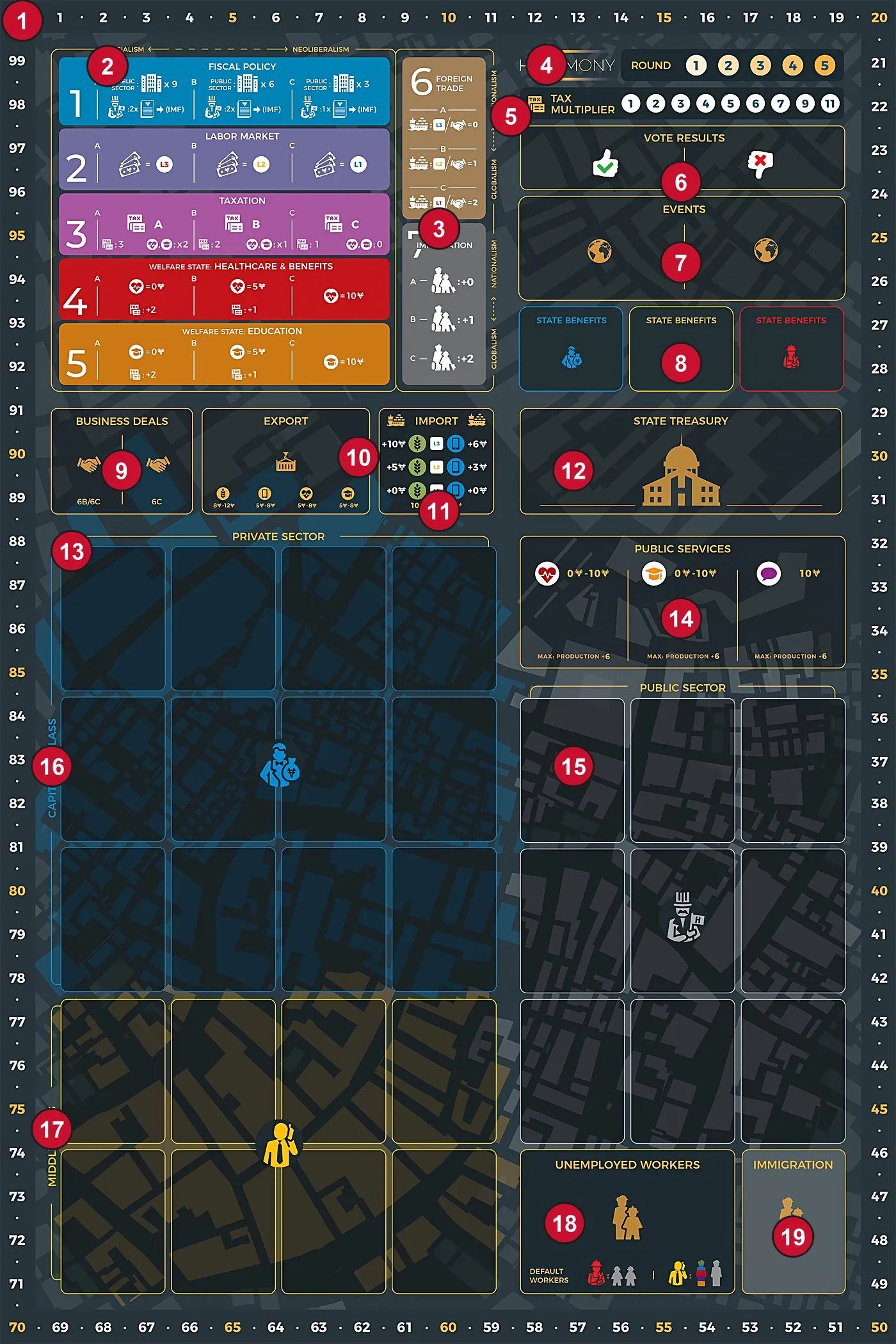
- Score track — victory points for all classes, 0–99.
- Politics table, Policies 1–5 — section A socialist, C neoliberal.
- Policies 6–7 — Foreign Trade and Immigration, A nationalist, C globalist.
- Round track — 5 rounds.
- Tax Multiplier — multiplies the Middle and Capitalist Classes’ Employment Tax.
- Vote results — drawn cubes and Influence go in favour or against.
- Events — two issues for the State each round (4 players).
- State Benefits — what the State has provided for each class.
- Business Deals — cheap bulk imports for the Capitalist Class.
- Export — this round’s Export card: what the Foreign Market buys.
- Import — Foreign Market prices of Food and Luxury, plus tariffs.
- State Treasury — the State’s money; all taxes go here.
- Private Sector — up to 12 Capitalist and 8 Middle Class Companies.
- Public Services — Health, Education and Media Influence for sale.
- Public Sector — Public Companies; how many are open depends on Policy 1.
- Capitalist Class part of the Private Sector.
- Middle Class part of the Private Sector.
- Unemployed Workers — new and jobless Workers wait here.
- Immigration — the deck that decides which immigrants arrive.
Working Class board
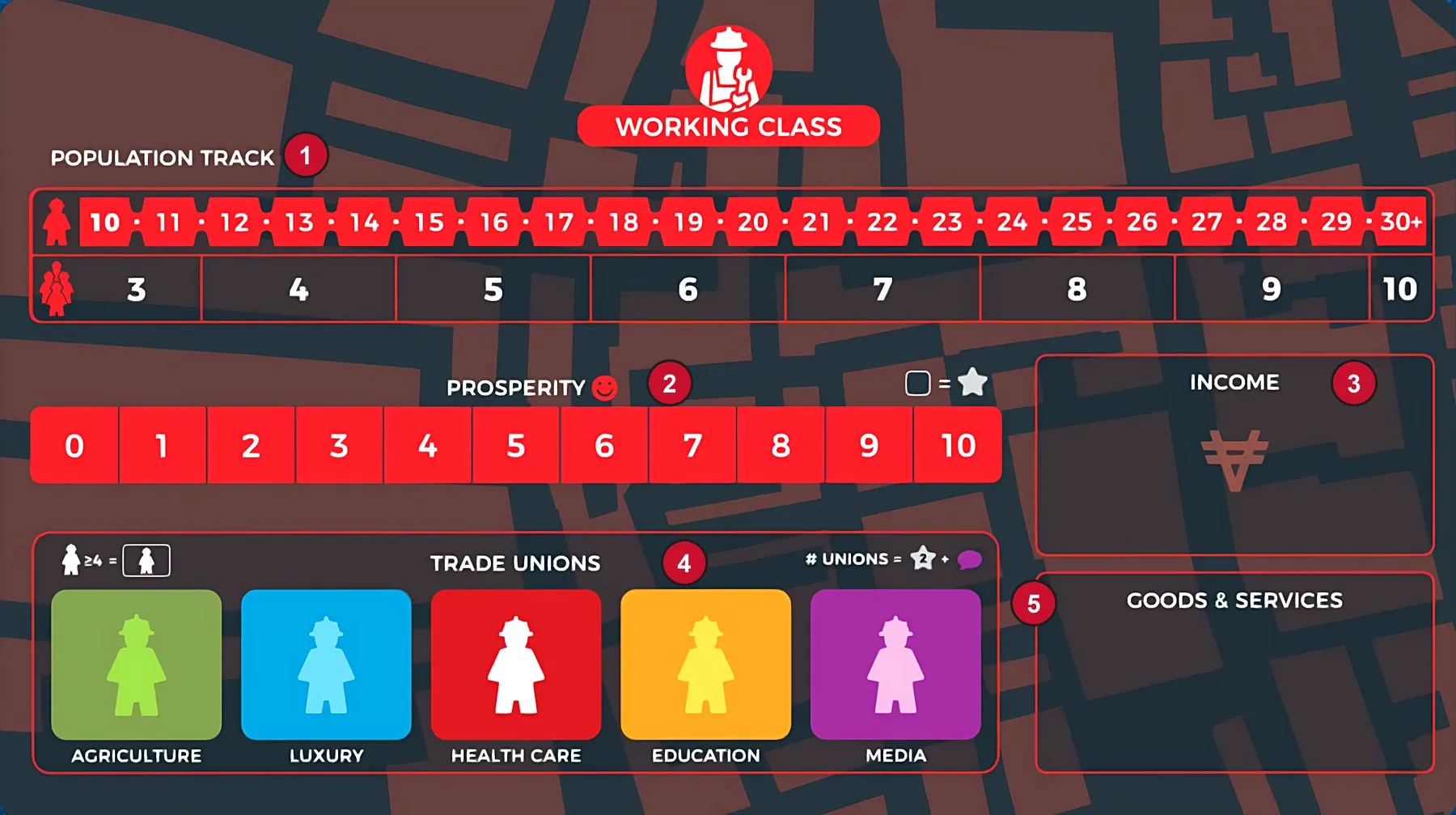
- Population track — your Workers, and below it your Population.
- Prosperity — your main source of points.
- Income — your money.
- Trade Unions — one slot per industry: Influence and points each round.
- Goods & Services — what you have bought and not yet used.
Middle Class board
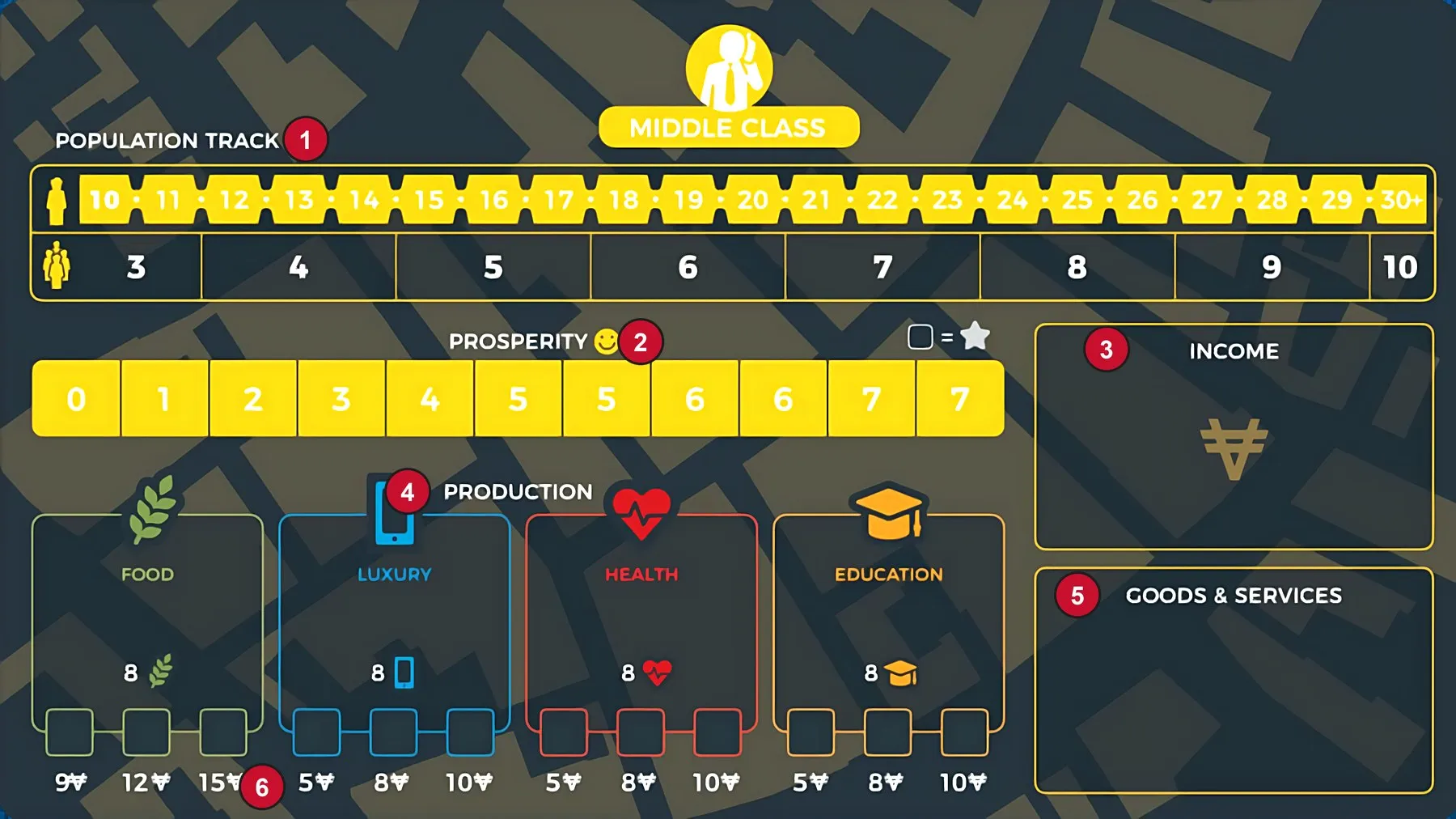
- Population track — your Workers and your Population.
- Prosperity — drops by 2 each round.
- Income — your money.
- Storages — what your Companies produced, 8 of each at most.
- Goods & Services — what you have bought (or bought from yourself) to use.
- Price markers — what you charge the other classes.
Capitalist Class board
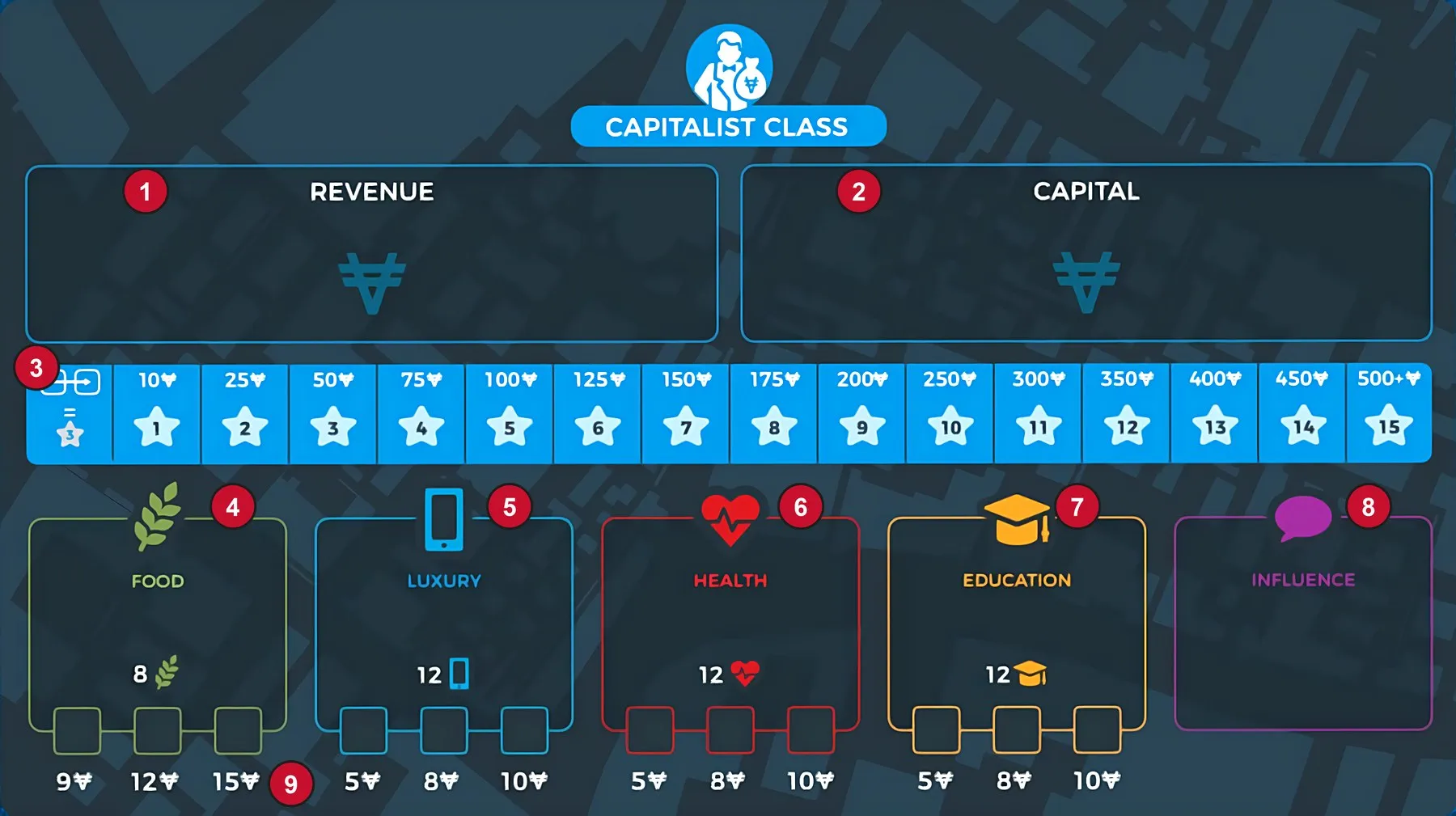
- Revenue — this round’s untaxed income; you pay from here.
- Capital — taxed money; scores every round.
- Wealth table — points for your Capital, plus 3 for each new step.
- Food Storage — 8 at most.
- Luxury Storage — 12 at most.
- Health Storage — 12 at most.
- Education Storage — 12 at most.
- Influence — no limit; never sold.
- Price markers — what you charge for each resource.
State board
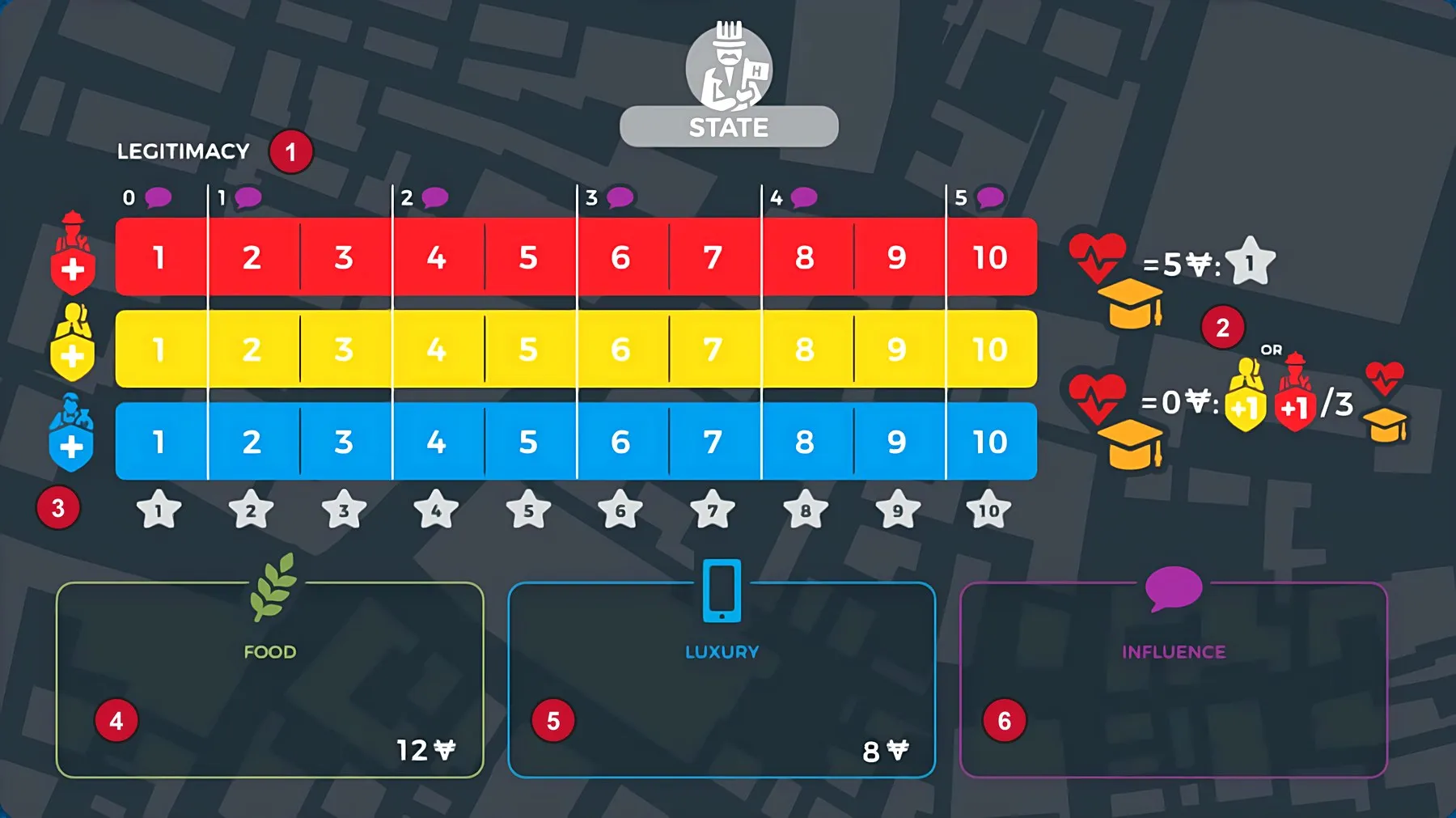
- Legitimacy tracks — one per class; the Influence above the lowest one comes each election.
- Welfare reminders — 1 point for selling at 5, Legitimacy for giving away.
- Legitimacy scoring — points for your two lowest tracks each round.
- Food — goods the State happens to own, for sale at 12.
- Luxury — for sale at 8.
- Personal Influence — yours to spend; cannot be bought.
A round
The full rules are in A Round, Phase by Phase. Five rounds; each has five phases:
- Preparation (skipped in round 1) — pay loan interest, draw back up to 7 cards, new Workers arrive, new Companies, Export and Business Deal cards appear; the State reveals 2 Events and a Political Agenda.
- Action — 5 turns each, in the order Working → Middle → Capitalist → State. On a turn, play 1 card: for its effect, or discard it for one of your Basic Actions. Also one Free Action, before or after. 2 cards stay in hand.
- Production — in reverse order: companies pay Wages and produce, classes eat Food equal to their Population, the IMF checks the State’s loans, everyone pays taxes to the State.
- Elections — each class adds Voting cubes to the bag; every proposed Bill is voted on: 5 cubes drawn plus Influence spent in secret.
- Scoring — Trade Unions, Wealth, Middle Class companies, State Legitimacy and Agenda score; unanswered Events cost the State Legitimacy.
How the game ends
After the 5th round’s Scoring Phase. Then: every class except the Capitalists may pay off
Loans at 55 each and loses 1 per 5 left unpaid; the
Capitalist Class loses 5 per Loan. Each class scores its end bonus (policies in its
favourite section, leftover money or goods). Most points wins; ties go to the class with more
Policies 1–5 in its section, then the State, then the most Voting cubes (details).
Ways to score
| Source | Who | How and when |
|---|---|---|
| Passing a Bill you proposed | All | 3 when it passes; 1 to each supporter who added a cube or Influence (Elections) |
| Prosperity | Working, Middle | Each step up scores the new Prosperity value (Working, Middle) |
| Use Healthcare | Working, Middle | +2 on top of the Prosperity step |
| Trade Unions | Working | 2 each, every Scoring Phase |
| Selling abroad | Middle | 1 per Export transaction |
| Wealth | Capitalist | Wealth table for its Capital every round, +3 per new step reached |
| Legitimacy | State | Sum of its two lowest Legitimacy tracks, every round |
| Political Agenda | State | 1 per Policy matching this round’s card |
| Benefits and Welfare | State | 1 when a class takes its Benefits; 1 when it sells Health or Education at 5 |
| Events, cards | All | As printed |
| Demonstration | Working (against others) | Others lose equal to unemployed Workers + Trade Unions |
| End: favourite Policies | All but State | Policies 1–5 in A (Working), B (Middle), C (Capitalist) (table) |
| End: leftovers | All | Working 1 per 10 money (max 15), Middle 1 per 15 money, goods in storage for Middle, Capitalist and State, State 1 per 30 in the Treasury |
| Loans at the end | All | Unpaid Loans cost points (above) |
What each resource is for
| Resource | Why you need it | How you get it | How you use it |
|---|---|---|---|
| Money (Vardis) | Everything costs money | Wages (Working/Middle), sales (Middle/Capitalist), taxes (State) | Buying goods and services, building, wages, taxes |
 Food | Every round each Working and Middle Class Worker must eat | Agricultural Companies, Foreign Market | Cover Needs: Food equal to Population, mandatory |
 Health | Prosperity and a new Worker | Healthcare Companies, Public Services | Use Healthcare: spend Population’s worth |
 Education | Prosperity and a skilled Worker | Education Companies, Public Services | Use Education: spend Population’s worth, upgrade a Worker |
 Luxury | Prosperity | Luxury Companies, Foreign Market | Use Luxury: spend Population’s worth |
 Influence | Extra votes; Immediate Votes | Media Companies, Trade Unions, Public Services, Lobby | 1 vote each in an election; 1 to call an Immediate Vote |
| Workers | Wages, Trade Unions, running companies | Start, each round, Immigration, Use Healthcare | Assign them to Companies |
| Companies | Production (and wages for the workers) | Build from your Market (Middle, Capitalist) | Produce in the Production Phase |
| Voting cubes | Your share of the 5 drawn cubes | Refill each election; Apply Political Pressure | Drawn in elections |
| Bill markers | Changing the Policies | 3 per class | Propose Bill |
 Machinery | More production without more wages | Capitalist cards | One per eligible Company |
 Legitimacy | The State’s points | Helping classes, Events, cards | Scored every round |
Teaching tips
-
Teach the round structure first, then let each player read their own class section and Player Aid — the four roles are asymmetric, nobody needs every detail of the others.
-
Explain Policies as the shared engine: wages, taxes, prices of Health and Education, tariffs and immigration all come from the Politics table, so every vote matters to everyone.
-
Stress the three easy-to-miss duties: eat Food every round, pay taxes to the State Treasury (not the supply), adjust the Tax Multiplier at once when Policies 3–5 change.
-
First game: 2 players, or play fewer rounds; the Middle Class is the hardest role to learn.
-
Contrast a mandatory Wage shortfall with an optional Company purchase: only the forced shortfall permits a Loan. Practice example.