Capitalist Class
Playing the Capitalist Class in Hegemony: Revenue and Capital, building and selling Companies, exports and Business Deals, Lobby, prices, wages and bonuses, Machinery, the two taxes and the Wealth table.
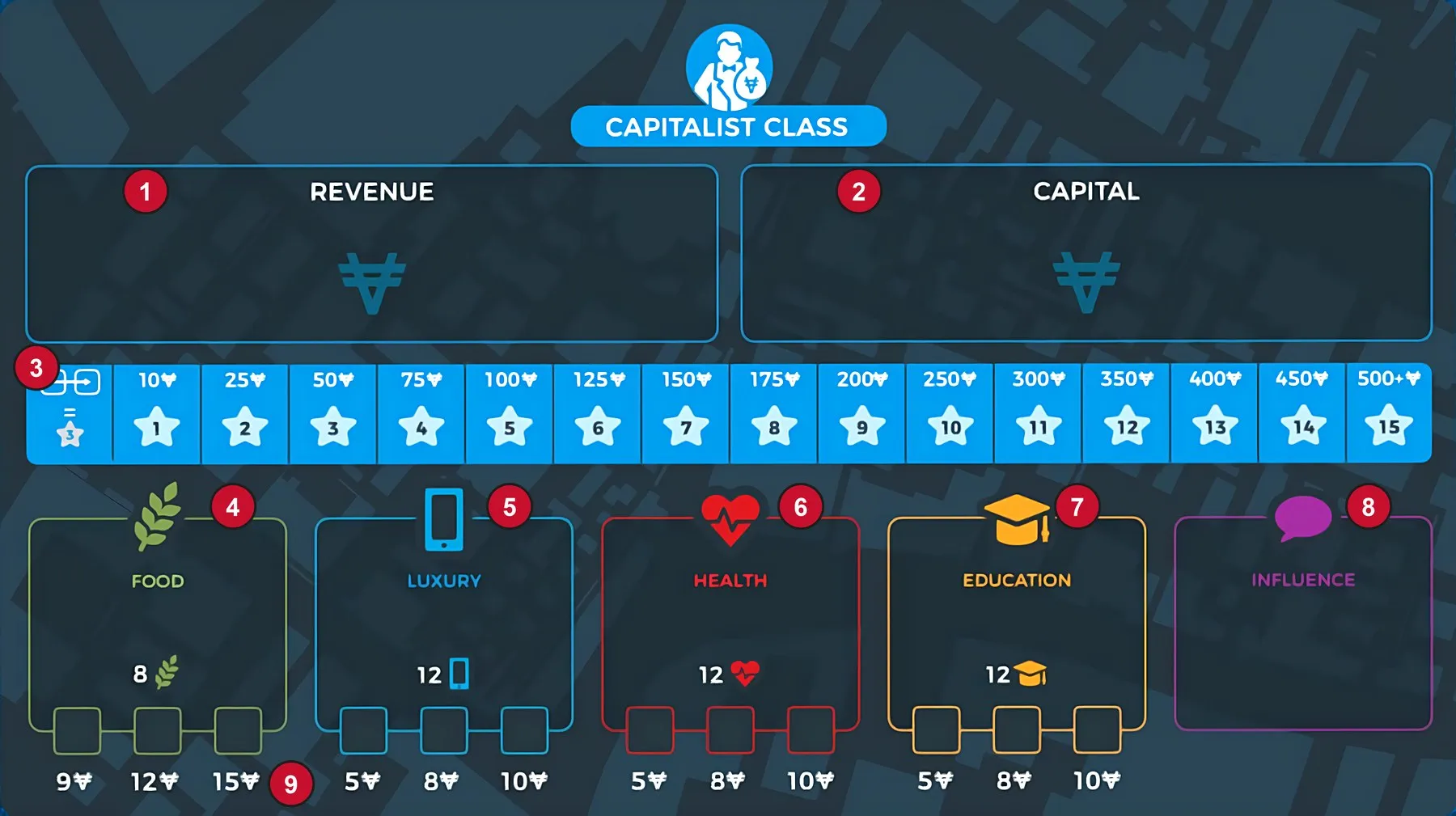
Goal
 You run Companies (up to 12) that employ the other classes’ Workers, sell
what they produce at home and abroad, and pile up Capital. Every round you score points for the
money in your Capital. Your favourite Policies are in section C (neoliberal): low taxes, low
minimum wage, expensive public services — and high tariffs (6A) so the others buy from you.
Revenue and Capital
Two money areas:
- Revenue — everything you earn goes here unless an effect says otherwise; you also pay from Revenue first. If it runs short, pay the rest from Capital.
- Capital — taxed money. After taxes, all Revenue moves here and scores. Effects that say “from your Capital” pay from Capital first, then Revenue.
If both are empty and you must pay, take a Loan: its 50 go to your Capital; Loan interest and paying a Loan off also come from Capital.
Preparation Phase
- Pay 5 interest per Loan.
- Draw 5 Action cards.
- Discard any Companies from your Market, refill it to 4.
- Discard the Business Deals left on the board and draw new ones by Foreign Trade (6B: 1, 6C: 2); replace the Export card. Do this before the other classes take their new Workers.
Basic Actions
Propose Bill
See Bills and Elections.
Build Company
Pay the cost of a Company in your Market (from Revenue), place it in your part of the Private Sector and put a marker on its Wage, at least the Labor Market minimum. If unemployed Workers of one class can fill all its slots, you may assign them at once (committed); gray slots take unskilled Workers first. Up to 12 Companies; with the Market empty you cannot build until next round.
Sell Company
Discard one of your Companies with no committed Workers; its Workers become unemployed; gain its cost in Revenue.
Sell to the Foreign Market
Any transactions on the Export card, each once per action (how). Unlike the Middle Class you gain no points for it.
Make Business Deal
Take one Business Deal from the board, pay for its goods and discard it (no refill). Goods you keep in your normal Storages may later be sold at home, but you also pay the tariff printed on the card for the current Foreign Trade section to the State. Goods put only in the Free Trade Zone pay no tariff, but may only be exported; whatever does not fit there is lost.
Lobby
Pay 30 from your Capital and gain 3  Influence.
Apply Political Pressure
Add 3 of your Voting cubes to the bag.
Free Actions
Adjust Prices
Move the price markers under your Storages: the price the other classes pay you.
Adjust Wages
Change any of your Companies’ Wages. Raising a Wage commits the Workers there; you may never lower a committed Company’s Wage or go below the minimum.
Give Bonus
Choose one operational Company, give 5 to the player whose Workers work there, and commit those Workers.
Buy Storage
Pay 20 for a Storage tile and put it under one resource’s Storage: it doubles that Storage. One extra Storage per resource.
Receive Benefits and Pay Off Loan
Receive Benefits (4 players): take your State Benefits; cubes into the bag; the State scores 1. Pay Off Loan: 50 from Capital.
Machinery
Some cards give you  Machinery tokens. Put each on one of your Companies showing the
Machinery icon (one per Company): it adds the production printed next to the icon, with no extra
Wage. No eligible Company: the token is lost. A Company with a Machinery token is not automated —
without Workers it does not produce.
Production Phase
Pay each Company’s Wage (one Wage per Company) and take its production.
Storages and the Free Trade Zone
Food holds 8, every other Storage 12; anything beyond is lost — except Food and Luxury, which may
overflow into the Free Trade Zone (export only). Influence has no limit and is
never sold. During Cover Needs the other classes may buy your Food; the money goes to Revenue.
Employment Tax
Your operational Companies (automated ones count; empty ones do not) × the Tax Multiplier.
Corporate Tax
Then, on what is left in Revenue after Employment Tax:
| Revenue | 3A | 3B | 3C |
|---|---|---|---|
| 5–9 | 1 | 2 | 2 |
| 10–24 | 5 | 5 | 4 |
| 25–49 | 12 | 10 | 7 |
| 50–99 | 24 | 15 | 10 |
| 100–199 | 40 | 30 | 20 |
| 200–299 | 100 | 70 | 40 |
| 300+ | 160 | 120 | 60 |
Scoring Phase
Move all Revenue to Capital. Score the Wealth table for your Capital (10 → 1  … 500+ →
15 ). If your Wealth marker is to the left of that level, move it there: +3 per
space moved. If your Capital drops later, the marker stays where it is.
| Capital at least | Points |
|---|---|
| 10 | 1 |
| 25 | 2 |
| 50 | 3 |
| 75 | 4 |
| 100 | 5 |
| 125 | 6 |
| 150 | 7 |
| 175 | 8 |
| 200 | 9 |
| 250 | 10 |
| 300 | 11 |
| 350 | 12 |
| 400 | 13 |
| 450 | 14 |
| 500+ | 15 |
Game End
- Neoliberal Policies (1–5 in section C): 1 / 2 / 3 / 4 / 5 of them score 1 / 4 / 8 / 12 / 18 .
- 1 per 2
 / 3
 / 3
 / 3
 in your
Storages, Free Trade Zone included.
- −5 per Loan still held — you may not pay them off at the end.