The State
Playing the State in Hegemony (4 players): Legitimacy with the three classes, Public Services and the two kinds of Influence, Events, providing benefits, Extra Tax, Campaign, elections and scoring — and how the State runs itself with 2–3 players.
Goal
 The State is a player only in 4-player games. It wants Legitimacy: to keep all three
classes satisfied, as evenly as possible, while dealing with the Events that come up each round.
It owns the Public Companies and collects every tax.
Public Services and Influence
All Public Companies produce services:  Health,
 Education and
 Influence. They go to the Public Services area of the main board, each holding
at most the State’s total production of that service plus 6. The State’s money is the State
Treasury, where all taxes and tariffs go.
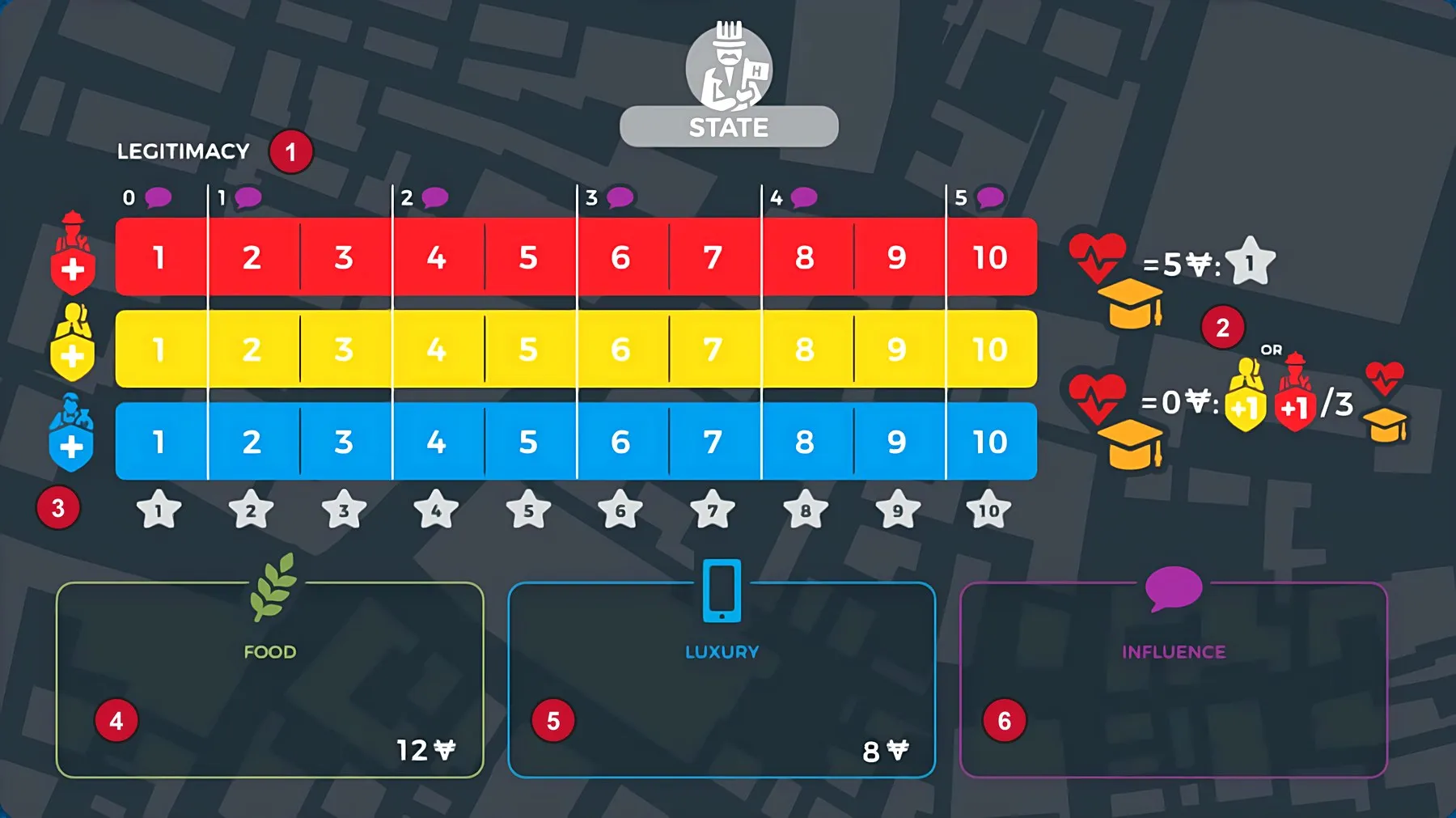
The State starts with no Food or Luxury, but cards or Events may give it goods or even Companies that produce them; those goods sit on the State board, for sale to the Working and Middle Class at the printed prices (Food 12, Luxury 8), with the same “production + 6” limit.
Two kinds of Influence:
- Media Influence — produced by Public Companies, in Public Services; the other classes may buy it for 10 .
- Personal Influence — gained by other effects, kept on the State board; only this can be spent by the State, and it can never be bought. The two are never swapped except by Campaign.
Legitimacy
Three tracks (1–10), one per class, start at 2. Legitimacy rises when the State helps a class and falls when it hurts one:
- Action cards played for their effect (by anyone) with class symbols at the bottom move the tracks;
- Events give Legitimacy as a reward, and cost it if left unanswered;
- a class taking free Health or Education gives +1 for every 3 taken.
A Legitimacy token  (white symbol on the class colour) gives +1 at once
and stays on the State board: +1 again to that class every Scoring Phase, after the tracks are
halved. A plain symbol
 is a one-off.
Preparation Phase
- Pay 5 interest per Loan.
- Reveal 2 new Events on the board.
- Reveal a new Political Agenda card beside your board.
- Draw 5 Action cards.
Selling Health and Education
The Working and Middle Class buy from Public Services during the Action Phase; the money goes to the Treasury. Policies 4 and 5 set the price — 10, 5 or free — and reward the State:
- sold at 5 each (section B): 1
 each time, whatever the amount;
- given free (section A): +1 Legitimacy with that class for every 3.
The two Welfare tiles in Public Services remind everyone which bonus applies.
Providing
Some cards and Events tell the State to Provide resources, money or Voting cubes to a class: put
them in that class’s State Benefits area (anything already there is discarded). If you do not
have them, you may buy them as part of the action — from other players at their prices or from
the Foreign Market (no tariff to yourself) — but never more than needed, and never from the class
you are providing to. When the class takes them with Receive Benefits, the State gains 1 .
Basic Actions
Propose Bill
As for everyone (Bills and Elections); the State has no Voting cubes, so it needs allies or plenty of Personal Influence to pass its own Bills.
Event Action
Choose an Event on the board and carry out its task, choosing among the options (usually a class); take the reward for your choice and discard the Event. “Spend” means pay from what you already have (no buying); “Provide” allows buying (above). “Up to” means at least 1. If you cannot do the whole task, you cannot take the action.
Sell to the Foreign Market
Export Food and Luxury the State owns, by the Export card.
Meet with a Party’s MPs
Give 2 Personal Influence to another player: +1 Legitimacy with that class.
Extra Tax
Take 10 from each other player (who must take a Loan if they cannot pay); then −1 Legitimacy with the two classes where it is lowest (you choose on a tie). You must have Legitimacy to lose.
Campaign
Move up to 3 Media Influence from Public Services to your board as Personal Influence.
Free Actions
Adjust Wages of Public Companies (raising commits; never below the minimum, never lowering committed ones). Pay Off Loan: 50 .
Production Phase
Pay the Wages of operational Public Companies and add their services to Public Services. Collect everyone’s taxes into the State Treasury.
Elections Phase
Instead of adding cubes, gain Personal Influence from the class with the lowest Legitimacy: the number printed above its track position.
| Lowest Legitimacy | Influence gained |
|---|---|
| 1 | 0 |
| 2–3 | 1 |
| 4–5 | 2 |
| 6–7 | 3 |
| 8–9 | 4 |
| 10 | 5 |
With any Personal Influence you must state a side in every election; without any you sit them out.
Scoring Phase
- Event penalties: apply the “No action” column of every Event still on the board, then discard them.
- Legitimacy: score the sum of your two lowest tracks. Then halve all three (round up), and add +1 per Legitimacy token you hold for that class.
- Political Agenda: 1 for each Policy matching the card; discard it.
Game End
- 1 per 2
 / 3
 / 3 / 3 /
3 Media the State holds.
- 1 per 30 in the Treasury.
The State in 2–3 player games
With no State player the State still exists: Public Companies produce and are paid from the Treasury, always at the minimum Wage; taxes go to the Treasury; Public Services are sold at the Policy prices. When Policy 1 opens or closes Public Companies, a whole row is turned at once for 60 (see Fiscal Policy). If the Treasury runs dry it takes a Loan (50 onto the Treasury), pays interest in each Preparation Phase and pays it back as soon as it holds more than 50. Events, Agendas and Legitimacy are not used.