Teach the Game
A table-ready introduction to Hansa Teutonica.
How you win
Grow your prestige as a Hanseatic merchant. Build offices, connect cities, develop your abilities and take the most valuable opportunities before the network closes.
On your turn, spend the actions shown by your Actions ability. Place or move traders along routes, displace rivals when needed, then claim a completed route to score city control and choose a reward. The player with most prestige after the endgame categories wins.
The boards
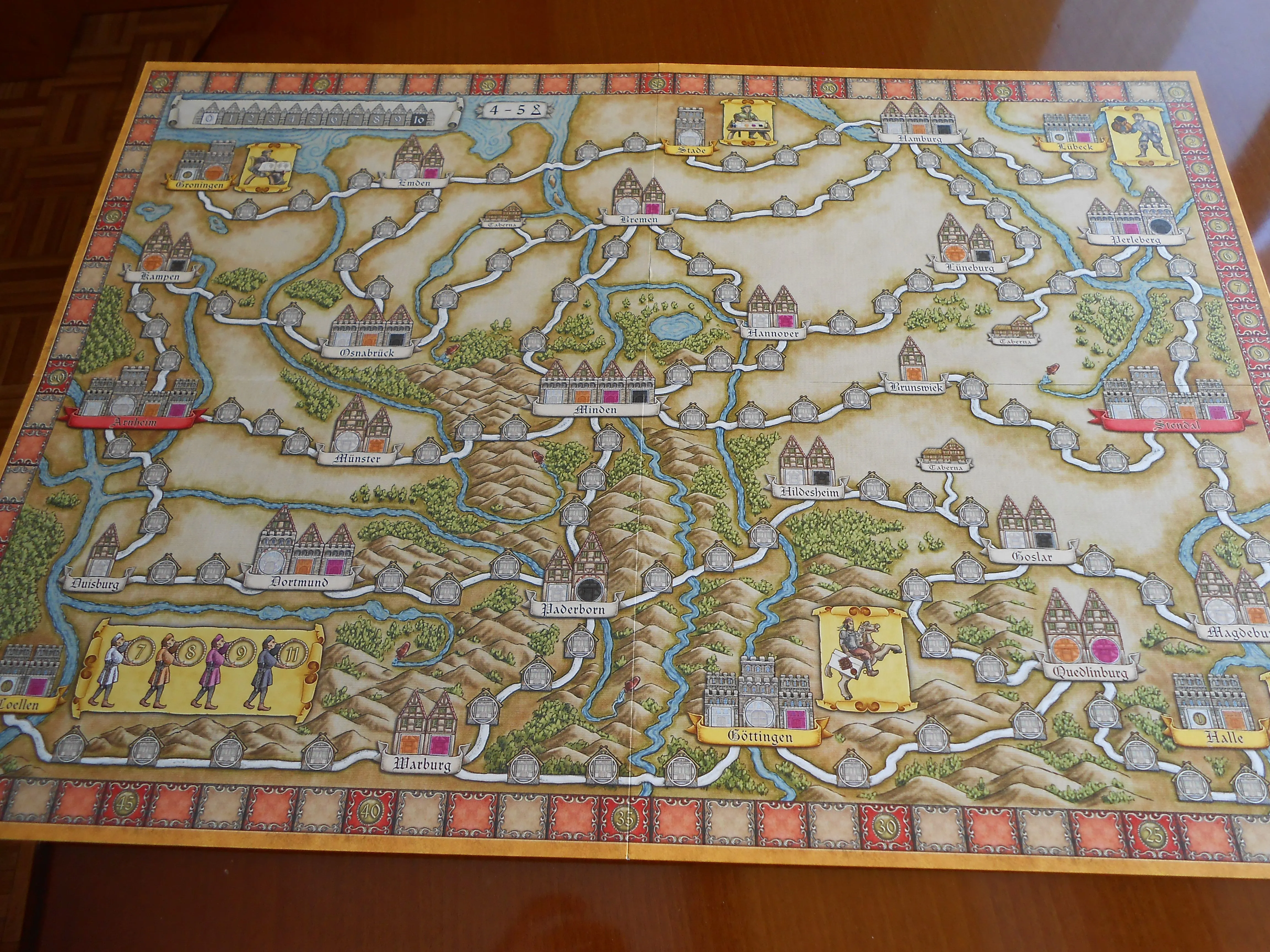
The map connects cities with trade routes. Cities contain office spaces; routes contain connection points. Some cities improve an ability, Coellen has special scoring, and red-banner cities define a long-distance connection. The player writing desk tracks five abilities and stores bonus markers.
- Cities — where offices are built and control is counted (route resolution).
- Trade routes — place pieces on their connection points (actions).
- Writing desk — tracks abilities and available actions (abilities).
A turn
Take the number of actions shown by your Actions track, usually two at the start. Choose among Income, Place, Displace, Move, and Create a Trade Route. You may repeat an action. You may also use collected bonus markers during your turns; they do not cost actions.
A route is complete when every connection point is filled only by your pieces. Spend a separate Create a Trade Route action to claim it. Score control of each endpoint city first, take the route’s marker if present, then choose at most one reward: establish an office, develop the city’s ability, or (on Coellen–Warburg) claim special points. Follow the full turn rules.
How the game ends
The game ends during a route claim if a player reaches 20 prestige, the marker supply runs out when a replacement marker is due, or the tenth city is completed. Finish that route action; all remaining actions and turns are lost. Add points from the score track, fully developed abilities, bonus markers, Coellen, controlled cities, and the largest connected office network.
Ways to score
| Source | Points |
|---|---|
| City control when a route is claimed | 1 per endpoint city controlled |
| Marked first office in selected cities | 1 immediately |
| East–West connection | 7 / 4 / 2 for first / second / third |
| Fully developed ability | 4 each, except City Keys |
| Collected bonus markers | 1 to 21 by collection total |
| Coellen | printed barrel value |
| City control at game end | 2 per controlled city |
| Largest network | offices in network × City Keys value |
What each resource is for
| Resource | Why it matters | How it enters play |
|---|---|---|
| Traders (cubes) | Fill square offices and route spaces | Start on your desk or in supply; move from personal supply to the board |
| Merchants (discs) | Fill round offices and Coellen scoring spaces | Start on your desk or in your personal supply |
| Personal supply | Pieces you can spend on actions | Refill with Income or when an ability is developed |
| General stock | Shared reserve | Income moves pieces from here to your personal supply |
| Bonus markers | One-time actions and endgame points | Claim routes; place replacement markers at turn end |
| Ability tracks | Improve your action economy and network score | Claim a route beside its marked city |
Teaching tips
- Keep personal supply and general stock visibly separate; only personal-supply pieces can be spent.
- Show that filling a route does not claim it: that takes another action.
- Resolve a route in printed order: city points, marker, then one reward.
- Teach the five abilities before explaining why players contest the upgrade cities.