Teach the Game
A script to read aloud: how you win Great Western Trail, the board and your player board, a turn, Kansas City, the end, every source of points and what each resource is for.
How you win
“We are 19th-century ranchers. We drive our herds along a winding trail to Kansas City, five to seven times each, and ship them west by train. Along the way we build, hire cowboys, craftsmen and engineers, and buy better cattle. In about 30 minutes per player, whoever has the most victory points wins.”
- You need: victory points
 — from deliveries to the far cities, your buildings, train stations, hazards and teepees, objective cards, your cattle, workers, certificates and money.
- You get them by: running the trail quickly and stopping where it pays, arriving in Kansas City with many different cattle breeds in hand, and investing in one kind of worker: cowboys (cattle), craftsmen (buildings) or engineers (railroad).
The boards
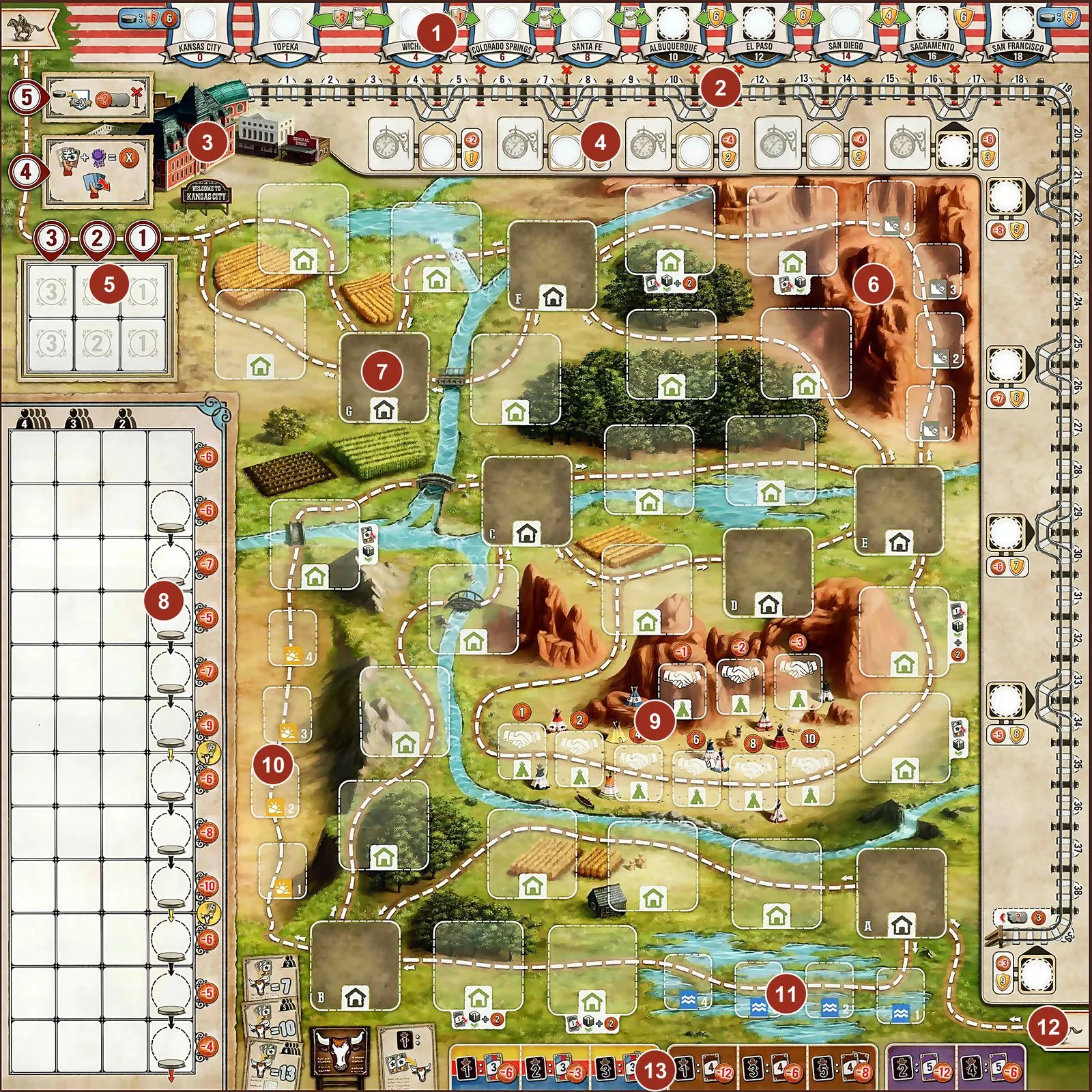
- Cities — Kansas City (0) to San Francisco (18); green arrows between cities give points or objective cards.
- Railroad track — spaces 1–39; red crosses are transport costs.
- Kansas City — the end of the trail and its five subphases.
- Train stations — upgrade cost and points; the first five have station master tiles.
- Foresight spaces — the six tiles that come into play next.
- Hazard section: rockfall — spaces 1–4 on the trail.
- Neutral building — the seven lettered tiles anyone can use.
- Job market — workers for hire, rows with their cost.
- Indian trade section — teepees, each with the money above it.
- Hazard section: drought.
- Hazard section: flood.
- Start of the trail — where your cattleman starts every trip after the first.
- Cattle market prices — what cowboys and dollars buy.
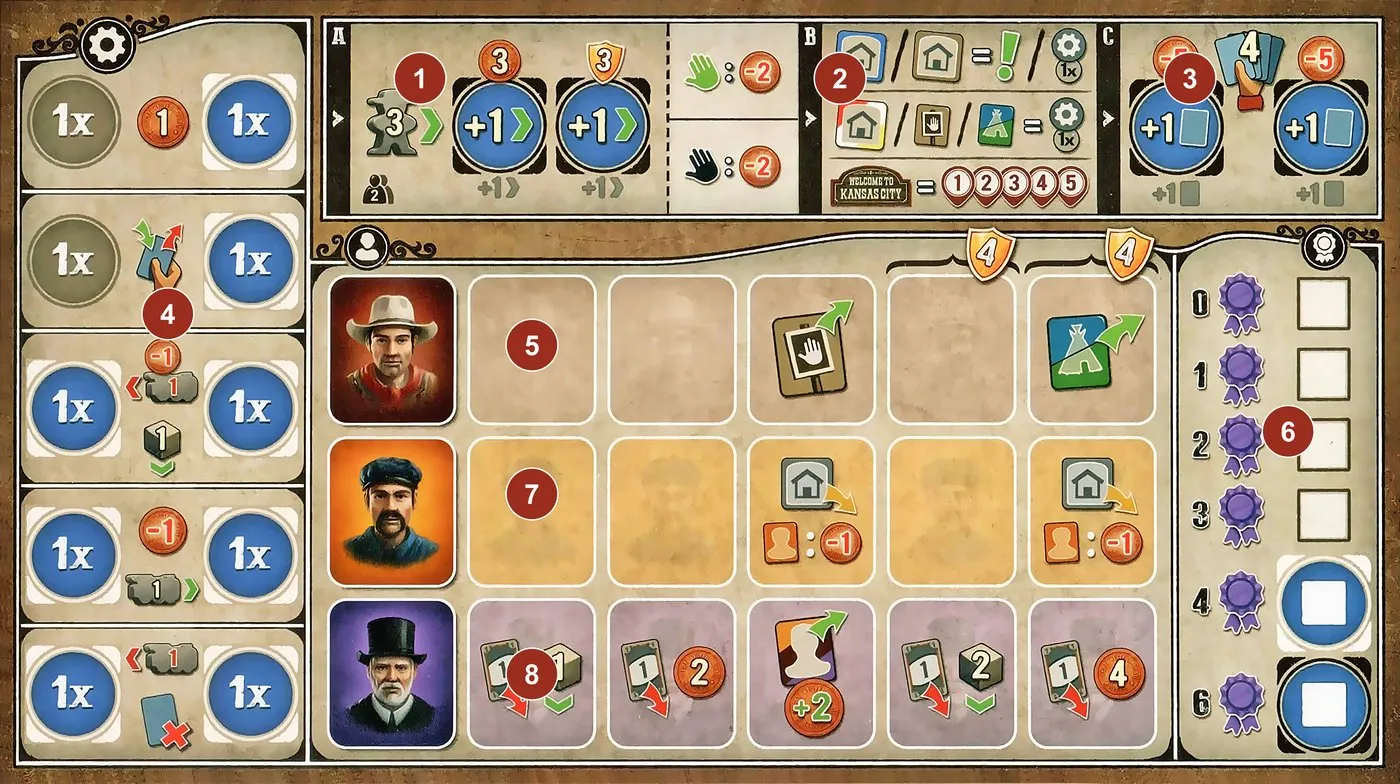
- Step limit — how far your cattleman moves; the discs open +1 (or +2) steps.
- Phase B reminder — what you may do where you stop.
- Hand limit — 4 cards; the discs open 5 and 6 (5 dollars each).
- Auxiliary actions — five small actions, two open from the start.
- Cowboy row — with immediate actions on spaces 4 and 6.
- Certificate track — temporary certificates (limit 3, then 4 and 6).
- Craftsman row.
- Engineer row — immediate actions on most spaces.
A turn
- Phase A — Move your cattleman forward 1 or more locations, up to your step limit; pay the green and black hands you cross (details).
- Phase B — Use the location where you stop (details):
| Where you stop | What you do |
|---|---|
| A neutral building or your own building | Its local actions (any, in any order) — or one  auxiliary action |
| Another player’s building, a hazard or a teepee | One auxiliary action |
| Kansas City | The five Kansas City subphases |
- Phase C — Draw up to your hand limit (details).
The actions on buildings:  hire a worker,
 place a building,
 buy cattle,
 move your engine,
 remove a hazard,
 trade with the Indians,
 take an objective, and discarding cattle for
 dollars or
 certificates.
How the game ends
When a player puts a worker on the last space of the job market (in Kansas City), the job market token leaves the board: that player finishes the turn and takes the token (+2 points). Everyone else takes one more turn, then the game ends (details).
Score eleven categories; most points wins, ties share the victory.
Ways to score
| Source | How and when |
|---|---|
| Money | 1 point per 5 dollars at the end |
| Buildings | The points printed on your private buildings on the board |
| Cities | Points on the city crests you have unlocked; Kansas City −6 per disc, San Francisco 9 per disc |
| Train stations | The points beside each station with your disc |
| Hazards | The points printed on the hazard tiles you took |
| Cattle | The points printed on the cattle cards in your deck |
| Objective cards | Points of fulfilled cards, minus the penalty of unfulfilled ones you played |
| Station master tiles | Each tile’s own task (workers, certificates, hazards, objectives or teepee pairs) |
| Workers | 4 points for each worker on the 5th or 6th space of a row |
| Disc space | 3 points for clearing the disc beside the second step-limit upgrade |
| Job market token | 2 points to the player who ended the game |
| Lost points | Kansas City deliveries (−6), unfulfilled objectives, negative city arrows |
What each resource is for
| Resource | Why you need it | How you get it | How you use it |
|---|---|---|---|
| Cattle cards | Income in Kansas City; points | Start with 14; buy in the cattle market | Different breeds in hand at Kansas City; discard for building actions |
| Dollars | Workers, buildings, cattle, stations, fees; 1 point per 5 | Kansas City income, discarding cattle, building actions | Pay costs |
| Certificates | Raise your hand’s breeding value; points | Discarding cattle, buildings, station masters | Spend in Kansas City to reach farther cities |
| Cowboys | Buy better cattle | Job market | One cowboy per purchase option, or add 2 cards to the market |
| Craftsmen | Your own buildings | Job market | You need as many as the building shows; pay 2 dollars each |
| Engineers | Engine movement | Job market | Move up to one space per engineer |
| Engine | Cheaper deliveries; stations | Engineers, buildings, auxiliary actions | Upgrade stations; reduce transport costs |
| Discs | Unlock upgrades and auxiliary actions | 14 on your board | Placed on cities and stations |
| Hazards and teepees | Points, objectives, station masters | Remove-a-hazard and trade actions | Kept in front of you |
| Objective cards | Points and a one-off bonus | Buildings, city arrows, station master | Play for the bonus, or keep in your deck |
Teaching tips
- Start with the loop: trail → Kansas City → back to the start, about five to seven times. Everything else feeds that loop.
- Show the Kansas City income early: only different breeds count, which is why you discard cattle on the way.
- Point out that hands are paid as you pass, and that the first turn starts on any neutral building.
- First game: buildings A–G on their lettered spaces and every private building on its a-side.