Teach the Game
A teachable overview of Aqua Mirabilis, from the Sundial and production loop to perfume scoring.
How you win
You are a perfumer competing for prestige at Versailles. Make flowers into scents, combine scents into perfumes, and present those perfumes to the King and Court. When the time marker reaches the final Sunday, finish the current round as instructed, resolve the final-Sunday effects and parade, then score bonuses. The player with the most prestige wins. Ties break by Dame favours, Experience, Letter of Reference level, then the number of complete perfumes; if still tied, the tied players share victory.
The boards
The shared board has the Flower Market and Apprenticeship area at Grasse, four Noble couples, the Versailles presentation area and Preference Matrix, four travel cities, a prestige track, and the day track. The Flower Market has six flower spaces, each with a worker space that can add another flower to a market visit. The matrix tracks the Court’s scent row and the King’s scent column; each intersection has four spaces (two in a two-player game) for previous presentations.
Your studio board is a work area, not a separate action board. It holds your Curriculum (Experience tiles), up to three Production Methods, scent supply, three perfume slots, Sundial, Letter of Reference, Dame favours and flipped City tiles. Keep Influence, Originality tokens and flowers beside it.
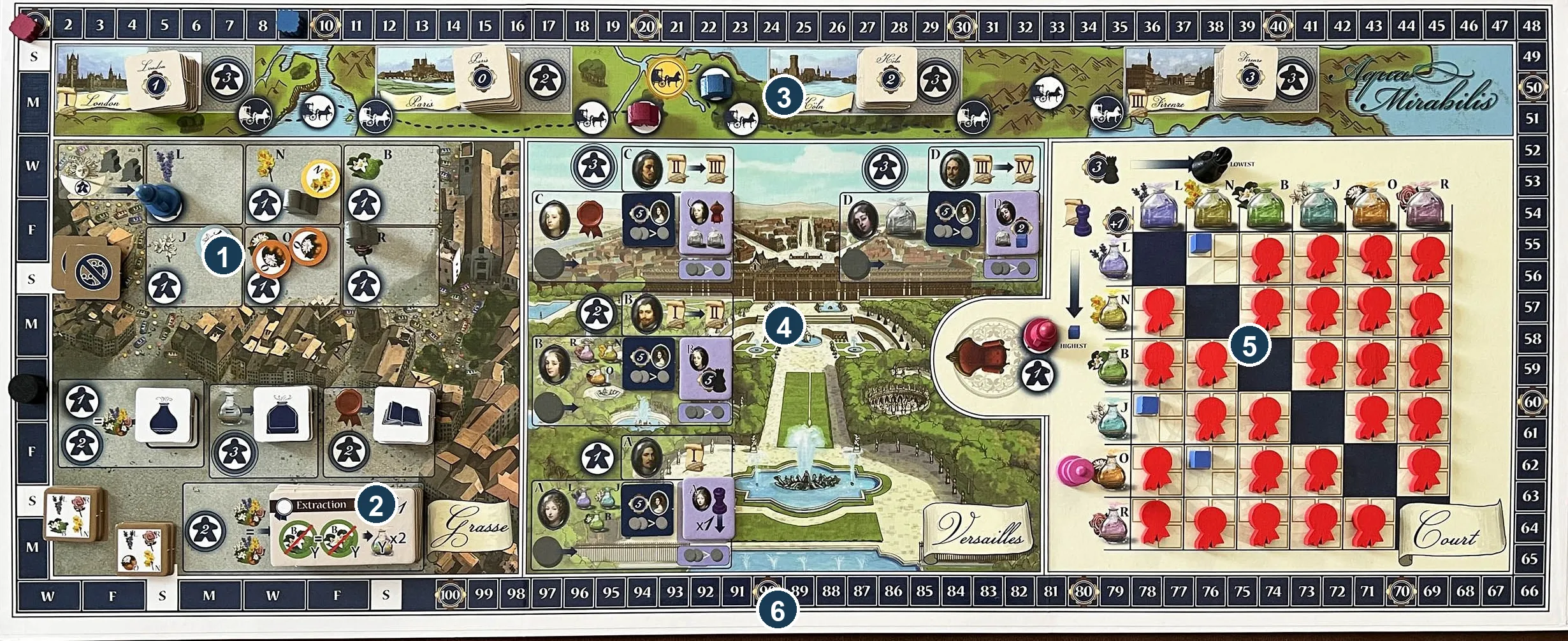
- Flower Market — choose a flower space and move Workers to gather more.
- Apprenticeship area — learn a permanent skill or a Production Method.
- Travel cities — use Coach movement during production to reach a city.
- Noble couples — meet the Nobleman and optionally make an eligible gift to the Dame.
- Versailles Preference Matrix — score each base-and-complement pair here.
- Day and prestige tracks — track the game end and each player’s score.
This photograph shows the two-player face; use the other face for three or four players.
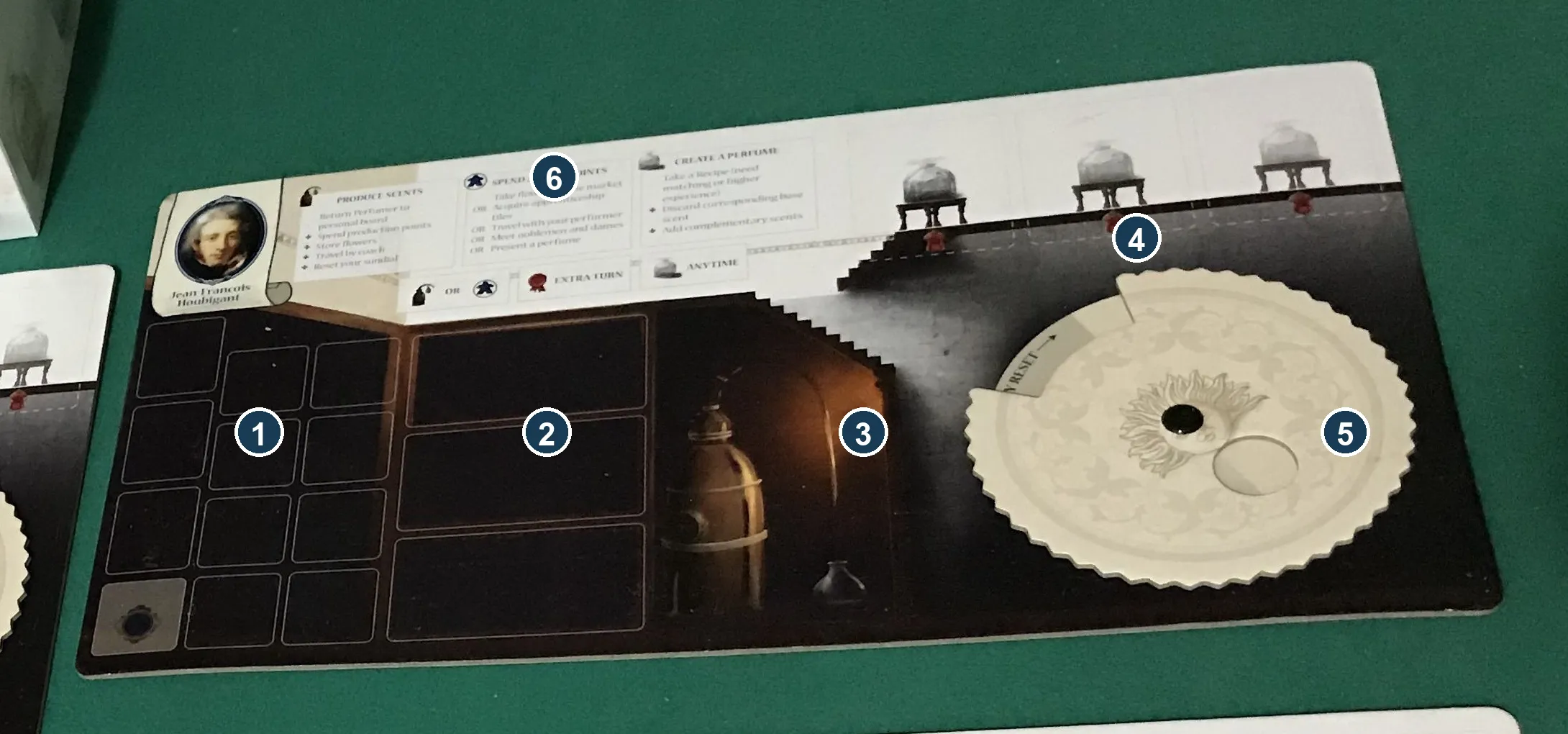
- Curriculum — keep Apprenticeship and unflipped City tiles here.
- Production Method slots — start with Distillation and add methods here.
- Scent depot — store produced Scents for Recipes and gifts.
- Perfume parade — hold up to three completed perfumes and show whether they have been presented.
- Sundial — pay Action Points and read production and Coach movement.
- Player aid — a reminder of the production, action and perfume loops.
The personal board photo is angled and small text may be hard to read; use the rules pages for exact costs and reminders.
A round and a turn
Play begins on the first Sunday. Starting with the first player, take turns clockwise. On a turn, either move your Perfumer to an available shared-board action and spend its Action Points, or return the Perfumer to your studio and use Production Points to make scents. The Sundial shows the tradeoff: as you spend Action Points, the remaining dial positions provide fewer Production Points and coach movement. Spending all remaining Action Points resets the dial and advances the day; choosing production also resets it and advances the day. Finish the action that caused a reset before carrying out Sunday procedures.
After a turn, you may spend one Originality token to take one extra turn immediately. You may not take more than two consecutive turns. An action type cannot be repeated on consecutive turns; the six market flower spaces are different types, while the four Versailles spaces form one type.
On a board-action turn, the action usually costs Action Points. At the market, pay for your Perfumer’s space and any workers you move, then take one flower from each occupied basket among your Perfumer and the two workers. At Apprenticeship, buy an eligible tile and add its Experience and effect. Travel takes the top City tile at the chosen city; the Letter of Reference level must meet that city’s requirement. Court life first offers the Nobleman action, then lets you give eligible gifts to the Dame and place matching Influence. Versailles lets you present a finished perfume for one Action Point.
On a production turn, you need at least one flower and one Production Point. Return your Perfumer to your studio, use any active Production Methods as often as their printed costs and inputs allow, and turn eligible flowers into scents. You may store leftover flowers on valid method inputs; discard anything left over. The dial may also let you move your Coach. Produce and travel using the same dial setting, then reset and advance the day.
How the game ends
When the marker reaches the final Sunday, follow the rulebook’s final-turn procedure: continue until play order returns to the player who triggered the end, allowing that player one final extra turn if they spend an Originality token. Resolve final-Sunday board effects, including the market and Preference Matrix changes, then hold the final perfume parade. Players may finish perfumes from available scents and Recipes before scoring their perfumes; no City tiles may be used in this step. During the parade, score eligible pairs as usual but do not place cubes or take Originality tokens. Finally add end-game bonuses.
Ways to score
| Source | Prestige |
|---|---|
| Each empty cell remaining in a claimed matrix intersection after placing your cube | 0–3 (0–2 in a two-player game), for each eligible scent pair |
| First presentation of a scent pair | Take its available Originality token; each token still held at game end is 1 point |
| Court preference match | Letter of Reference value (1, 2, 3 or 5) for each eligible pair matching the Court row |
| King preference match | 3 points, or 5 with Dame B; once per perfume, on the first pair only |
| Perfection (both preferences match) | 1 point per matching pair |
| Dame D favour | 2 points each time you place a matrix cube |
| Flipped City tiles | Their printed end-game values |
| Dame majorities | 5 points per Dame; a tied majority scores none |
| Final Bonus tile | Its printed condition and value |
What each resource is for
| Resource or piece | Why you need it | How you get it | How you use it |
|---|---|---|---|
| Flowers | Inputs for making Scents | Take them from the market or a City effect | Convert with an eligible Production Method, store on a matching method, or discard after production |
| Scents | Ingredients for perfumes and some Apprenticeships or gifts | Produce from Flowers or gain from effects | Pay a Recipe’s base unless you have its Base Scent tile; fill every complement slot with a different Scent |
| Recipes | Define each perfume’s base, complements and Experience level | Take one when your Experience meets its level | Complete it immediately, then present the perfume once before the final parade |
| Experience | Unlocks higher-level Recipes | Gain it from Apprenticeship and unflipped City tiles | Keep enough to meet the Recipe level; flipping a City tile removes its contribution |
| Letter of Reference | Unlocks City piles and sets Court-preference points | Gain or upgrade it through a Nobleman | Check the city’s minimum level and use its value when scoring a matching Court row |
| Influence | Competes for each Dame’s favour | Place a token after an eligible gift or effect | Majority controls the favour; each majority is worth 5 at game end |
| Originality tokens | Flexible action and scoring resource | Claim from an available matrix intersection or a City effect | Spend for an extra turn or specified cost; each token kept is worth 1 point |
| Action Points | Pay for shared-board actions | Rotate the Sundial | Spend the action space’s printed cost |
| Production Points | Pay for converting Flowers to Scents | Read from the Sundial’s production setting and Apprenticeships | Spend the method’s cost during production |
| Coach legs | Reach a City for a tile | Read the remaining travel setting on the Sundial | Move the Coach during production, up to the allowed distance |
| Blue cubes | Track previous presentations | Take from your player supply | Place one in each available matrix intersection used by a perfume pair |
| Workers and Perfumer | Collect Flowers from more than one basket | Shared Workers begin on the market; the Perfumer is your piece | Place the Perfumer on one flower space and optionally move Workers to collect one Flower per occupied basket |
| Coach and markers | Track travel, timing and preferences | Each starts in its printed setup position | Track City progress, Sunday procedures, the end trigger, and the King’s and Court’s scoring preferences |
Teaching tips
Teach the Sundial and its tradeoff first, then demonstrate one market visit with the workers. Show the Production Methods next, including where leftover flowers can be stored and that anything else is discarded. Explain Recipe completion before describing Experience and City tiles, so players understand why a City benefit can cost recipe access. Finish with Court life and the Preference Matrix, emphasizing that a full intersection yields no points and the King bonus is limited to once per perfume. End with the Sunday reset and final parade so the time track is clear from the start.
- Point out that a production turn advances the day and spending all Action Points also advances it.
- Remind players that no Flower can be converted unless an active method accepts it.
- Show one Recipe and name its base, Experience level and distinct complements before anyone collects ingredients.
- During the first presentation, score each pair separately and check whether its matrix intersection still has room.