Teach the Game
Build a hospital engine, diagnose and treat patients, and earn the most points over seven rounds.
How you win
“Run a growing hospital, keep patients alive, and show the board of directors that your hospital should lead the world.” Players build production and card effects, then use those resources to treat patients. Most Victory Points at the end wins.
The boards
The shared board tracks seven rounds, Ambulance rewards, Quality of Care, Prestige, Victory Points, four Insurance Companies, and resource production. Each player has a Hospital board with four patient spaces; Outpatient Clinics and Clinical Trial cards add capacity.
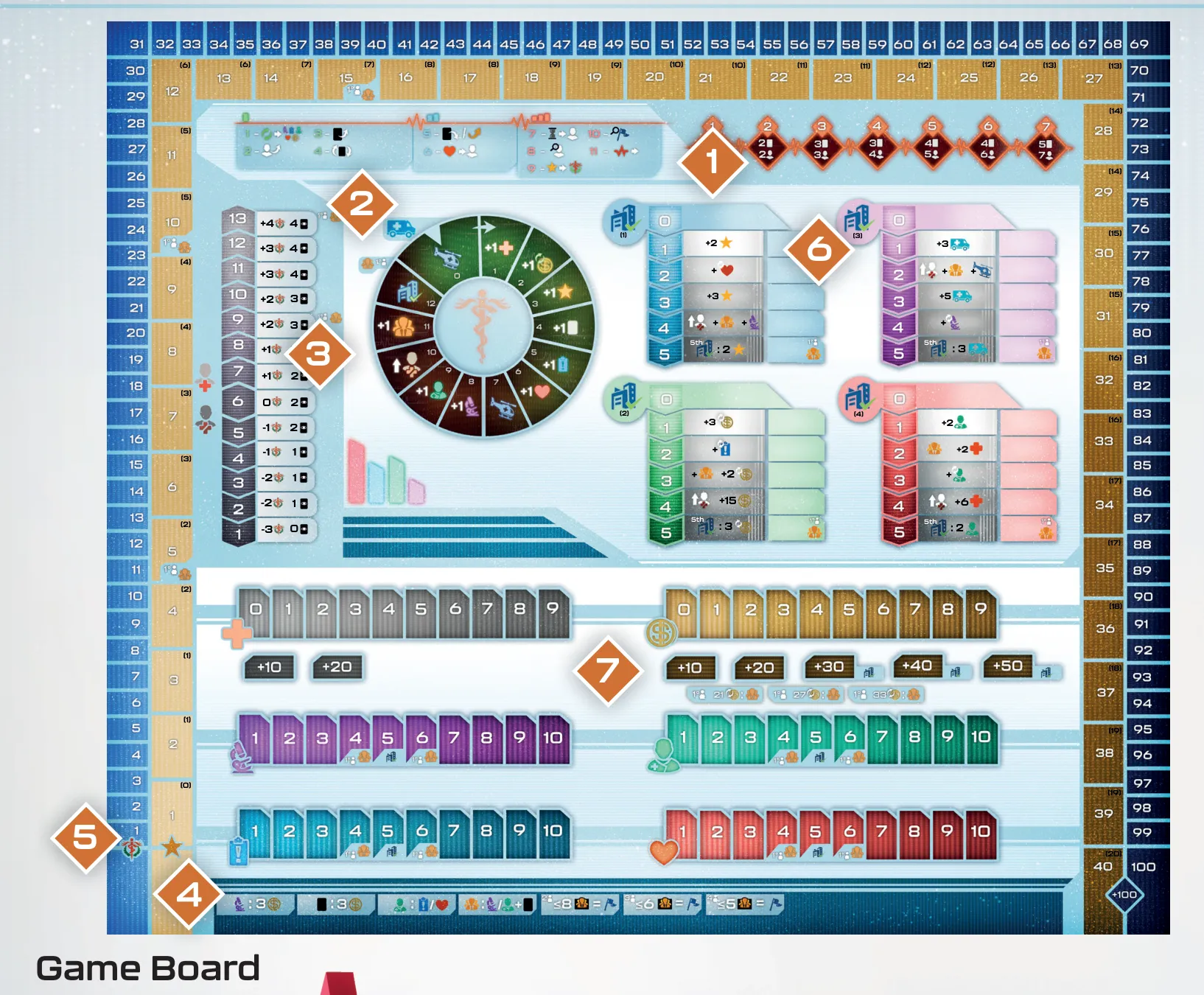
- Round track · 2. Ambulance track · 3. Quality of Care · 4. Conversion reminder · 5. Prestige and points · 6. Insurance Companies · 7. Resource production.
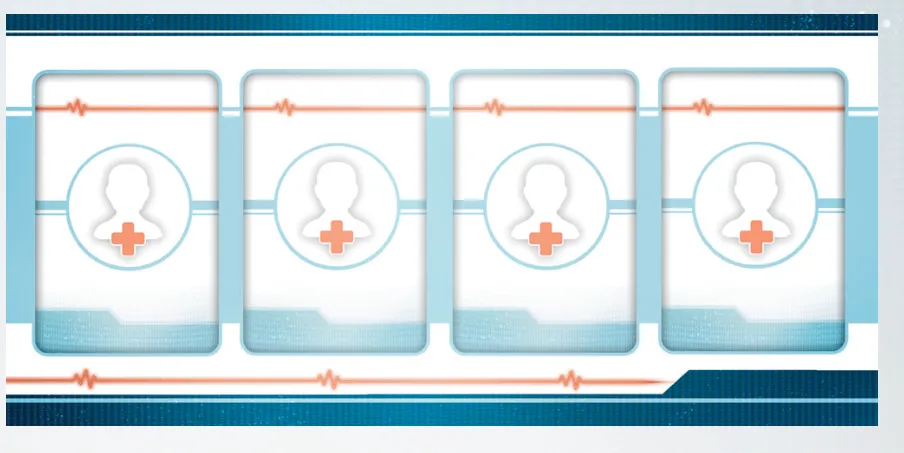
- Patient space 1 · 2. Patient space 2 · 3. Patient space 3 · 4. Patient space 4.
A round
Each round has four phases: Preparation, Actions, Patient Treatment, then Cleanup. In Preparation draw the round’s Medical cards and Patients, take production, and ready used action cards. On your turn in Actions, play a Medical card, activate one of your action cards, or pass. Treatment can be simultaneous: spend Diagnostics to identify Patients, then Healing to cure them. Cleanup adds time, checks deaths, scores Prestige, checks the end condition, and advances the round. See Rounds and Actions and Patients and Treatment.
How the game ends
The game ends after round 7, or earlier if Congress Doctors on the main board fall to the player-count threshold: 8 or fewer at 2 players, 6 or fewer at 3, or 5 or fewer at 4. Add final scoring from Quality of Care and comparisons against each rival. The highest score wins; tiebreaks start with Quality of Care, then Prestige. Full scoring.
Ways to score
| Source | Points |
|---|---|
| Cured Patients | Score the value on each Patient; also gain its Credit reward. |
| Prestige | At each Cleanup, score half your Prestige, rounded down. |
| Quality of Care | At game end, score or lose the value shown at your position. |
| Rival comparisons | At game end, gain 1 point for each opponent whose value you exceed on Quality of Care, Insurance Companies, Prestige, Credit production, Diagnostics, Healing, Research or Staff. |
| Cards and effects | Follow the immediate, ongoing or action reward printed on each card. |
What each resource is for
| Resource | Why you need it | How you get it | How you use it |
|---|---|---|---|
 Credits | Pay many Medical cards and build income. | Credit production, Patients, cards and selling. | Pay card costs; discard a hand card or Research for 3 Credits as a free action. |
 Diagnostics | Identify Patients. | Production, cards, Ambulance rewards. | Pay diagnostic difficulty during Treatment. |
 Healing | Cure diagnosed Patients. | Production, cards, Ambulance rewards. | Pay healing difficulty during Treatment. |
 Research | Play some Medical cards. | Production and card effects. | Pay card costs or trade one for 3 Credits. |
 Staff | Flexible treatment resource. | Production and card effects. | Substitute for Diagnostics or Healing during Treatment. |
 Congress Doctors | Flexible specialist resource. | Reach marked spaces on board tracks. | Use as Staff or Research; gaining one also draws a Medical card. |
 Time | Tracks delays on Patients. | Cleanup. | Place on unresolved Patients; priority determines when they die. |
 Treated Patients | A progress track earned by curing Patients. | Cure a Patient (except Terminal Patients) and card effects. | Pay Clinical Trial costs. |
Teaching tips
- Explain the patient clock early: Critical patients need treatment this round, while Severe patients die at two Time.
- Show how Staff and Congress Doctors cover resource shortages, and how Clinical Trials spend treated-patient progress.
- Remind players to leave space for arriving Patients; rejecting one costs Quality of Care.
- The released English rules run for seven rounds; older prototype tutorials show different setup and card rules.