Teach the Game
A script to read aloud: how you win Galileo's Truth, the boards, a Cycle, the end, every way to score and what each resource is for.
How you win
“It is 1610, and we are scholars in Galileo’s Italy. Over five Cycles we write treatises, build inventions and observe the sky — while the Inquisition watches. Every bold idea raises our Suspicion; too much of it means Penance, Prison or the Stake. Most points after the fifth Cycle wins.”
- You need: VP — mostly from writing Treatises first, Academic Levels, Mastery, Observation Tiles, Inventions and a free (and preferably Copernican) Natural Philosopher at the end.
- You get them by: playing Treatise Cards for Books and actions, spending those Books, Coins and Research on the pyramid, the Workshop and the sky — and keeping your Suspicion low enough to stay out of the Inquisition’s hands.
The boards
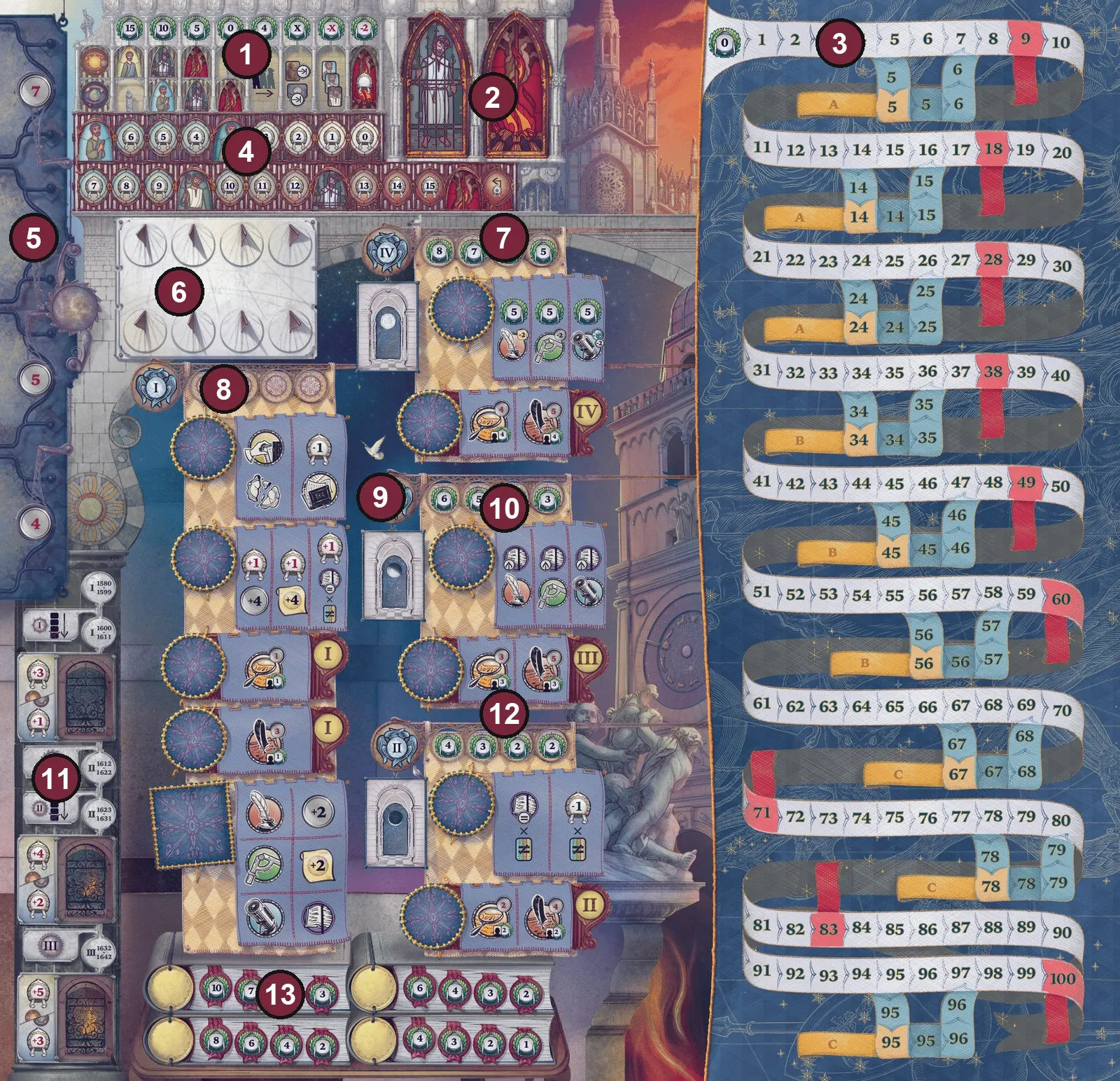
- Cathedral — your final status: free, in Prison or at the Stake, Copernican or Ptolemaic.
- Prison and Stake — where an arrested or condemned Natural Philosopher goes.
- Scoring Track — VP, with Travel detours and Suspicion spaces.
- Suspicion Track — with the Penance, Prison and Stake pictures.
- Workshop — four Inventions for sale; the price rises towards the top.
- Turn order tracks — current order, Passing Area and next Cycle’s order, with the Inquisition Token.
- Level IV action spaces — and its Academic Level row.
- Level I action spaces — where everyone starts.
- Graduation spaces — what it takes to reach Levels II, III and IV.
- Level III action spaces.
- Cycle Track and Prohibitions — five Cycles, the turning points and the three Prohibitions.
- Level II action spaces.
- Mastery Tracks — first to fill a Subject scores most.
Beside it: the pyramid of Treatise Boards (Levels I to IV) and the three Invention decks. Each player has a personal board: Bookshelf, Window and Desk.
A round
The game has five Cycles (full rules):
- Income (not in Cycle 1) — Income Inventions, then your Bookshelf pays VP, Coins, Research and cards.
- Actions — one Main Action each, in turn order, until everyone passes: play Treatises, use your Natural Philosopher, use an Invention, upgrade your Level, play Penance, Abjure — or pass. Once someone passes, the Inquisition charges 1 Suspicion for every further action.
- End of the Cycle — reset turn order, update the Workshop, and in Cycles 2, 3 and 5 check the Prohibition.
How the game ends
- After Cycle 5’s End of the Cycle Phase (scoring).
- Score your Natural Philosopher’s status, 4 VP per player below you on status, End-Game Inventions and your Scoring Mentor; lose VP for Penance Cards and for Suspicion gained after the Stake.
- Ties: the earliest in turn order wins.
Ways to score
| Source | How and when |
|---|---|
 Writing Treatises | The leftmost free seal space’s VP — earlier is better |
| Copied and read Treatises | Others pay you VP when they copy or read a Treatise where your seal is leftmost |
 Academic Levels | 4 / 6 / 8 VP for the first to reach Level II / III / IV, less for later players |
 Mastery | Filling a Subject Track: up to 10 VP on the best Mastery Track |
 Astronomy income | VP each Income Phase from your Astronomy Level |
 Observing the Sky | 2 VP bonus if Copernican, plus VP on tiles and Window spaces |
 Inventions, Travel Tiles, Mentors | Printed VP;  End-Game Inventions at the end |
| Final status | 15 / 10 / 5 (Copernican) or 10 / 5 / 0 (Ptolemaic) for free / Prison / Stake |
| Rank | 4 VP per player with a lower status score |
| Scoring Mentor | When unlocked, VP at the end for its goal |
| Penance Cards | −3 / −4 / −5 at the end unless paid off |
| The Stake | −2 VP per Suspicion gained after condemnation |
What each resource is for
| Resource | Why you need it | How you get it | How you use it |
|---|---|---|---|
 Books | Pay for Treatises, Inventions and observations; feed income | Treatise spines, cards, action spaces, tiles | Spend from your Bookshelf — the Level matters, not just the count |
 Coins | Inventions, Copy and Read, paying off Penance | Physics income, cards, spaces | Pay from your Desk (max 10) |
 Research | Writing Treatises and observing | Mathematics income, cards, spaces | Pay from your Desk (max 10) |
| Treatise Cards | Your hand: Books and actions | Writing or copying Treatises; Philosophy income draws | Play same-Subject stacks; remove for their Books |
| Wax Seals | Your claims on the boards | Start on your Mentors | Placing or discarding them unlocks Mentors |
| Natural Philosopher | One strong board action per Cycle; final status | Stands ready each Cycle | Place on a space of your Academic Level |
 Suspicion | The cost of boldness | Actions, Scoring Track, Inquisition, Prohibitions | Keep it low: Penance at the pictures, then Prison, then the Stake |
 Principle | Better observations and status | Start Copernican | Abjure once: −5 Suspicion, but weaker sky and status |
Teaching tips
- Teach the Suspicion Track early with its three pictures — every decision is priced in Suspicion.
- Show one stacked Treatise play: same Subject, all spines give Books, only the top card’s icons count.
- Explain the Book Level requirement with the example: having enough Books is not enough.
- Play Cycle 1 slowly and point out the moment the Inquisition Token flips.