Suspicion, Books and Boards
Galileo's Truth key concepts: the Principle Coin, icons, Suspicion with Penance, Prison and the Stake, the Scoring Track, the Bookshelf and spending Books, the Window, the Desk, Mentor Cards and Wax Seals.
Principle Coin
Everyone starts  Copernican. With the Abjure action you may turn your coin to
 Ptolemaic — once, for good. Wherever a card, space or tile shows the Principle split, you do the half that matches your coin: when you Observe the Sky, play Treatises, use Inventions and resolve Prohibitions. It also changes your final status.
Icons
- Secondary Actions have a round frame and are optional (list).
- Effects have no frame and are mandatory (list).
- A discount must be used. An arrow means: if you do the first icon, you also do the one it points to. Icons in brackets after a colon change the Secondary Action they follow.
Suspicion
Your marker on the Suspicion Track shows how closely the Inquisition watches you.  moves it forward,
 moves it back (never below 0). Actions, points on the Scoring Track, other players and the End of the Cycle can all move it — even on other players’ turns.
Between the numbers are three kinds of picture. They are markers, not spaces.
Penance
The first time your marker moves past a Penance picture, take the matching Penance Card (I, II or III) from your play area and put it face down on top of your draw deck. Moving back and past it again later gives nothing more.
A Penance Card in your hand must be played as a Main Action this Cycle (Play a Penance Card). You can never discard it, and you can’t pass while you hold one. Each Penance Card you still own at the end costs VP.
Prison
Moving past the Prison picture means arrest: your Natural Philosopher goes to the Prison space and can’t be used. If it was on an action space, lay it down (it counts as used this Cycle); the space it left is free again. Moving back past the Prison picture releases it at once — standing if it hadn’t been used, lying down if it had. This can happen many times, even in one turn.
The Stake
Moving past the Stake picture means condemnation: your Natural Philosopher goes to the Stake for the rest of the game. Then:
- Put your Suspicion Marker back on 0.
- Keep tracking Suspicion, but Penance, Prison and the Stake no longer affect you.
- Every Suspicion you gain from now on costs 2 VP at the end.
Scoring Track
- Travel spaces: at each fork you choose the path. The longer path scores more slowly, but as soon as your marker reaches or passes a Travel space you gain that Travel Tile’s icons (in any order, by the end of your turn; at once if outside your turn). A line on a tile means choose one side.
- Suspicion spaces: reaching or passing a space with a Suspicion Tile raises your Suspicion by the number shown. Then the tile is flipped or removed:
| Players | What happens to the tile |
|---|---|
| 2 | The first player to reach it flips it (2 → 1); it stays |
| 3 | The first player flips it; the second removes it |
| 4 | The first player flips it; the third removes it |
- Past 100 VP: Suspicion Tiles no longer affect you and you can’t take longer paths.
Personal board
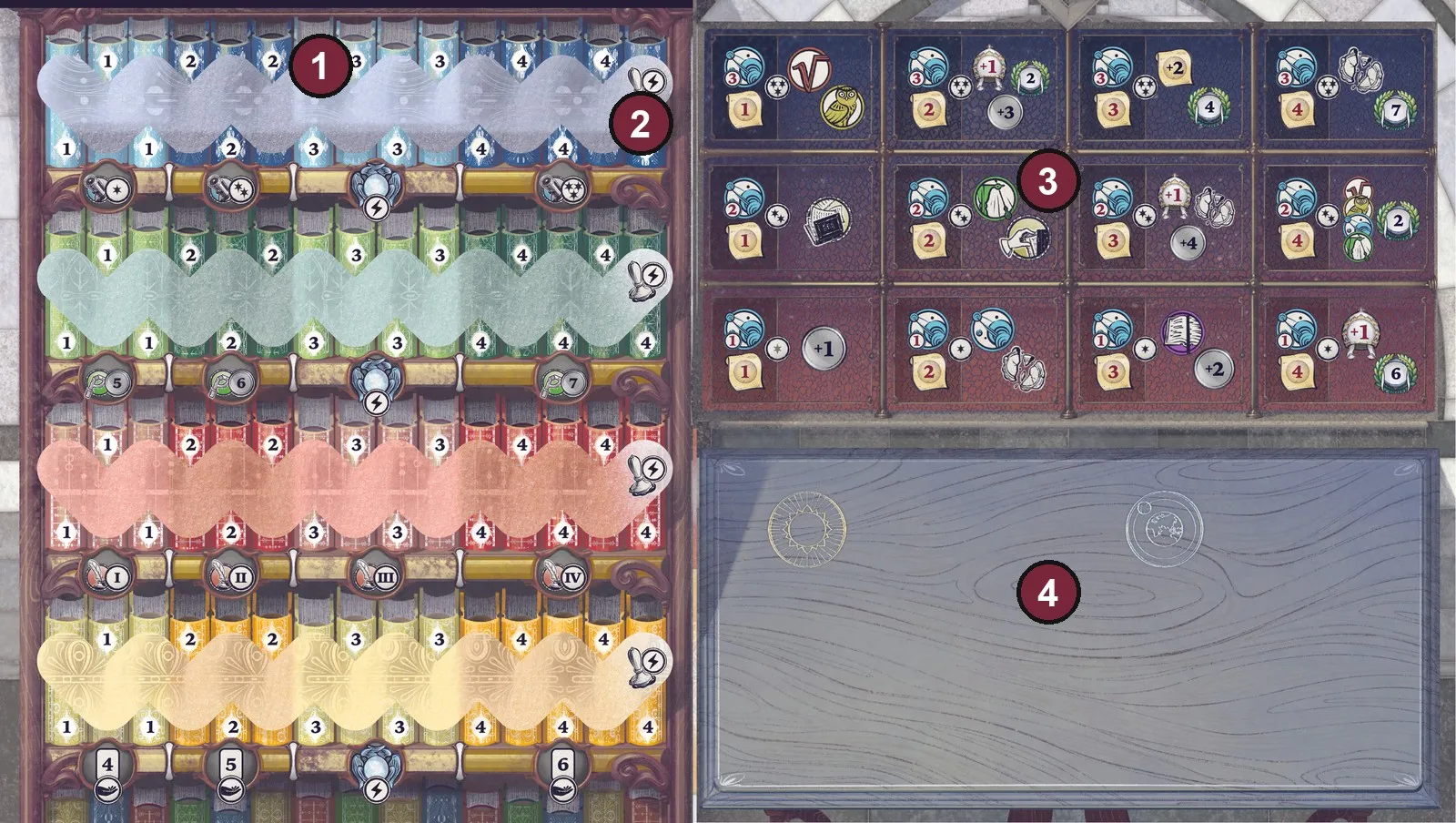
- Bookshelf — your four Subject Tracks.
- Mastery bonus — the end of each track.
- The Window — where your Observation Tiles go.
- The Desk — your Coins, Research and Principle Coin.
The picture is preview art from the publisher’s Tabletop Simulator module; check icons against the physical board.
Bookshelf
Four shelves track your Books:  Astronomy,
 Physics,
 Mathematics,
 Philosophy. Each is split into four Levels: I and II have 3 spaces, III has 4, IV has 5.
- Gaining Books: move the marker right one space per Book.
 is a Book of any Subject you choose.
- Spending Books: each single cost has a Level requirement — your marker must be on a Level showing at least that many Books. Then move it left one space per Book paid. A marker on the leftmost space can’t pay. Discounts lower the amount you pay, never the Level you need.
Mastery bonus
The first time a marker reaches the last space of its track, take a Wax Seal from any Mentor Card and put it on the leftmost free space of that Subject’s Mastery Track on the main board; score the VP printed there. You keep the bonus even if the marker moves back in the same turn. Books gained beyond the last space are lost. You can have only one seal on each Mastery Track.
Desk
Your  Coins,
 Research Tokens and Principle Coin. You own 10 of each kind: gain = move tokens onto the Desk, pay = move them off. You can never hold more than 10 or fewer than 0.
Mentor Cards and Wax Seals
You start with four Mentors — one Scoring Mentor and three Standard Mentors — with a Wax Seal on every lit candle.
- Removing seals: many actions take a Wax Seal off a Mentor of your choice, to discard it (
 ) or place it on the main board or a Treatise Board.
- Unlocking: when a Mentor has no seals left, its icons unlock — use them by the end of your turn. A Scoring Mentor pays its VP at the end of the game. If two empty at once, finish one before the other.
- No seals left on Mentors: take one from your reserve when you must place one.
- Seals on the main board or Treatise Boards stay there for the whole game.