Teach the Game
A first-game script for Counter Attack's hex-pitch football match.
How you win
Score more goals than your opponent by the end of the match. Move players with the ball, create a passing lane, then shoot or take a snapshot when a runner reaches the penalty area. The printed rules use two halves; use the official scenarios to learn specific matchups before a full league game.
The pitch and the teams
The publisher recommends a 90-minute match played as two 45-minute halves; the included sand timers limit decisions, while managers track match time separately. 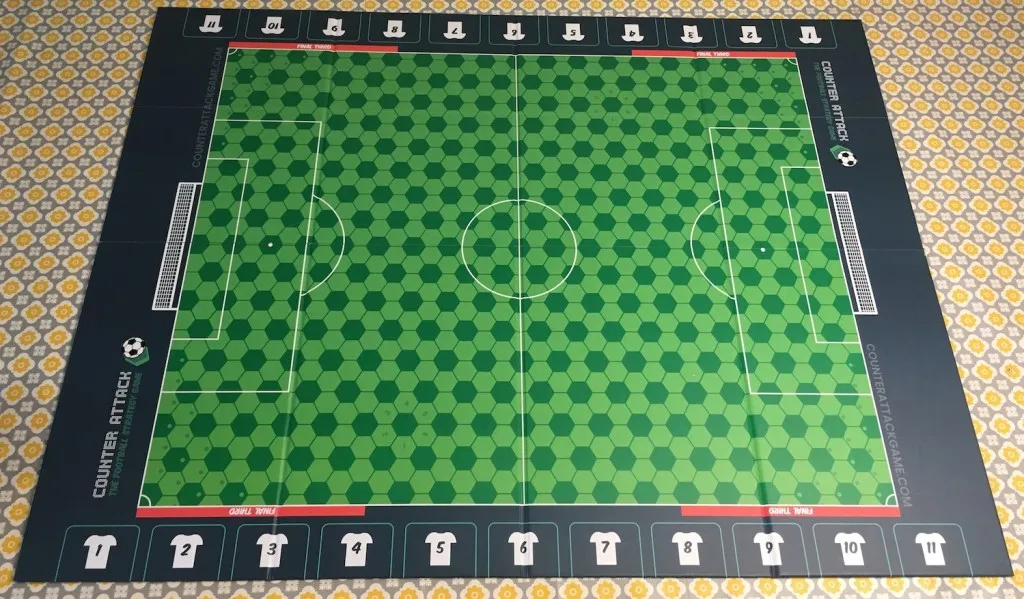
The pitch is a hex grid divided into halves and penalty areas. Each team has a goalkeeper and eleven players on the pitch; a drafted squad also includes five substitutes. A player card gives the skills used for movement, duels, passing, heading, shooting, saving and handling. The ball’s route and distance are measured with the supplied sticks, not by counting hexes.
A match
Managers alternate movement phases. In a standard phase, the attacking team moves up to four players by their Pace and the defending team moves up to five. The attacker then moves up to two additional players, each up to two hexes. Resolve any tackle when a defender adjacent to the ball carrier chooses to challenge. A successful tackle ends the phase and changes possession.
How the game ends
The rulebook suggests two 45-minute halves. When the score is tied, it says the managers may play extra time or decide the match with a penalty shootout; it does not give a detailed tie-break sequence in the core rules. Agree on a method before kick-off, and do not treat the two sand timers as a match clock.
Ways to score
A goal is scored when an attacker’s shot beats the goalkeeper’s save roll. A standard shot compares Shooting plus a die against Saving plus a die; outside the box and snapshots reduce the shooter’s total. A headed shot is resolved after a high pass and a header duel. The match score is the number of goals; there are no league points or resource conversions in a standard match.
What each resource is for
| Piece or value | Use |
|---|---|
| Player cards | Give each footballer’s skills and Pace. |
| Ball | Marks possession and the point from which passes and shots are measured. |
| Distance sticks | Set legal distances for passes, headers and shots. |
| Dice | Resolve contests, accuracy, fouls, injuries and referee decisions. |
| Yellow and red cards | Track bookings; a second yellow or a straight red removes a player. |
| Injury tokens | Mark a player whose Pace is reduced for the rest of the match. |
| Sand timers | Limit each manager’s decision time in the timed game. |
Teaching tips
- Start with the Core rules and use the 4-5-2 movement sequence; add Advanced rules after players understand the ball and tackle flow.
- Explain Zone of Influence before the first pass: nearby defenders can intercept, contest or deflect.
- Show a standard pass and a shot with the sticks before the opening kick-off.
- When a tackle, header or shot ties, resolve the loose ball rather than awarding possession automatically.
- Use the official Old versus New or Tortoise and the Hare solo scenario to practise a focused matchup.