Teach the Game
A concise teach for Arkwright: The Card Game: factory investment, market timing and share value.
How you win
After three decades, your final score is your remaining shares multiplied by their final value. Loans remove shares, and each ship used reduces share value at the end. Whoever has the highest total wins; most money breaks a tie, otherwise the tie is shared. The aim is to grow a valuable company without letting wages, loans or shipping erase the value you built.
The boards
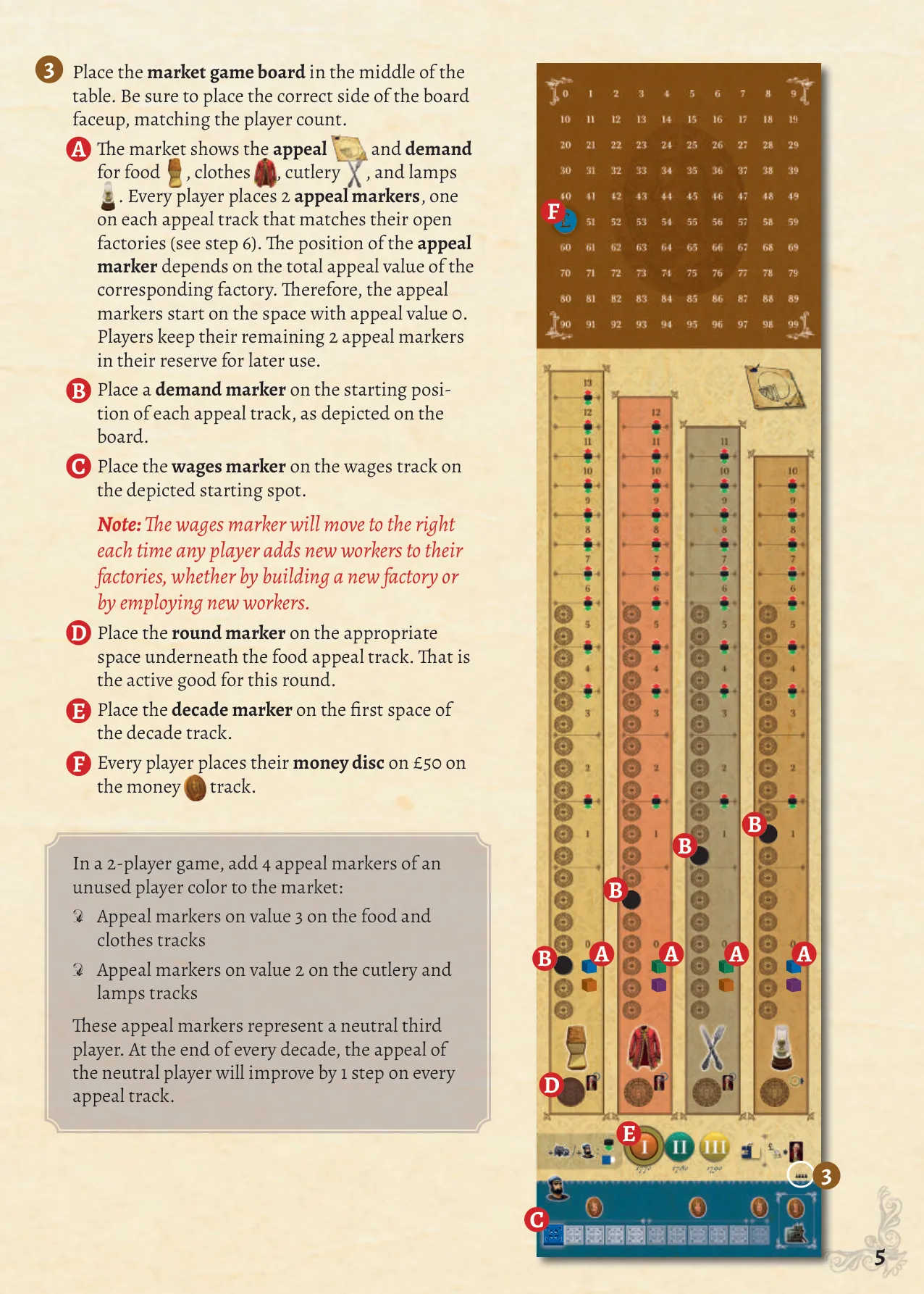
The shared Market board tracks four goods—Food, Clothes, Cutlery and Lamps—each with a demand track and an appeal track. Factory prices and appeal compete for home-market sales. A player board tracks shares, share value, money, loans, shipping penalties and six developments. A factory consists of its tile, an office, up to two worker cards and optional quality, distribution and warehouse cards. The factory and its cards together determine capacity, cost, appeal and sale price.
| Marker or good | What it tracks |
|---|---|
| Food, Clothes, Cutlery, Lamps | The four product types that activate in turn. |
| Appeal and Demand | The maximum quantity the home market accepts is your appeal minus demand, never more than your appeal. |
| Shares and Share value | Shares are multiplied by final share value. |
| Workers and Machines | Workers add production and wages; machines replace wages with maintenance. |
| Quality and Distribution | Quality trades between price and appeal; Distribution adds appeal and wears down after producing. |
| Shipping and Loans | Shipping earns cash but lowers final value; loans add cash but remove shares at scoring. |
| Money and Development | Money pays costs and buys shares; developments improve the factory system. |
A round
Play three decades of four rounds each. Each round activates one good in this order: Food, Clothes, Cutlery, Lamps, then repeat. In player order, each player takes one action, sets the price and appeal of an open factory for the active good, then develops once. After everyone acts, all factories for that good produce, sell, store or ship. Preparation advances the round; at each decade boundary, development cards refresh and players choose a new starting player.
How the game ends
After the twelfth round, sell every good left in warehouses at the printed fixed price for that good. Then use remaining money to buy as many shares as possible at the current share value. Subtract one share per loan, then subtract one point of share value per shipping token. Multiply the remaining shares by that value.
Ways to score
The main score comes from shares times share value. During the game, selling at least two goods to the home market in a round raises your share value by one; among the qualifying players, the highest-appeal factory raises it one more (an Entrepreneur development changes the tie rule). Shipping earns money at the factory’s income value but adds a token that lowers final share value. At final scoring, remaining warehouse goods convert to money, then money can purchase more shares. Money is the tie-breaker.
What each resource is for
- Money buys shares and pays production costs; at the end, it buys additional shares.
- Shares and share value form the final score. Loans add money now but remove shares later.
- Workers raise output and add wages. Machines replace worker wages with £1 maintenance each.
- Quality can raise price or appeal; Distribution raises appeal and declines by one each time that factory produces.
- Warehouses hold goods that cannot be sold at home; ships turn stored goods into income, at the cost of a final share-value penalty.
- Development improves actions, production and component limits. Demand and appeal decide how much of each good the home market will buy.
Teaching tips
Teach the factory as one joined system: capacity makes goods, price earns money, appeal competes for the home market, and distribution helps appeal but wears down. Explain the market tracks before the actions, then show how each action changes that system. Point out that workers are permanent, building or hiring moves all demand tracks, and shipping is a cash tool with a lasting score cost. Leave the Expert options and solo automa for a later game unless the group already knows the base rules.