Teach the Game
Teach Watergate as a tug of war over tempo, momentum and evidence connections.
How you win
One player is the Editor and tries to make a visible chain from at least two informants to Nixon in the center of the evidence board. The other is Nixon and tries to collect five momentum tokens on the Administration card. Nixon can also win if the supply is empty when the next momentum token must be placed during evaluation.
Tell players that this is an asymmetric two-player card game: both hands contain different actions, but every card can also become a movement value. The official Frosted Games page links the current rules.
The boards
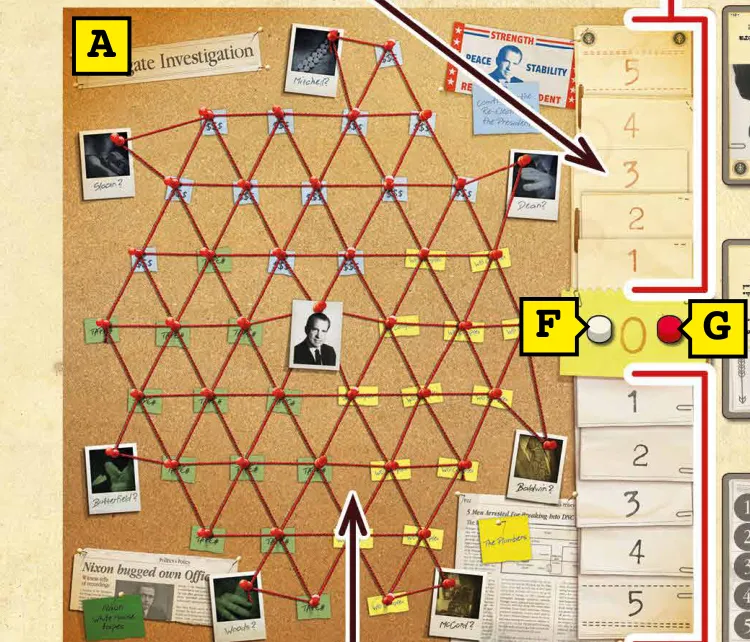
The research track has a central zero and five spaces toward each side. Initiative, the current momentum token and hidden or revealed evidence tokens struggle along it. A token that reaches your side’s space 5 is claimed immediately.
The evidence board shows seven informant spaces around Nixon. Red threads connect spaces. Face-up evidence tokens create connections; an empty space or a face-down token breaks a route. Each evidence token may be placed on a matching color space, or one of its two colors.
Each player has a momentum card with five numbered spaces. Nixon wants to fill all five; Editor can receive tokens too, but surplus tokens are removed.
A round
- Initial phase: both draw the number shown by initiative (4 or 5) from their personal deck. Nixon secretly draws three evidence tokens from the bag and places them face down on zero.
- Card phase: initiative starts. Players alternate until both hands are empty. Play exactly one card and choose its value or action.
- Evaluation phase: return tokens on zero to the bag; award initiative and momentum; reset initiative and place a new momentum token; then pin evidence from each side, beginning with the player who has initiative.
The first person to reach a claimed track token on space 5 takes it at once. They may use its printed reward immediately; evaluation then skips awarding that token again.
How the game ends
A win happens immediately. Nixon wins upon placing a fifth momentum token on the Administration card, or when evaluation needs a new token and the common supply is empty. The Editor wins as soon as two face-up informants have uninterrupted face-up evidence paths to Nixon.
Ways to score
Watergate has no point total. Winning is the only score condition:
| Goal | Trigger |
|---|---|
| Nixon’s momentum | Fifth token placed on Nixon’s card |
| Nixon’s supply race | No token remains for the evaluation reset |
| Editor’s evidence network | Two informants connect to Nixon through face-up evidence |
What each resource is for
| Component | Purpose |
|---|---|
| Role cards | Their value moves a legal track token; their action text changes the position, removes a card or disrupts a turn |
| Initiative token and card | Decide who begins next round and whether hands contain four or five cards |
| Momentum tokens | Nixon’s win condition; also the marker tugged on the research track |
| Evidence tokens | Hidden information during the track contest, then colored links or blockages on the board |
| Informant tiles | Face-up tiles are Editor recruits; face-down tiles are Nixon’s blockers |
| Evidence bag | Randomizes the three new tokens Nixon places each round |
Teaching tips
- Explain the two win conditions before card text. Both players can see how close each race is.
- Show that a card’s value and action are alternatives. A strong movement may be more useful than an event.
- Demonstrate hidden evidence: the Editor must name a color and ask Nixon before moving a face-down token.
- At evaluation, follow the printed order precisely; initiative changes who pins evidence first.
- Point out that a visible route needs an informant tile, matching face-up evidence on every thread space, and an unbroken path to Nixon.