Teach the Game
A six-year Chicago worker-placement game about livestock markets, building a meatpacking business, and labor politics.
How you win
“Build a stronger meatpacking business than your rivals while steering the markets and managing labor unrest. After six years, the player with the most savings wins.”
Each year, place workers to slaughter livestock, construct factories, advertise, open branches, or influence politics. Turn those choices into savings, then score your buildings, reputation, branches, and final market margins.
The boards
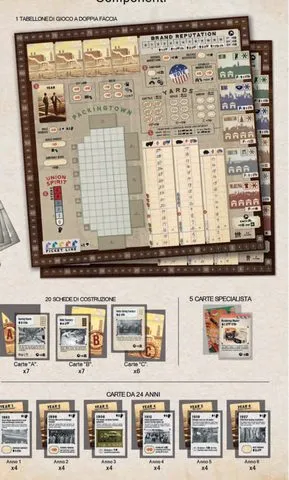
The main board combines the livestock Yards, the Packingtown grid, rail markets, and worker action spaces. Your player board tracks cash, savings, reputation, meat values, and morale. See Gameplay and Actions for each area.
A round
The game lasts six years. Each year has three phases:
- Markets and labor. Add livestock, reveal the Year card and resolve it, then adjust Union Spirit. A severe labor crisis starts a strike.
- Worker placement. In turn order, place one worker at a time and resolve its action. Continue until workers are placed or held back.
- Election and cleanup. A Campaign action can set next year’s party and first player. Retrieve workers and adjust livestock prices by supply.
See Gameplay and Actions for details.
How the game ends
After Year 6, finish the year and score. [Westward] With the expansion, the H.R. Department can end the game at the close of its year; otherwise play through Year 8. See Westward Expansion.
Ways to score
| Source | Result |
|---|---|
| Savings | Keep every point already on your Savings track. |
| Cash | Convert remaining cash into savings at the printed rate. |
| Final profit margins | Add or subtract the final cattle, hog, and sheep margins. |
| Brand Reputation | Rank players; the highest ranks earn the listed bonus. Stacked ties favor the marker higher in the stack. |
| Branch houses | Score from the rail connections serving each market. |
| Buildings and Specialists | Add their printed end-game values. |
| Low Morale | Lose savings according to the penalty shown on your board. |
What each resource is for
| Resource | Use |
|---|---|
| Workers | Take one action apiece each year. |
| Cash | Pay for actions, land, and building footprints; collect it from slaughter and some rewards. |
| Savings | Final score that cannot be spent during the game. |
| Livestock | Slaughter once per type each year to collect the current meat value less livestock price. |
| Buildings | Expand the connected Packingtown network and gain immediate and end-game benefits. |
| Brand Reputation | Improve meat values and compete for a final ranking bonus. |
| Low Morale | A lasting penalty from labor unrest; some actions remove it. |
Teaching tips
- Remind players that each livestock type can be slaughtered only once per player each year.
- Explain that livestock price and meat value are separate tracks; their difference is profit margin.
- Point out that buildings must connect back to a player’s slaughterhouse.
- Saving cash for a later action competes with converting it into end-game savings.
Rehearse a slaughter action
Use Yellow’s cattle example: meat value nineteen minus livestock price fifteen gives four dollars of profit. Put a worker on a cattle space containing an animal, return that animal to supply and take four dollars. You do not need fifteen dollars in hand first.
Leave the worker in place and ask whether Yellow can slaughter cattle again this year. No, even if cattle remain. A different animal type can still be used once this year. The action needs an animal in its space.