Teach the Game
A script to teach Dominant Species at the table — how you win, the board, a turn, the end, every way to score and what each piece is for.
How you win
“It is 90,000 BC and an ice age is coming. Each of us is a whole class of animals — mammals, reptiles, birds, amphibians, arachnids or insects. We adapt to the earth’s food, spread over its tiles and push each other out, while the glaciers creep in. Two to four hours. Whoever has the most victory points when the Ice Age card is taken wins.”
You need two things on as many tiles as possible:
- Many species (cubes) — the most cubes on a tile scores its points when it is scored.
- The best match of elements — that makes you dominant there, and the dominant animal takes a powerful Dominance card when the tile is scored.
The loop: place your action pawns, then resolve the actions top to bottom — adapt to elements, add and move species, glaciate and compete — and finally score tiles with Domination.
The board
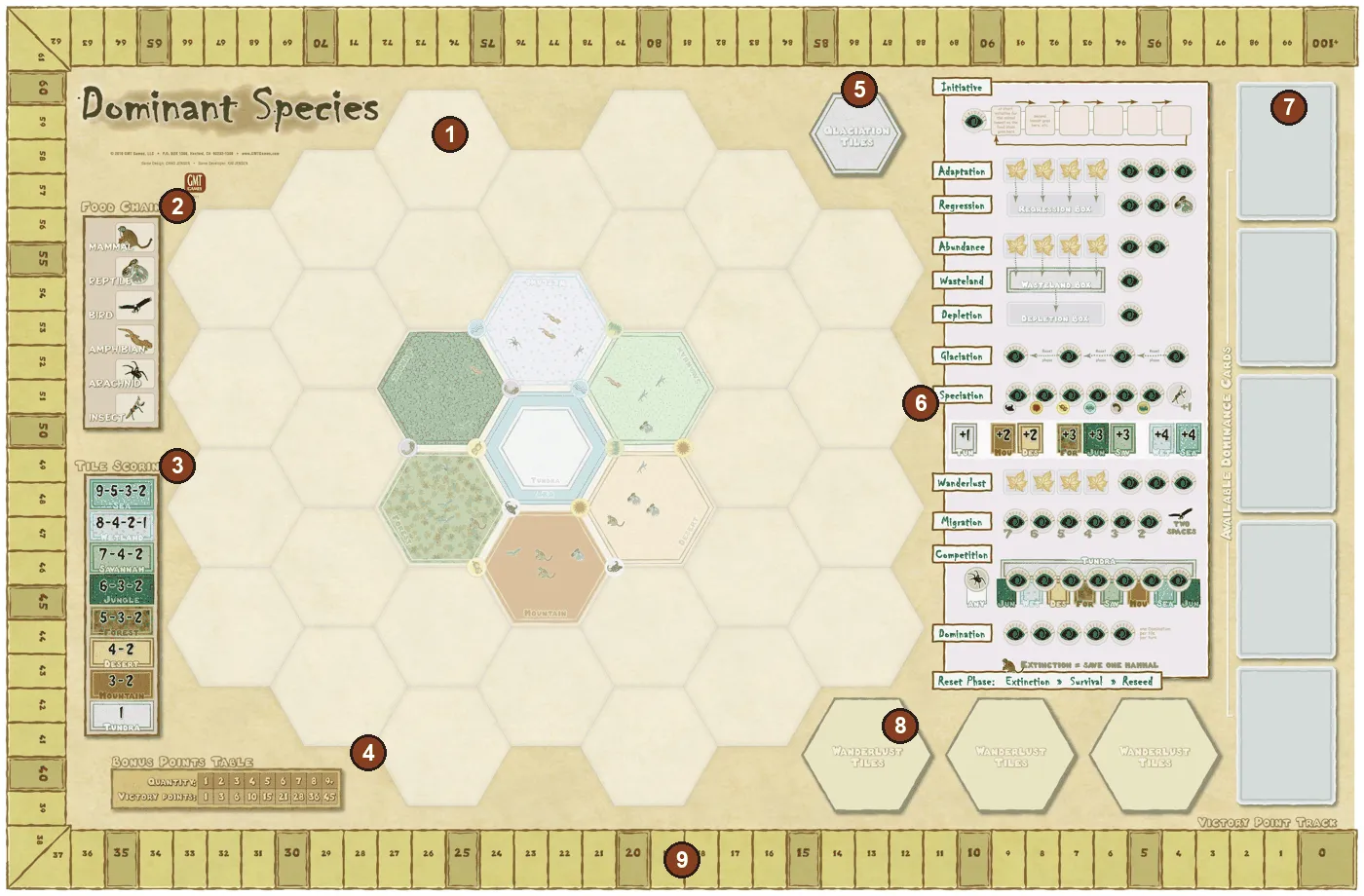
- Earth — the hex grid. Seven tiles at the start; new terrain arrives with Wanderlust, tundra with Glaciation (Earth and tiles).
- Food chain — mammal down to insect; it breaks every tie.
- Tile scoring — what 1st to 4th place earn on each terrain.
- Bonus points table — 1, 3, 6, 10, 15… for a count of 1, 2, 3, 4, 5…
- Glaciation tiles — the tundra stack.
- Action display — twelve actions; everything you do is chosen here (The action display).
- Available Dominance cards — five face-up rewards.
- Wanderlust tiles — three stacks of new land.
- Victory point track.
Each player also has an animal display: printed elements, up to six in total, and a summary of the actions.
A turn
- Planning — in Initiative order, place one action pawn at a time on any empty
 eyeball until everyone has placed all of theirs (Planning phase).
- Execution — pawns come off top to bottom, left to right; each triggers its action:
| # | Action | In short |
|---|---|---|
| 1 | Initiative | Move up in turn order, place the pawn again |
| 2 | Adaptation | Take an element onto your display |
| 3 | Regression | Everyone loses elements whose type sits in the box; pawns protect |
| 4 | Abundance | Put an element on earth |
| 5 | Wasteland | Elements on tundra matching the box are wiped |
| 6 | Depletion | Remove one matching element from earth |
| 7 | Glaciation | Turn a tile into  tundra (one per turn), score bonus |
| 8 | Speciation | New  species around an element |
| 9 | Wanderlust | Lay a new tile, score bonus, move in |
| 10 | Migration | Move 2 to 7 species one tile |
| 11 | Competition | Kill one opposing species on up to three tiles |
| 12 | Domination | Score a tile; the dominant animal takes a card |
- Reset — endangered species die (Extinction), the Survival card scores, the display refills (Reset phase).
How the game ends
The Ice Age card is the bottom card of the Dominance deck. When it is taken, each animal scores bonus VP for the tiles it dominates; the turn finishes, then every tile is scored once more by species count. Ties go to the animal higher on the food chain (End of the game).
Ways to score
| Source | How | When |
|---|---|---|
| Domination | Tile scoring table by species count (sea 9-5-3-2 … tundra 1) | Each Domination action |
| Glaciation | Bonus table for tundra tiles next to the new one | When you glaciate |
 Wanderlust | Bonus table for tiles next to the new tile | When you lay it |
| Survival card | Bonus table for tundra tiles you occupy | Every Reset Phase |
 Ice Age | Bonus table for tiles you dominate | When the card is taken |
| Dominance cards | Biodiversity, Ecodiversity, Fertile (gains); Niche Biomes (losses for leaders) | When taken |
| Final scoring | Every tile by species count | End of the game |
What each resource is for
| Piece | Why you need it | How you get it | How you use it |
|---|---|---|---|
 Action pawns | Every action | 7 to 3 by player count; some cards add or remove | Placed on eyeballs each turn |
| Species | Majorities, presence | Gene pool via Speciation, Aquatic, Fecundity, insects’ bonus | On tiles; most cubes score |
| Dominance cones | Mark who is dominant | Best matching on a tile | Take Dominance cards; Ice Age bonus |
 Elements on your display | Matching, dominance, survival | Adaptation, some cards | Count against disks around each tile |
 Elements on earth | Supply for everyone | Abundance, Wanderlust, cards | Speciation spots; keep your species alive |
| Tundra | Survival points | Glaciation | Occupy many tundra tiles |
| Initiative | First pick of eyeballs | Initiative action, Nocturnal | Place before others each round |
Teaching tips
-
Count cubes and element matches separately on one tile, then show a tied dominance total (rehearsal).
-
Spend most time on dominance versus majority: cubes score, matching takes the card.
-
Walk one Regression → Wasteland → Depletion cycle: elements slide down one box each turn.
-
Read the five face-up cards aloud each turn — they drive everyone’s Domination choices.
-
Point out that only Glaciation sends cubes back to the gene pool; everything else kills them.