Earth, Elements and Dominance
The Dominant Species board, the six animals and their abilities, earth tiles, elements, matching, dominance, endangered species, the gene pool, victory points and the bonus points table.
Everything in Dominant Species turns on two counts per tile: how many species (cubes) each animal has there, and how many elements each animal matches there. The first scores the tile; the second decides who is dominant.
The game board
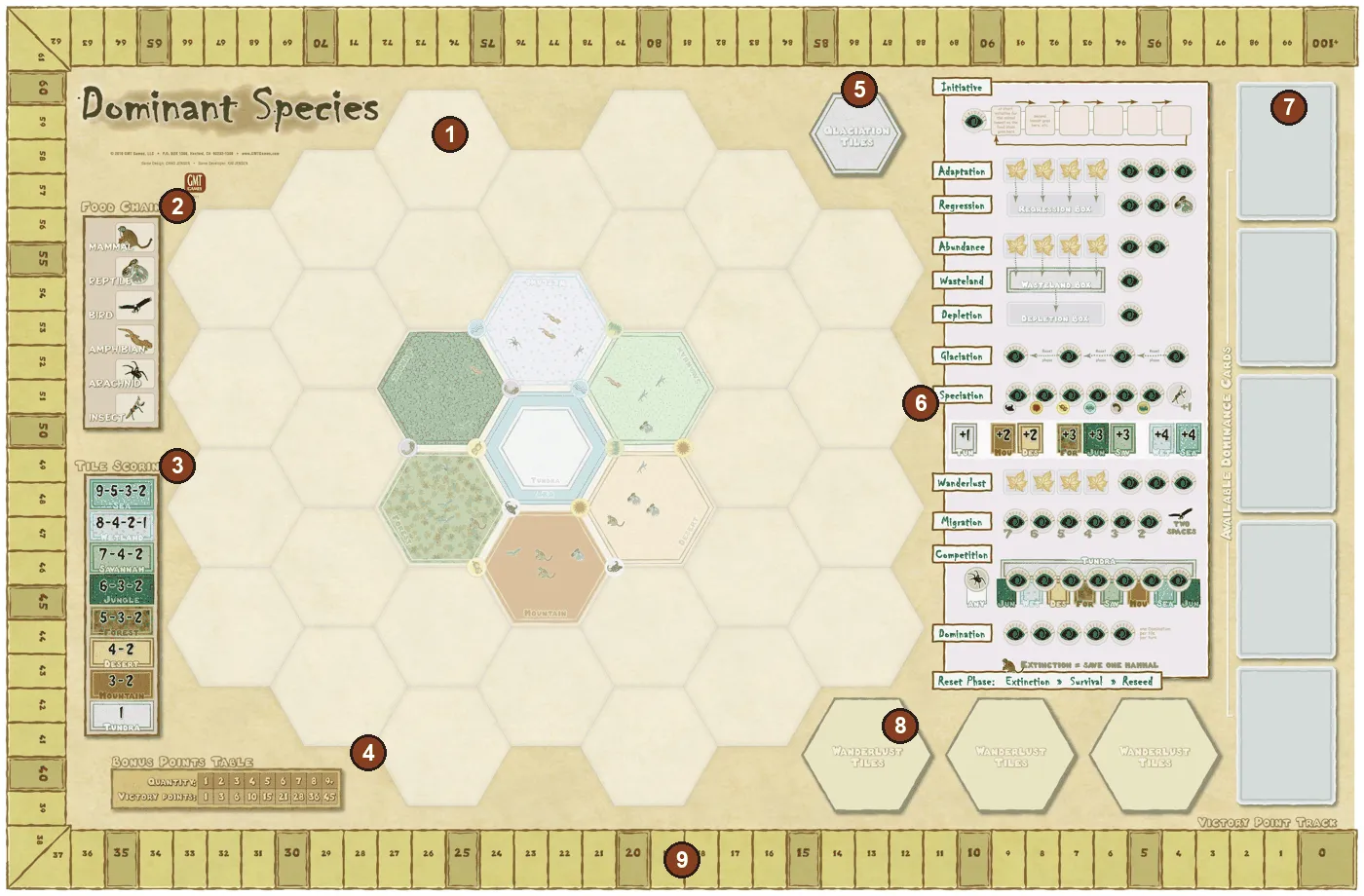
- Earth — the hex grid where tiles are laid; it starts as seven tiles and grows.
- Food chain — mammal at the top, insect at the bottom; breaks ties.
- Tile scoring table — points for 1st to 4th place on each terrain.
- Bonus points table — converts a count into bonus VP.
- Glaciation tiles — the stack of tundra tiles.
- Action display — the twelve actions, top to bottom.
- Available Dominance cards — five face-up cards.
- Wanderlust tiles — three stacks of new terrain.
- Victory point track — around the edge.
Animals and the food chain
Each player is one animal class. The food chain, best to worst, is  mammal,
 reptile,
 bird,
 amphibian,
 arachnid,
 insect. It breaks every tie in tile scoring and the final score, and sets the order
whenever animals act together (Wanderlust moves, Disease, Immigrants).
Special abilities
| Animal | Printed elements | Ability |
|---|---|---|
| Mammals |  | Each Extinction, save one endangered species of your choice. |
| Reptiles |  | A free pawn on the third Regression space every turn. |
| Birds |  | In Migration, each bird may move up to two tiles (not over empty hexes). |
| Amphibians |  | Start with three printed elements instead of two. |
| Arachnids |  | A free Competition first each turn: one tile, any terrain. |
| Insects |  | After all Speciation, place one species from the gene pool on any tile. |
The reptile, arachnid and insect bonuses need no pawn. Birds still need a Migration pawn.
Animal displays
Each animal display holds the printed elements (they can never be removed), empty spaces for added elements — six elements at most, printed ones included — and a summary of every action in order. See all six on the Cards & Components page.
Earth and tiles
Earth is every tile on the board. Seven large tiles start in the centre; Wanderlust adds new large tiles at the edges and Glaciation lays small tundra tiles on top of large ones.
| Terrain | Speciation limit | Tile scoring (1st–2nd–3rd–4th) |
|---|---|---|
 Sea | 4 | 9 – 5 – 3 – 2 |
 Wetland | 4 | 8 – 4 – 2 – 1 |
 Savannah | 3 | 7 – 4 – 2 |
 Jungle | 3 | 6 – 3 – 2 |
 Forest | 3 | 5 – 3 – 2 |
 Desert | 2 | 4 – 2 |
 Mountain | 2 | 3 – 2 |
 Tundra | 1 | 1 |
Adjacency
Tiles sharing an edge are adjacent. A tundra tile is smaller than the tile under it, but it counts as touching everything the covered tile touched.
Elements
Six element types: grass, grub, meat, seed,
sun and water. On an animal display an element is need; on earth it is
supply. On earth, disks sit on tile corners, so one disk can touch up to three tiles.
The draw bag
New elements always come from the cloth bag, and every removed element goes back into it.
Matching elements
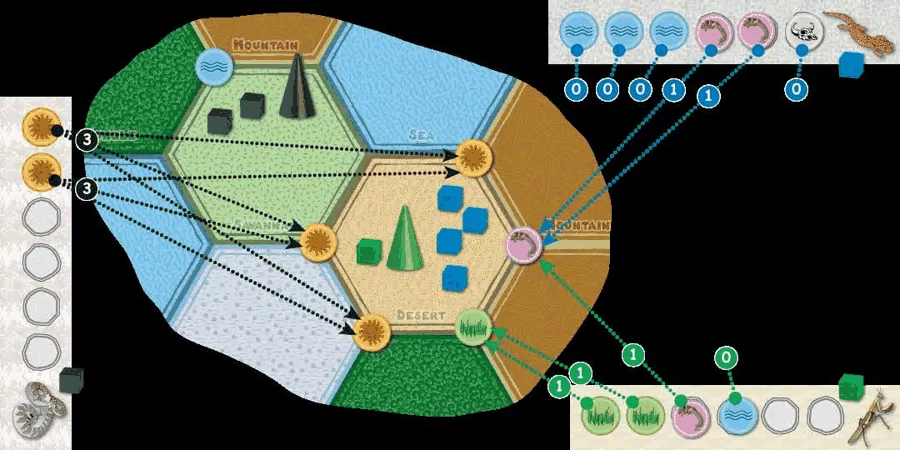
To find an animal’s matching elements on a tile, take each element on its display in turn and count how many disks of that type touch the tile; add up the counts. Two meat on your display and two meat around the tile is 2 + 2 = 4 — every copy on the display counts again.
Dominance
An animal is dominant on a tile when it has at least one species there and matches more elements than every other animal present. A tie for the most means nobody is dominant. Mark it with one of your cones.
- Dominance does not depend on the number of cubes — one cube can dominate.
- An animal alone on a tile is dominant unless it is endangered there.
- It changes at once whenever elements, displays or species change.
Claiming dominance
Players move the cones; the rules do not do it for you. A cone stays until someone claims the tile or shows a tie. Check after anything that adds or removes elements (Adaptation, Abundance, Wasteland, Depletion) or species.
Cones are not a hard limit: if you dominate more than 10 tiles, mark the rest with anything.
Endangered species
A species is endangered on a tile where its animal matches zero elements (including a tile with no elements at all). Endangered species can never be dominant, and they die in the Reset Phase’s Extinction unless the mammals save one.
Species and the gene pool
Your cubes not yet on earth are your gene pool. New species always come from it.
- Species removed from earth for any reason except Glaciation go back to the box, out of the game — never to the gene pool.
- Glaciation sends displaced species back to their gene pools.
- With no cubes in the pool and none on earth you are still in the game: you just cannot speciate or migrate.
Victory points
Move your cube along the track when you gain or lose VP. Past 100, put a spare cube on the +100 space. Scores never go below zero.
Bonus points table
Bonus VP come from this table: find the count in the top row, score the number below it.
| Count | 1 | 2 | 3 | 4 | 5 | 6 | 7 | 8 | 9+ |
|---|---|---|---|---|---|---|---|---|---|
| Bonus VP | 1 | 3 | 6 | 10 | 15 | 21 | 28 | 36 | 45 |
It is used for Glaciation and Wanderlust (adjacent tiles), the Survival card (tundra tiles occupied) and the Ice Age card (tiles dominated).