Cards & Components
Every Dominant Species component face: all 26 Dominance cards and the Survival card, the eight terrain tiles, six elements, each animal's pieces and display, and the action spaces of the action display.
Every distinct face, with what it does and where the rules explain it. Card, tile, element and piece pictures are GMT Games’ art from the VASSAL module; the action display is from the rulebook. “You” is the player who took the card; that player makes every choice on it (Taking a Dominance card). You may take one that does nothing for you to deny it to a rival; FAQ. The card set should contain one of each; FAQ.
Boards
Animal displays
The action-summary side of each display (as in the VASSAL module). Printed elements and six element spaces are on the physical display — check against the physical component. FAQ Intelligence and Parasitism affect animals according to food-chain order. FAQ
| Picture | Animal display |
|---|---|
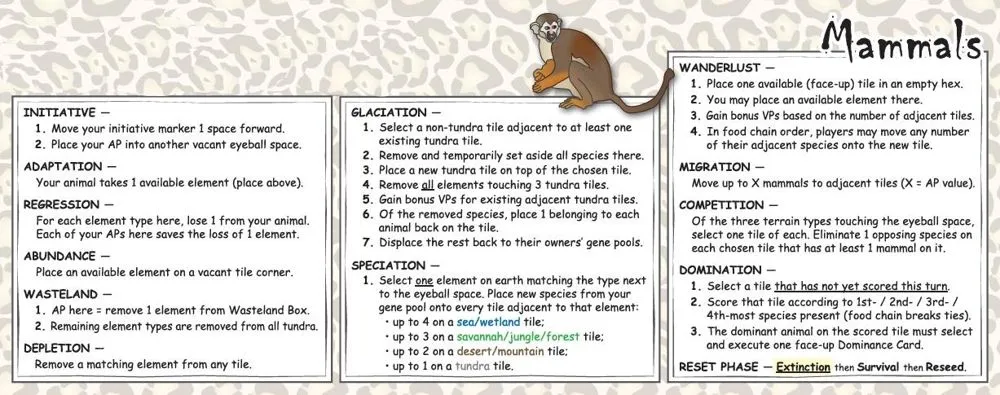 | Mammals. |
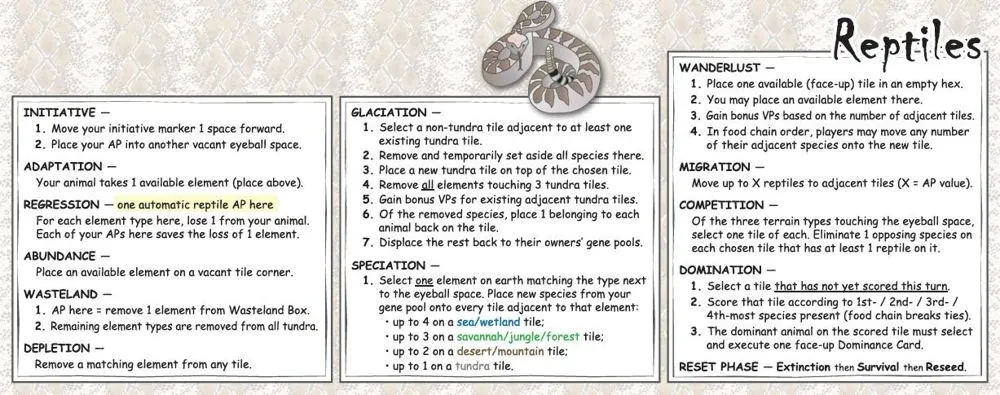 | Reptiles. |
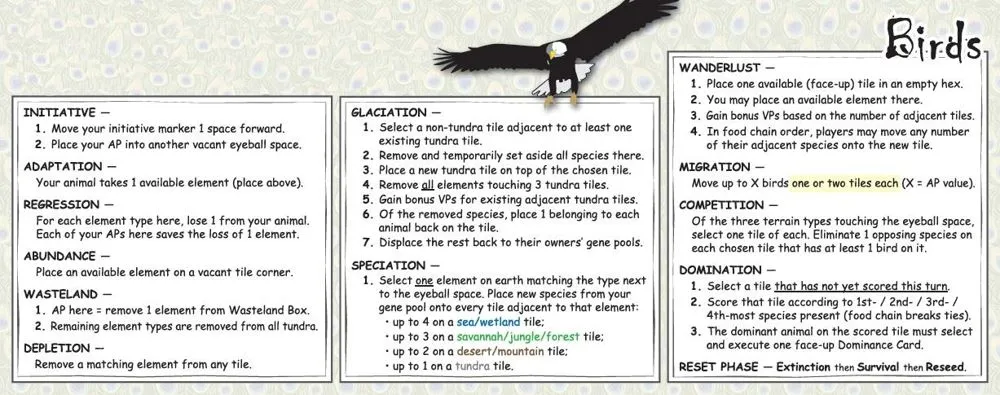 | Birds. |
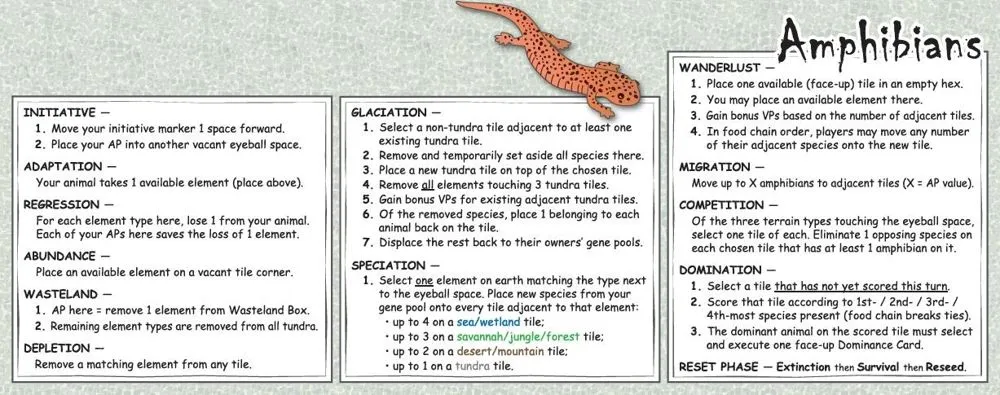 | Amphibians. |
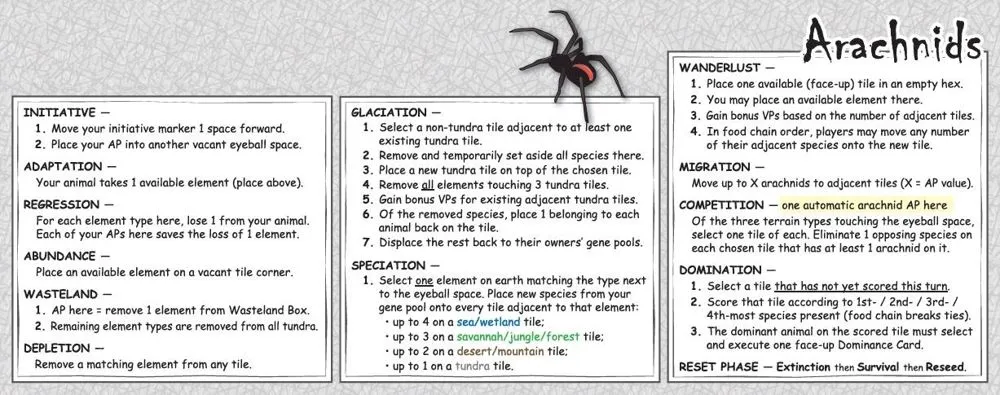 | Arachnids. |
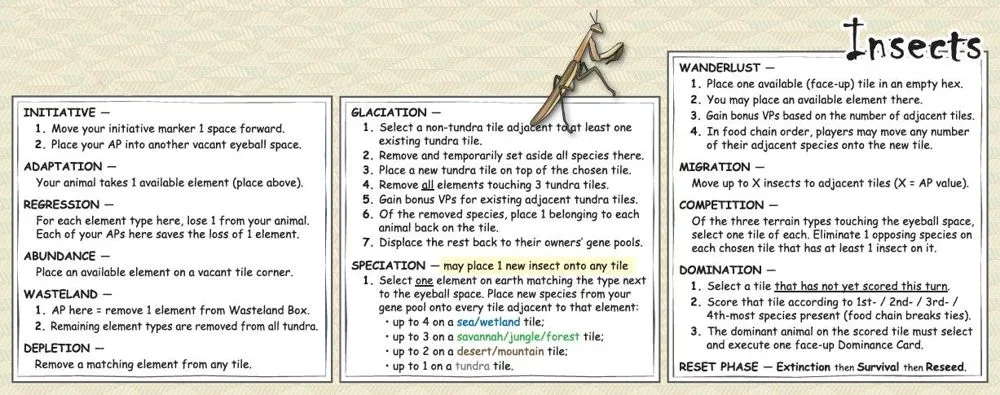 | Insects. |
Action spaces
Each pawn uses a different empty eyeball; choose any open spot in a section, and an action with no pawn is usually skipped. FAQ FAQ FAQ FAQ FAQ
The action display’s 41  eyeballs (The action display).
| Space | What it does |
|---|---|
 | Initiative (1) — move up one on Initiative, then place the pawn again (Initiative). FAQ FAQ |
| Adaptation (3) — take an element onto your display (Adaptation). FAQ |
 | Regression (2 + reptile space) — each pawn saves one element (Regression). FAQ FAQ FAQ |
| Abundance (2) — put an element on earth (Abundance). FAQ |
| Wasteland (1) — remove one disk from the Wasteland box (Wasteland). FAQ FAQ |
| Depletion (1) — remove a matching element from earth (Depletion). FAQ |
 | Glaciation (4, a queue) — one tundra tile per turn (Glaciation). With Instinct, a pawn placed on an earlier empty space may resolve before pawns already waiting farther down. FAQ FAQ FAQ FAQ FAQ |
 | Speciation (6, one per element + insect space) — new species around an element (Speciation). FAQ FAQ FAQ FAQ FAQ |
| Wanderlust (3) — lay a new tile (Wanderlust). FAQ FAQ |
 | Migration (6: 7, 6, 5, 4, 3, 2 species) — move species (Migration). FAQ FAQ |
 | Competition (7 + arachnid space) — kill opposing species on three terrains (Competition). FAQ FAQ FAQ FAQ |
| Domination (5) — score a tile, take a card (Domination). Dominance is which animal has the strongest match on a tile; Domination is the action that scores a tile. FAQ FAQ FAQ FAQ FAQ FAQ FAQ FAQ |
Cards
Dominance cards
26 cards, one of each. Five lie face up; Ice Age is always the last card of the deck. After scoring a tile, the animal with the most matching elements takes a face-up card, even if another animal scored the most VP. Resolve as much as possible now, then return the card to the box. The row stays unfilled until Reseed. “Eliminate” sends a species to the box; “from your gene pool” means a cube still available to place. An element on earth can touch up to three tiles, so check every tile it borders.
Rulings that apply to every row below: Blight, Catastrophe, Hibernation, Ice Sheet, Mass Exodus: may I pick a tile where the card does little?.
| Picture | Card and effect |
|---|---|
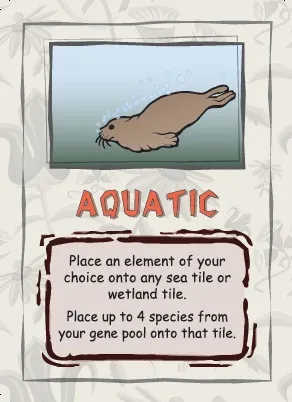 | Aquatic — Put an element of your choice (from the bag) on any sea or wetland tile, then up to 4 of your species from your gene pool on that tile. Either half is skipped if impossible. Check for a vacant corner touching the chosen tile. No vacant corner skips the element; an empty gene pool skips the cubes. FAQ |
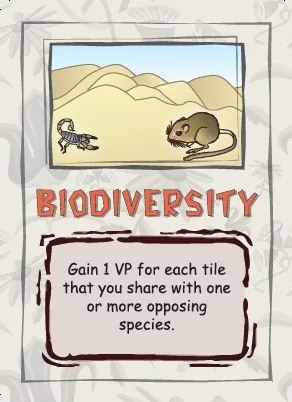 | Biodiversity — 1 VP for each tile you share with at least one opposing species (one per tile, however many opponents). Count shared tiles, not rival cubes or rival animals. Three opponents on one tile still give 1 VP. FAQ |
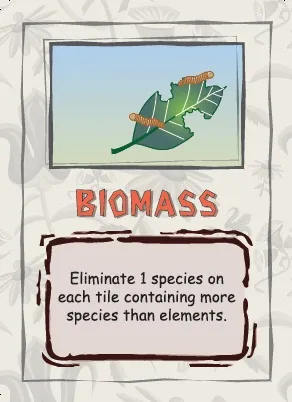 | Biomass — On every tile with more species than elements, eliminate one species; you choose whose (your own if you are alone there). Compare cubes with disks tile by tile. Remove exactly one cube on each overcrowded tile, including a tile occupied only by you. FAQ |
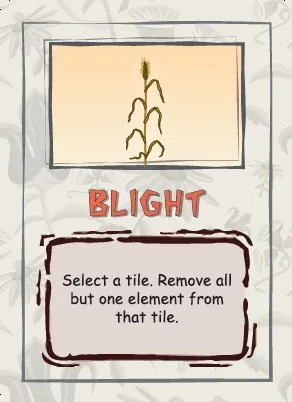 | Blight — Pick a tile and remove all but one of its elements; you choose which stays. Look at every element bordering that tile before choosing the survivor; shared-corner disks also supply neighboring tiles. |
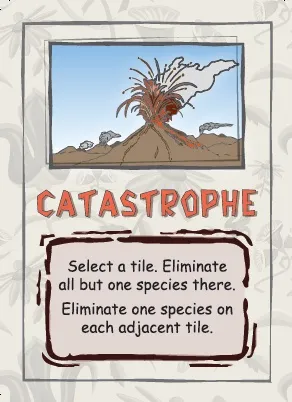 | Catastrophe — Pick a tile and eliminate all but one species there, then one species on every adjacent tile (your own if you are alone there). You choose which. Resolve the center first, then visit each neighboring tile. The neighboring loss is mandatory even where only your cubes remain. FAQ |
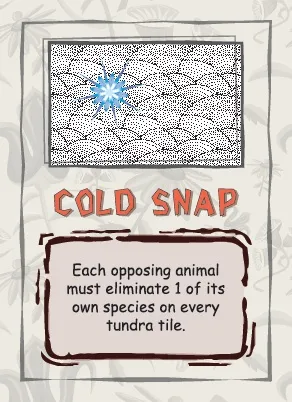 | Cold Snap — Every other animal loses one species on each tundra tile. Visit each tundra tile separately; each opposing animal there loses one cube, while your cubes are untouched. |
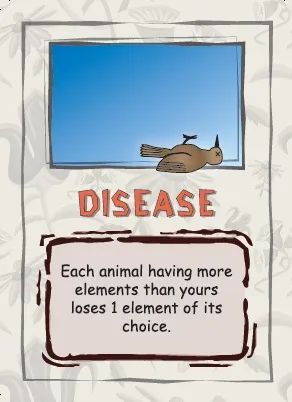 | Disease — Every animal with more elements than you loses one added element of its choice, in food-chain order. Count printed and added elements to see who is affected. Only an added disk can be removed; put it back in the bag. FAQ |
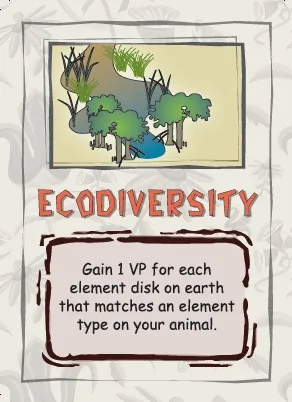 | Ecodiversity — 1 VP per element disk on earth matching a type on your display; each type counts once however many copies you have. Mark your distinct element types, then count all earth disks of those types. Two suns on your display do not double the sun score. FAQ |
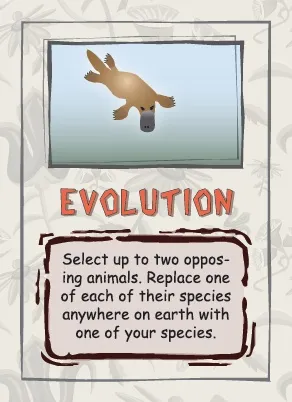 | Evolution — Choose up to two opposing animals and replace one species of each, anywhere on earth, with one of yours from your gene pool. The two victims must belong to different animals. You need one available cube for each replacement, but need not occupy either tile. Official FAQ |
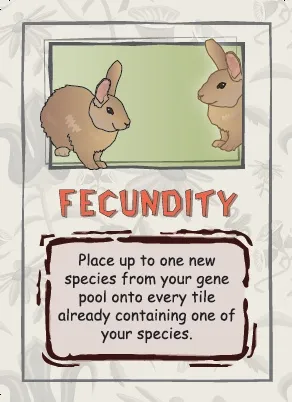 | Fecundity — Up to one new species from your gene pool on every tile where you already have a species. A tile with several of your cubes still gets at most one more. If your pool is short, choose which occupied tiles receive one. FAQ |
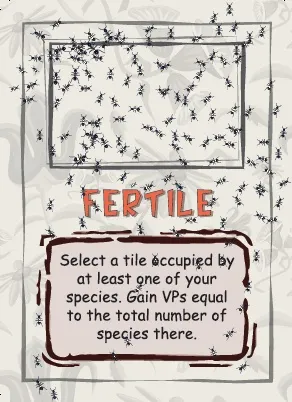 | Fertile — Pick a tile where you have a species: 1 VP per species there, every animal’s included. You need only one cube of your own to qualify; then count every cube on that one tile. FAQ |
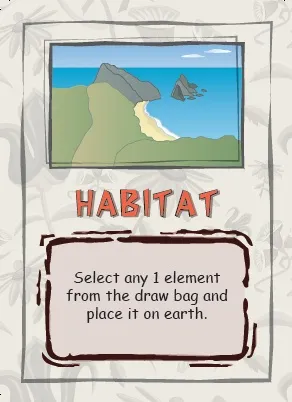 | Habitat — Choose any element from the bag and place it on earth. Choose the type deliberately; this is not a random draw. Put the disk on a vacant earth corner. FAQ |
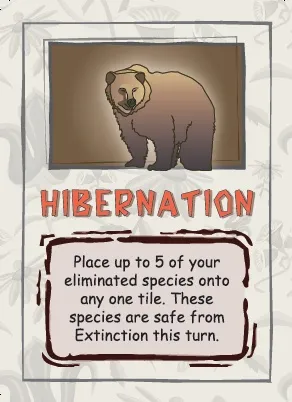 | Hibernation — Put up to 5 of your previously eliminated species onto one tile; they are safe from Extinction this turn. Not from your gene pool. Use cubes eliminated during play, not cubes left in your pool or removed at setup. Keep all returned cubes together on one tile. |
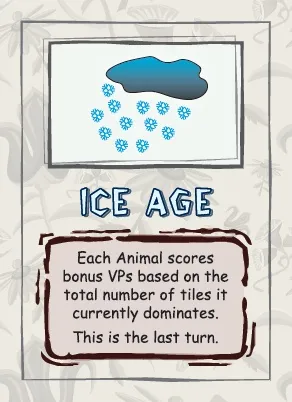 | Ice Age — Every animal scores bonus VP for the tiles it dominates now. This is the last turn (Ice Age). Count each animal’s dominance cones for the immediate bonus. Finish Domination, Extinction and Survival, then score all tiles once more without cards. Official FAQ FAQ |
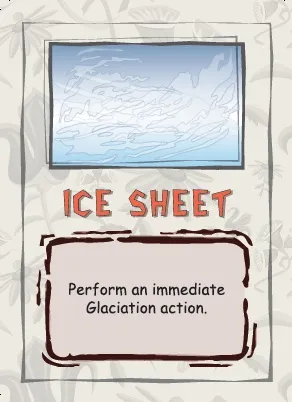 | Ice Sheet — Carry out a Glaciation at once, with all its normal rules. Follow the normal tile placement, species loss and scoring sequence; this card does not create a separate kind of glaciation. |
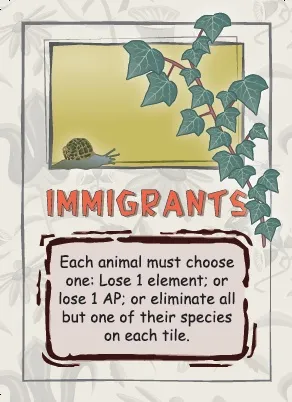 | Immigrants — In food-chain order, every animal loses an added element, or an action pawn, or all but one of its species on each tile. Each animal chooses its own option when its turn comes. An animal with only printed elements cannot choose the element option. FAQ |
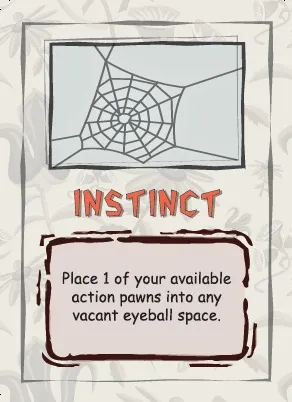 | Instinct — Put one of your available pawns on any empty eyeball, even one still to act this turn; usually a very early placement for next turn. Check whether that space has yet to resolve. If so, the pawn can act this turn; otherwise it waits for the next one. FAQ |
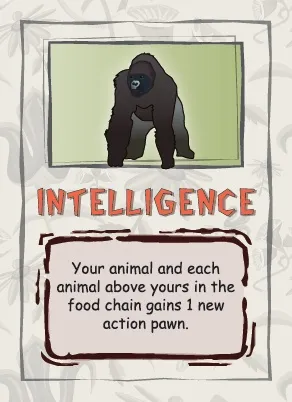 | Intelligence — You and every animal above you on the food chain gain one action pawn for the rest of the game. Take the new pawns from those set aside at setup. If mammals take the card, only mammals gain one. Action pawns FAQ |
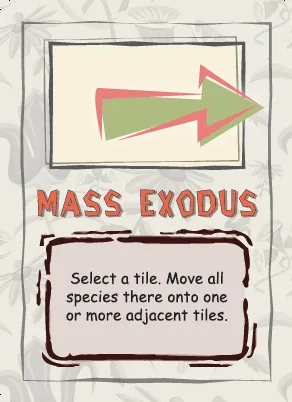 | Mass Exodus — Pick a tile and move every species on it, all animals’, onto one or more adjacent tiles as you choose. Move every cube off the chosen tile; you may split them among different adjacent tiles, including opponents’ cubes. FAQ |
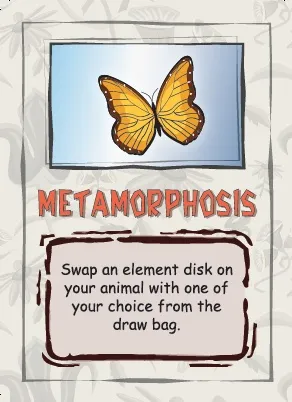 | Metamorphosis — Swap one added element on your display for an element of your choice from the bag. Printed needs stay put. Return one added disk and deliberately choose its replacement from the bag. FAQ |
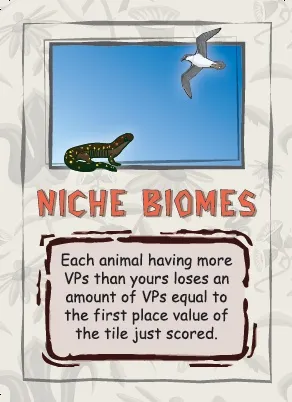 | Niche Biomes — Every animal with more VP than you loses the first-place value of the tile just scored (never below 0). Compare scores after the tile has been fully scored. Use the tile’s printed first-place number, even if its winner scored a different place. FAQ |
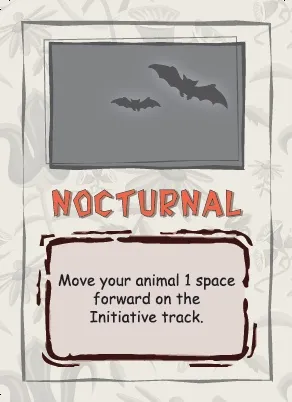 | Nocturnal — Move one space forward on the Initiative track (no effect if already first). Swap into the next position on the track; if you are already in front, it is still legal to take this card. FAQ |
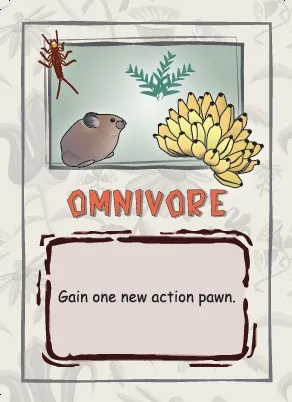 | Omnivore — Gain one action pawn for the rest of the game. Take a pawn set aside at setup and include it in future Planning Phases. FAQ |
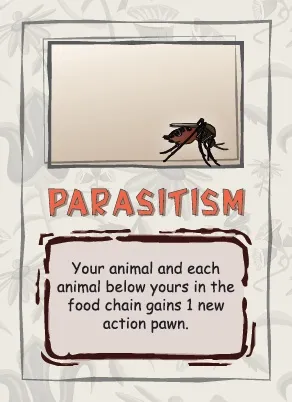 | Parasitism — You and every animal below you on the food chain gain one action pawn. Take new pawns from those set aside at setup. If insects take the card, only insects gain one. FAQ |
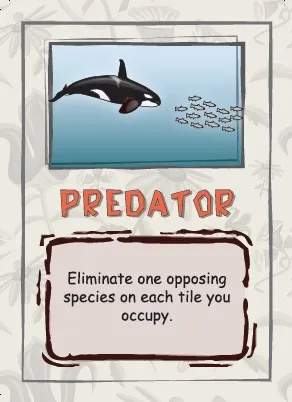 | Predator — Eliminate one opposing species on every tile you occupy (any opponent; skip tiles with only your species). Check all your occupied tiles. Pick one rival cube per shared tile; a different rival may be chosen on each. FAQ |
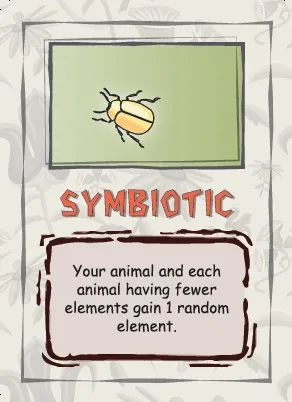 | Symbiotic — You and every animal with fewer elements than you gain one random element from the bag (printed elements count). Count both printed and added elements before comparing. Animals tied with you do not gain one. FAQ |
Survival card
| Card | Effect |
|---|---|
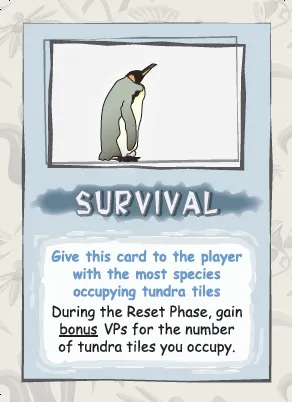 | Survival — Not a Dominance card. Held by the animal with the most species on tundra (nobody on a tie); each Reset Phase it scores bonus VP for the tundra tiles its holder occupies (Survival). FAQ FAQ |
Tiles
Terrain tiles
31 large tiles (the seven starting terrains plus 24 for Wanderlust) and 12 small tundra tiles. The random setup variant assigns starting VP from the pictured terrain arrangement. FAQ Glaciation removes all species from the covered tile, leaves one cube per animal, and returns other cubes to their gene pools. FAQ Dominance must be claimed when correct, and cones mark the current holder; a wrong cone should be corrected. FAQ Dominance can be claimed on tundra and by an animal alone on a tile; ties in matching elements go to food-chain order. FAQ FAQ FAQ The rulebook gives only the totals; the VASSAL module’s tile stacks, which add up to the same 31 and 12, hold 7 sea tiles and 4 of each other terrain: one of each starts on the board, and the 24 Wanderlust tiles are 6 sea and 3 of each other terrain.
| Tile | Use |
|---|---|
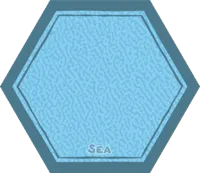 | Sea — speciation 4; scores 9-5-3-2 (Earth and tiles). |
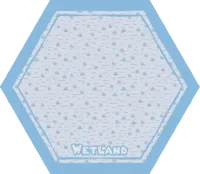 | Wetland — speciation 4; scores 8-4-2-1. |
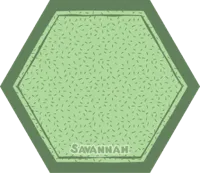 | Savannah — speciation 3; scores 7-4-2. |
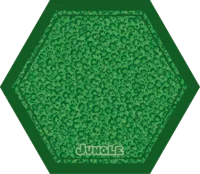 | Jungle — speciation 3; scores 6-3-2. |
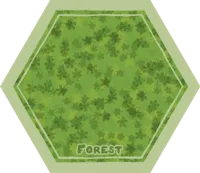 | Forest — speciation 3; scores 5-3-2. |
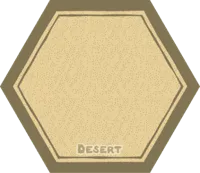 | Desert — speciation 2; scores 4-2. |
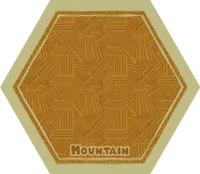 | Mountain — speciation 2; scores 3-2. |
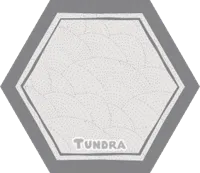 | Tundra (small) — laid on a large tile by Glaciation; speciation 1; scores 1. |
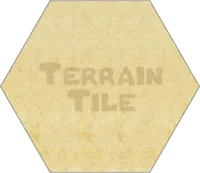 | Back of a large tile — the face-down Wanderlust stacks (Wanderlust). |
Tokens & pieces
Elements
120 disks in six types, kept in the bag (Elements). Starting board tiles cover their printed elements; those covered disks still count. FAQ
| Element | Printed on |
|---|---|
 | Grass — insects (2). |
 | Grub — arachnids (2). |
 | Meat — mammals (2). |
 | Seed — birds (2). |
 | Sun — reptiles (2). |
 | Water — amphibians (3). |
Animal pieces
Each colour has action pawns (cylinders), 10 dominance cones and up to 55 species cubes, plus a square initiative marker. The colours are those of the VASSAL module; check against your copy. Cube supply is limited: if your gene pool and earth are empty, you cannot add a species. FAQ Each animal has ten cones; FAQ.
| Pieces | Animal |
|---|---|
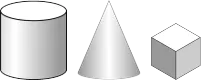 |  Mammals — top of the food chain; save one endangered species each Extinction. FAQ FAQ FAQ FAQ |
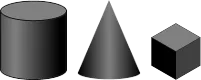 |  Reptiles — free Regression pawn; it can protect one added element during Regression. FAQ |
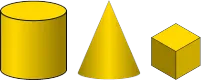 |  Birds — migrate up to two tiles. FAQ |
 |  Amphibians — three printed water. The printed disks remain in place and cannot be lost. FAQ |
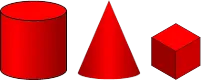 |  Arachnids — free Competition. FAQ |
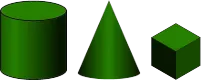 |  Insects — free species after Speciation; start first on Initiative. FAQ |
Details: Special abilities.
Icons
To be added.