Teach the Game
A six-turn airline investment and operations game for 2–6 players.
How you win
“Build wealth in aviation’s early years. Buy airline shares, help companies grow routes and income, and finish with the most cash and valuable stock.” You win by taking cash dividends and growing the market value of the shares you hold. Players can operate an airline if they own at least one of its shares, so shared ownership creates both cooperation and competition.
The boards
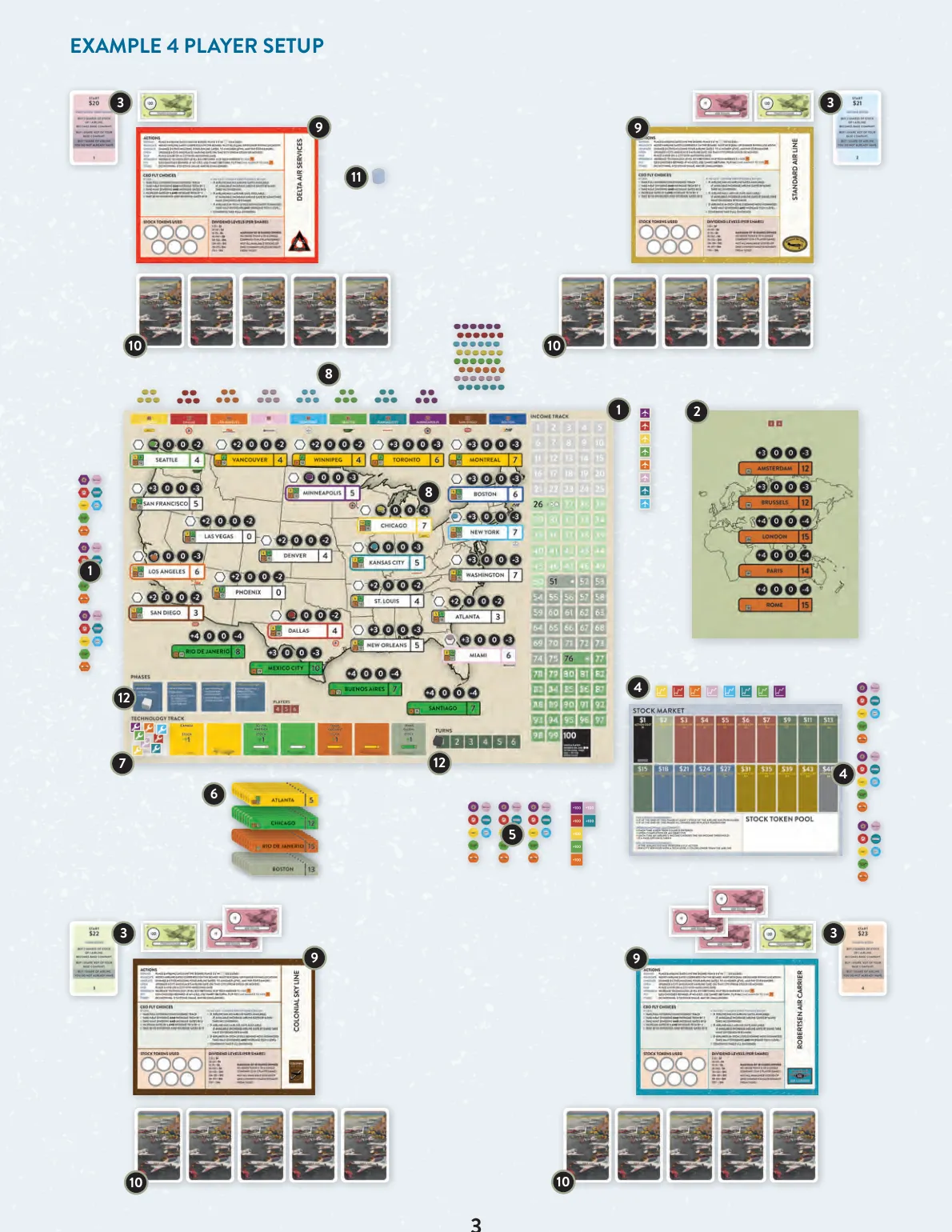
- Main board — cities, routes, income, technology, and turn tracks.
- Destination board — regions opened as airlines improve their technology.
- Turn order cards — first-round order and starting cash.
- Stock market — share prices and available stock.
- Stock pool — shares added as airlines grow.
- City upgrade tiles — raise city income.
- Technology track — expands where an airline may operate.
- Gate discs — show each airline’s presence in cities.
- Player boards — hold shares used for operations and track dividends.
- Contract cards — reward a player for matching an airline’s network.
- First Player marker — sets who starts operating.
- Turn and phase markers — track the current turn and phase.
A turn
Each turn has three phases:
- Stock: buy airline shares. The first stock round has special rules for founding the airlines.
- Operations: use a share from your player board to take an action for that airline. You may operate an airline in which you own a share, even if another player owns more.
- End of turn: check airline penalties, award contracts, advance the turn, return used shares, and pass the First Player marker.
See Stock and Turn Order and Airline Operations for the full procedure.
How the game ends
The game lasts six turns. After the sixth End of Turn phase, each airline makes one final flight and pays full dividends. Add your cash to the current market value of every share you own. The highest total wins; tied players share the victory. Details: Game End and Scoring.
Ways to score
| Source | How it pays |
|---|---|
| Airline dividends | On a Fly action and on the final flight, collect according to the airline’s dividend level and your shares. |
| Airline stock | At the end, add each share’s current Stock Market value to your cash. |
| Contract cards | When you award a contract to an airline serving every listed city, its share price rises and you receive that card’s cash bonus. |
What each resource is for
| Resource | Why you need it | How you get it | How you use it |
|---|---|---|---|
| Cash | Buy shares, pay for optional actions, and fund some upgrades. | Starting money, dividends, and contract bonuses. | Pay the bank; remaining cash counts at the end. |
| Stock tokens | Represent ownership and let you operate an airline. | Buy them from the available pool. | Use them for operating actions; their final market value counts at the end. |
| Gates | Establish an airline in a city and add income. | Taken from the airline’s supply. | Place, move, and expand routes as technology permits. |
| Technology | Opens regions and increases the airline’s reach. | Research actions. | Enables more distant cities and higher city upgrades. |
| Contracts | Give you a private route objective and a cash reward. | One from each value deck at setup. | Award one when an airline serves all its listed cities. |
Teaching tips
- Explain that a player owns shares while an airline performs the map actions; any shareholder may operate that airline.
- Teach the first stock round carefully: players start different airlines and then make two more purchases.
- Show how city occupancy affects income before describing the seven operating actions.
- Emphasize that an airline that does not fly, or has gates below its technology requirement, can lose stock value during cleanup.