Teach the Game
Teach the shuttle cycle, surface colony, and race to build a self-sustaining Mars settlement.
How you win
Score the most Opportunity Points (OP). Each player runs a company helping to build the first colony on Mars: you construct the buildings the colony needs, upgrade them into Advanced Buildings, develop Technology, and contribute to the colony’s Missions. Points come during the game (mostly from building what the colony needs) and in a big final scoring.
Ties go to the most Crystals, then the most Advanced Buildings, then the most Progress cubes; otherwise the tied players share the win. Solo play is different: you must meet every requirement of one solo goal.
The boards
The main board has two sides. On the left is the Orbit side, the space station: the Warehouse of Resources, the Tech Grid, the Blueprint display and the Landing Pod. The rest is the Colony on the surface of Mars: a hex map where everyone builds, plus the Life Support System (LSS) track, the Scientist and Contract display, the Missions and the Progress area. A row of Turn Order spaces 1–4 sits on the Orbit side and 5–8 on the Colony side, and the Shuttle runs between them.
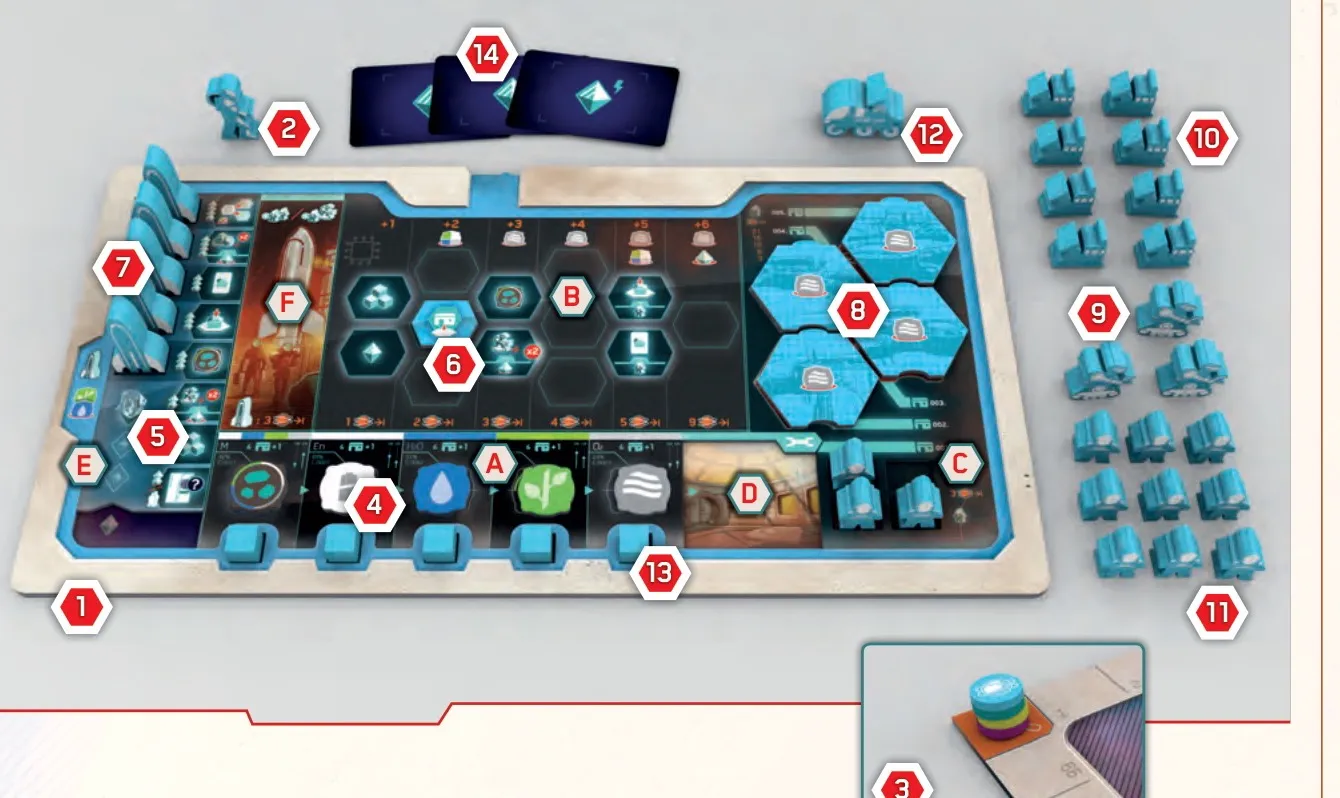
Player board and starting pieces (Rulebook p. 6).
Your player board is your main Shelter:
| Section | What it holds |
|---|---|
| A · Storage | Your five Resources. You can store as many of each as your Shelters on the map plus one. |
| B · Laboratory | Your Tech tiles, which move right as you develop them. |
| C · Living Quarters | Your available Colonists: 4 slots at the start (3 filled), +2 for each Shelter you build. |
| D · Working Area | Colonists you sent to boost actions; they come back when you travel. |
| E · Depot | Up to 8 Crystals, but your 5 Ships cover 5 slots at the start. Each slot also shows an Executive action that opens when its Ship leaves. |
| F · Hangar | Ships you have welcomed: points at the end, or a private trip in the Shuttle phase. |
A round
Each round has two phases.
- Colonization phase. In turn order (spaces 1 to 8), each player takes 1 Main action from the side of the board where their marker is, and may take 1 Executive action before or after it. Lay your marker down when you finish.
- Shuttle phase. The Shuttle moves one space toward the middle, or travels if it is already on the innermost red space. Then, in turn order, everyone decides whether to travel to the other side: free if the Shuttle just left your side, otherwise by discarding a Ship from your Hangar.
Where you are decides what you can do, so the real puzzle is timing: get your Orbit work done before you go down, and your surface work done before you go up. Details are in Gameplay and Actions.
How the game ends
The end is triggered at the end of a Colonization phase in which the Remaining Missions marker reaches the end of its track. It moves one space for each completed Mission (3 needed) and one space each time the Colony reaches level 3, 4 or 5 — so a fast-growing colony ends the game sooner, and reaching level 5 triggers it on its own. Finish the round, then play one more round without a Shuttle phase. See Game End and Scoring.
Ways to score
- During the game: 2 OP for the first Building of each LSS type; the LSS Reward when you build a type the colony still needs; the Progress area the first two times the colony levels up; OP printed on Blueprints you take.
- At the end: Progress cubes (1/2/4/7/11), 3 OP per Ship in your Hangar, Colonists in your Living Quarters, Tech tiles by column, Advanced Buildings (3 or 5 each, and −3 or −5 for each Blueprint you never built), Scientists (3 OP per matching Advanced Building on Mars, anyone’s) and Earth Contracts (gain or lose their OP).
What each resource is for
Each Resource builds the next building in the Mars construction cycle, shown by the arrows on your Storage:
| Resource | What it’s for |
|---|---|
| Minerals | Builds Generators; also pays 1 per upgrade and can replace any other Resource (not Crystals, not for Contracts). From: Mines when you travel to Orbit; constructing Mines. |
| Batteries | Builds Water Extractors; also pay for Tech tiles. From: Generators. |
| Water | Builds Greenhouses; also pays for Ships. From: Water Extractors. |
| Plants | Builds Oxygen Condensers; also pay for Ships. From: Greenhouses. |
| Oxygen | Builds Shelters; also pays to develop Tech. From: Oxygen Condensers; the Oxygen you get when someone uses your Tech. |
Crystals pay for Executive actions, extra movement and crowded action slots. A Crystal you gain waits below your Depot until the start of your next turn. Colonists work action slots, man Mines and boost actions. Bots decide where you can build (their hex and the adjacent ones). Your Rover collects Crystals, Research tiles and Discovery tiles. Ships add Colonists and Bots, open Executive actions and let you travel on your own.
Teaching tips
- Start with the two sides of the board and the Shuttle: everything else depends on where you are.
- Teach the LSS next: building what the colony needs gives the big rewards, and filling a whole row raises the Colony level, which brings new Blueprints, Tech and Resources and slows the Shuttle.
- Show the construction cycle on the player board and the rule that a Complex needs a Tech tile of the right level — anyone’s, which gives its owner an Oxygen or a free development.
- Leave Scientists, Contracts and Executive actions for last, then walk through final scoring once.
- For a first game use the First Colonists variant (Rulebook p. 24); the common mistakes are listed at the top of the FAQ.