Turns and Actions
Setup and the turn sequence for the three-year city game.
Setup
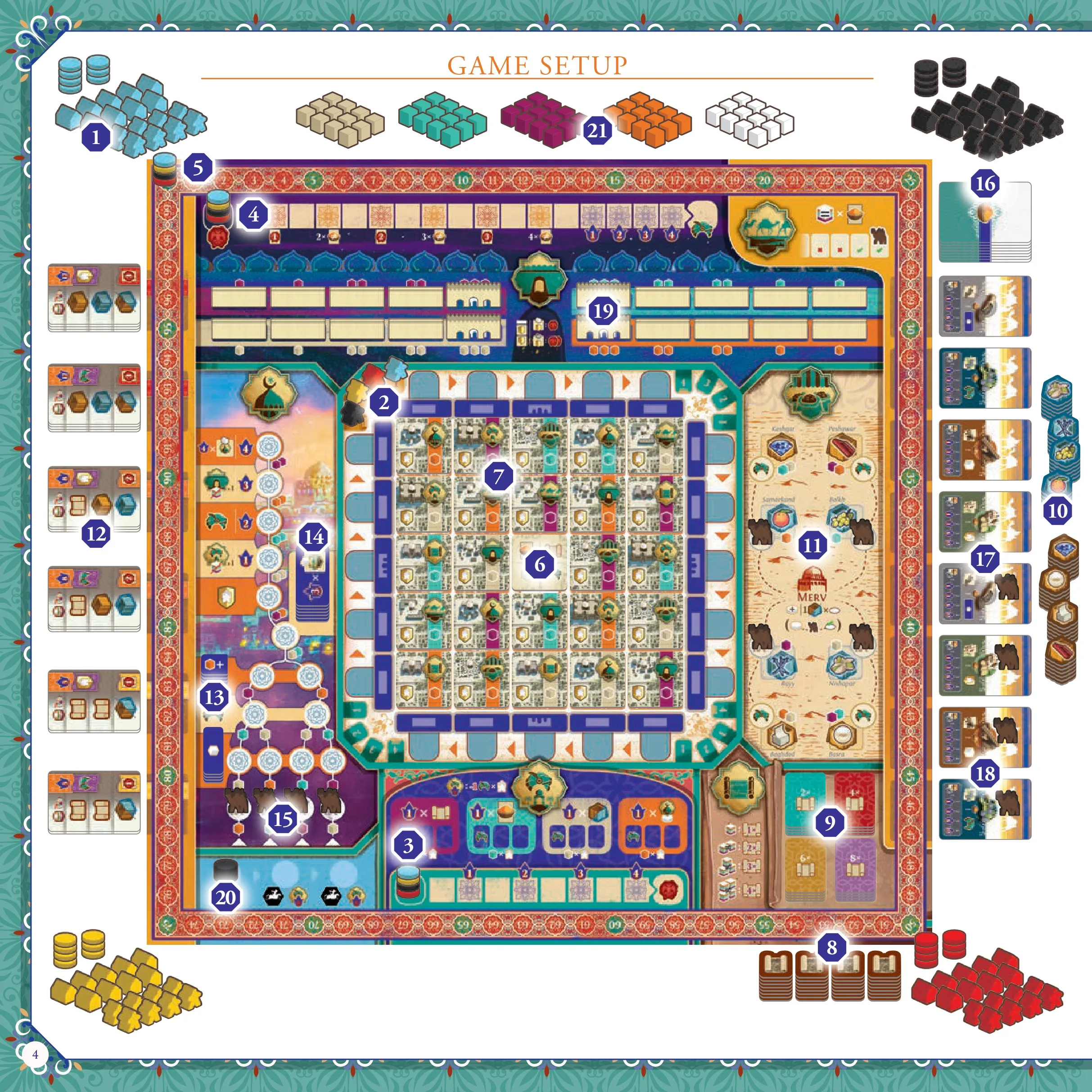
- Player pieces: choose colours and place the player pieces.
- Starting queue: line up master meeples in the north-west queue.
- Favour track: place each player’s favour disc.
- Influence track: place each player’s influence disc.
- Score track: place each player’s score disc.
- Camel market: choose a side and place it in the centre.
- Building sites: shuffle and place the 24 site tiles.
- Scrolls: set out the scroll supply.
- Breakthroughs: sort the tiles by requirement.
- Goods: separate common and rare goods.
- Inner-city camels: place a camel on each inner city.
- Contracts: make and order the six stacks.
- Upgrades: sort the upgrades by type.
- Scoring tiles: place them on their indicated spaces.
- Mosque camels: place a camel on the four bottom spaces.
- Caravan deck: shuffle and place the deck.
- Caravan row: deal eight cards face up.
- Caravan camels: mark the farthest cards according to player count.
- Walls and gates: fill their marked reserve spaces.
- Year marker: put it on year one.
- Resources: sort cubes by colour.
Players and queues
Each player takes one colour’s master meeple, nine buildings, ten discs and eight servants. Return unused sets to the box except pieces reserved for the High Courtier and solo Corrupt Magistrate. Randomize the master meeples in the north-west corner, then put a disc on the first space of each player’s favour, influence and score tracks. The extra pieces for two-player and solo games are detailed in their respective variant pages.
City and resources
Choose one face of the camel-market tile at random. Shuffle and place the 24 building-site tiles in the other city spaces. Set out the resource cubes in colour supplies. Each site normally produces its printed colour; white upgrades replace that yield, while a bonus upgrade adds its cube to the normal yield.
Library
Set the scrolls by the library and sort breakthrough tiles onto spaces showing their scroll thresholds. Every second scroll through the eighth earns a breakthrough; the scrolls are never spent for this.
Marketplace
Separate common and rare goods. Put a camel on each of the four inner cities: Rayy, Samarkand, Nishapur and Balkh. Outer cities are reached through these inner cities.
Contracts
Sort contracts by matching backs, then split each set by the favour or soldier reward to make six stacks. Within a stack, order cards face up from highest points to lowest and place them by the mosque.
Mosque
Sort upgrades by type and put them on their indicated spaces. Put the four scoring tiles on their matching space and place camels on the four bottom spaces of the mosque track.
Caravansary
Shuffle the 24 caravan cards and deal eight face up. Place a camel on the two cards furthest from the deck with one or two players, three with three players, or four with four players; return the rest to the box.
Year and round
Put the year marker on year one and place the wall pieces on their marked spaces. Choose a starting player.
Year and round
Play three years. Each year has four action rounds, followed by an invasion in years two and three, then annual scoring. Each player normally takes one turn in each round (12 turns total). The first round moves along the north edge, then east, south and west, returning to the north-west queue.
Take a turn
- Move your master meeple to an unoccupied action slot along the side you are on.
- Activate one building site in the same column during rounds one and three, or the same row in rounds two and four. The camel market is not a building site. If the chosen site is empty, place one of your buildings there; if you have none left, choose an occupied site.
- Gain resources from the activated site and from each of your own buildings in the active row or column. An activated site owned by another player also gives that owner its normal yield and their upgrades’ yields from the active row.
- Take one main action: the activated site’s printed action, gain favour, or deploy a soldier.
Caravansary
Spend any number of cubes of one colour, with white cubes allowed, to take that many caravan cards. You may take the front card or a card with a camel; after taking a camel-marked card, the next card in line becomes reachable. You may spend your camels to mark additional cards. Take camels from cards you take. Refill the row to eight if possible. Your influence determines how many spice types you may collect: one at the start, two at the first threshold, three at the next, and all four at the last. You cannot discard a spice type once collected.
Each completed pair immediately grants its spice boon: ginger deploys a soldier, juniper grants favour, cinnamon gives a white cube, and pepper places a white upgrade on an eligible site. Pairs two, four, six and eight each trigger again.
Palace
Place any number of courtiers in halls that have space. The first courtier you place costs one cube, the second two, the third three, and so on. Pay the hall’s exact colour (white may substitute). The first courtier in a hall grants favour. During annual scoring, each courtier costs one favour and scores according to its hall.
Library
Spend up to four cubes of different colours; multiple white cubes are allowed. Take one scroll per cube. At 2, 4, 6 and 8 total scrolls, choose one available breakthrough from that threshold. Committed scrolls still count. The first breakthrough is a lasting discount of one cube on a matching action once per turn; the second allows one resource-colour substitution per turn; the third and fourth offer one-time benefits.
Marketplace
Place one disc as a trading post. Your first must be in an inner city. Later, place in an inner city or in an outer city connected through an inner city where you already have a post. The first post in an inner city takes its camel; the first in an outer city gains favour.
After placing the post, buy at most one common good from each inner city and one rare good from each outer city where you have a post. Common goods cost one shown-colour cube; rare goods cost two shown colours. White substitutes. To reach a city without your post, spend a camel on its connecting route. Return those route camels to the front of the caravansary after shopping, skipping already marked cards.
Mosque
Advance any number of spaces by paying the exact colours on the path segments (white substitutes). Take each boon and printed points as you reach it. You may share spaces with another player. The first player on each starting path takes its camel. Rewards include upgrades, favour, a scoring tile, a soldier, a courtier, wall pieces, and the final mosque scoring bonus.
Wall
Pay the colour cost shown to build any available wall segments and gates. Gates go in a side’s middle slot; segments go in the other empty slots. For the two closest sites in that row or column, gain one influence per own building and two per opponent building, up to four influence from a single piece.
Favour and soldiers
As the main action, gain one favour or deploy one soldier. A soldier goes on a building that has no soldier or upgrade and is not already protected by a wall. Gain one influence for deploying it on your building, two on an opponent’s. You may decline to place the soldier. When advancing onto a numbered track space, score its printed points. If a track is full, favour converts to influence and influence converts to favour; if both are full, there is no gain.
Camel market
If the camel market is in your active row or column, before or after the main action either take all camels on it, or place one camel on an uncovered slot and take that slot’s boon. The seven possible boons shown across the two tile faces are a white cube, a scroll, a caravan card, favour, a rare good, a free mosque advance or a soldier. Take only the boon printed on the selected side and space.
Contracts
At any point on your turn, fulfil any number of face-up contracts if you meet the influence requirement. Spend the shown resource, take the card, and commit its listed scrolls and goods to it. Committed items are not discarded: they remain in your collection for palace scoring and committed scrolls still count for breakthroughs. Score the contract immediately and take its favour or soldier reward.
End of a round
Move master meeples to the next corner queue in the order of their action slots, starting with the meeple furthest counterclockwise. Put each as far back as possible. Before placing your meeple, you may spend camels to skip empty queue spaces; camels can also be placed on spaces already containing camels. If your meeple lands on camels, take them.