Teach the Game
Teach the Game for 13 Days: The Cuban Missile Crisis, 1962.
How you win
Lead the USA or USSR through three rounds of the Cuban Missile Crisis. Win prestige through secret agendas, card events and the aftermath, while keeping your brinkmanship from becoming nuclear war.
You need to finish with the prestige marker on your side. Build influence in arenas and manage your DEFCON markers to win the agendas revealed each round; either player can score either agenda.
The board
The nine arenas hold influence. Three DEFCON columns track military, political and world-opinion tension. Prestige is a shared tug of war; the round track ends at the aftermath.
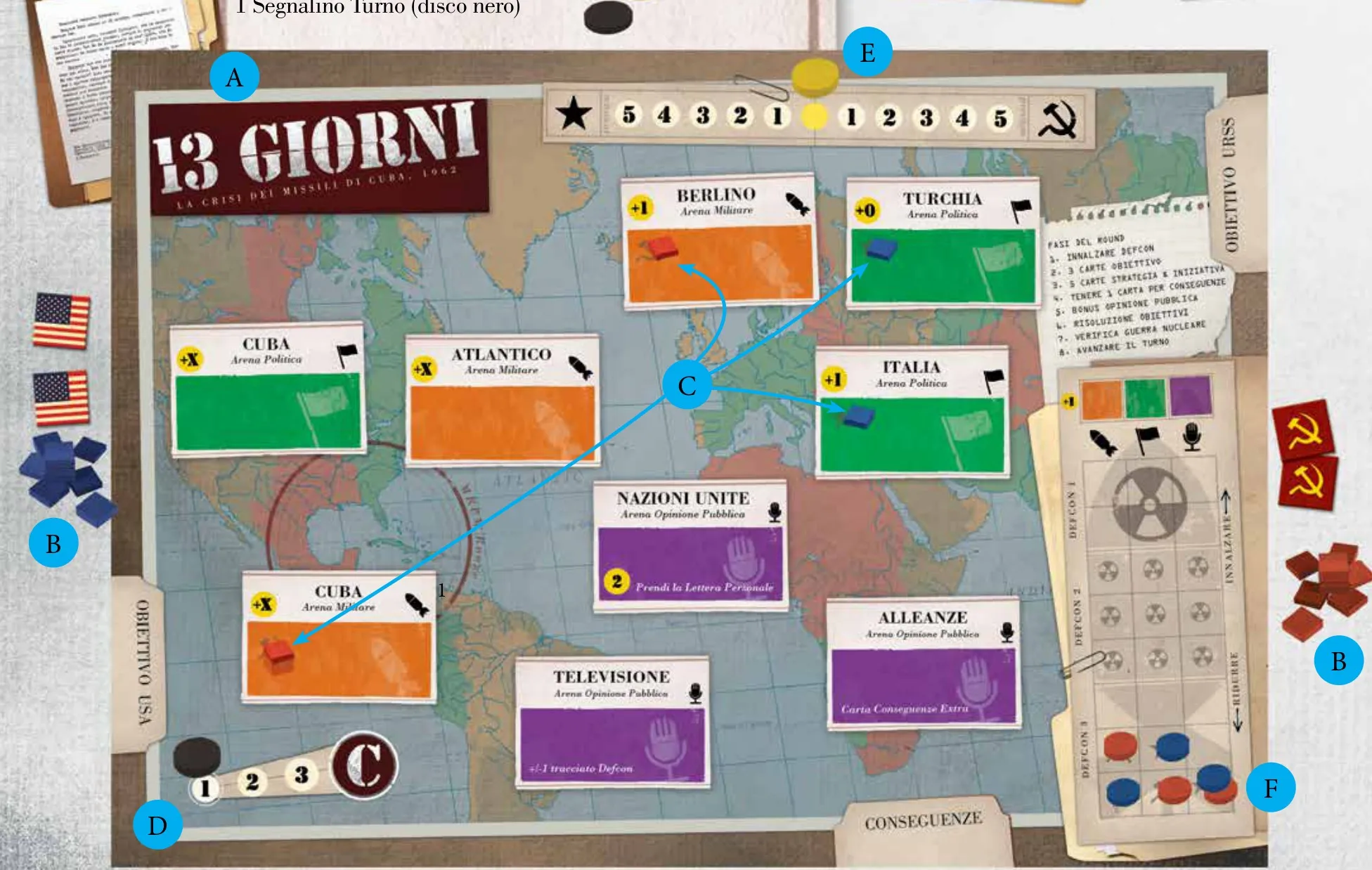
- A — Board — the arenas where influence competes.
- B — Player supply — cubes and agenda flags.
- C — Starting influence — the four initial cubes.
- D — Round track — three rounds before the aftermath.
- E — Prestige — the shared score.
- F — DEFCON — tension in three categories.
A round
- Raise every DEFCON marker one step, including in round one.
- Each player draws three agendas, flags all three possibilities and secretly keeps one.
- Deal five strategy cards each. The player behind in prestige chooses who starts; the USSR chooses on a tie.
- Alternate four card plays each: command influence or resolve an eligible event.
- Put the last card in the aftermath pile.
- Resolve world opinion: Television, United Nations, then Alliances.
- Reveal both agendas and score them simultaneously.
- Check for nuclear war, then advance the round.
See Gameplay for the sequence and Strategy Cards and DEFCON for card play.
How the game ends
At the round-end war check, you lose if any of your markers is in DEFCON 1 or all three are in DEFCON 2. If both sides trigger war, both lose. Otherwise, after round three, resolve the aftermath for 2 prestige. Higher prestige wins; the Personal Letter breaks a tie.
Ways to score
| Source | When and how |
|---|---|
| Arena agenda | End of round: the influence majority scores its lead, plus the arena bonus. |
| DEFCON agenda | End of round: the higher marker scores the difference in steps, plus 1. |
| Personal Letter agenda | End of round: its holder scores 2. |
| Strategy events | When resolved, if the event grants prestige. |
| Aftermath | End of game: the faction with the larger total command value scores 2. |
Prestige moves along one shared track, at most 5 points from the centre. Opposing agenda awards cancel before applying that limit.
What each resource is for
| Piece | Why you need it | Get and use |
|---|---|---|
| Influence cubes | Win arena majorities | 17 per side; command or events place them, removal returns them to reserve. Maximum 5 per side per arena. |
| Strategy cards | Act and shape the aftermath | Draw 5 each round; play 4 and set aside the last. |
| Agenda cards and flags | Set a hidden scoring opportunity | Draw 3, mark all possibilities, keep 1 secret. |
| DEFCON markers | Measure escalation and war risk | Three per side; commands, events and agendas move them. |
| Personal Letter | Strengthen a command and break the final tie | USA starts with it; using it gives +1 command and passes it to the opponent. United Nations can take it back. |
Teaching tips
- Show the difference between the two Cuba arenas before choosing agendas.
- Demonstrate a three-cube command: two DEFCON steps, not three.
- Explain opposing events before dealing the first hand.
- Point out that war is checked after agenda escalation, not after each card.